

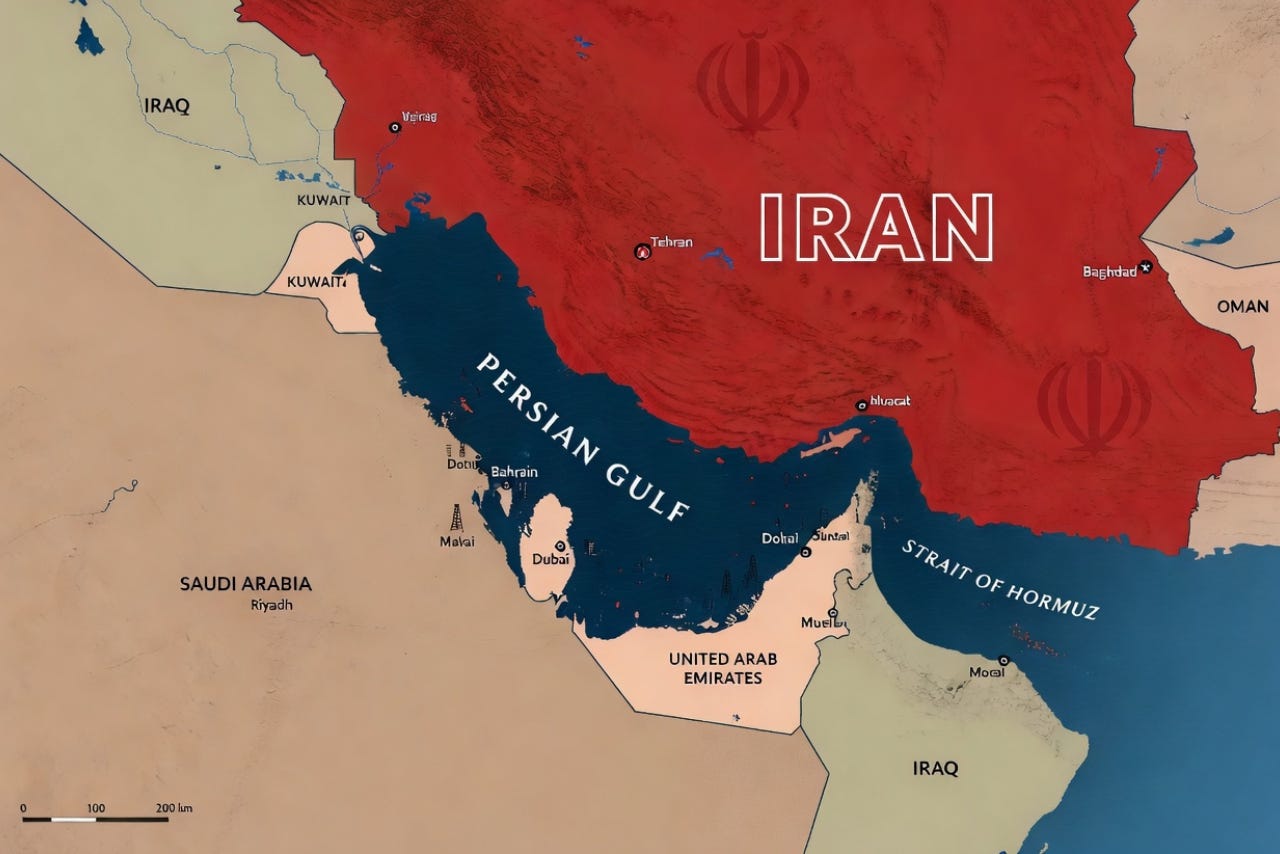
The military confrontation with the regime in Iran has reached a critical point. The strategic question is no longer whether the Iranian mullahs can be weakened; that phase has already passed. The real question now is who will finish the job. If the ruling clerical regime is ultimately defeated, the decisive efforts must come from the Islamic nations of the Gulf: Saudi Arabia, the United Arab Emirates, Qatar, Kuwait, Bahrain, Oman, and, to a lesser extent, Iraq, rather than from the United States and Israel.
Operation Epic Fury significantly altered the military balance in the region. While Iran still possesses missiles, drones, underground facilities, and remnants of its proxy network, the perception of invincibility surrounding the Islamic Revolutionary Guard Corps has been shattered. Although the regime’s remaining military capabilities remain a threat, they have been severely weakened. Large portions of Iran’s upper-echelon command-and-control infrastructure have been eliminated, and its air defenses have proven to be entirely ineffective. Missile launch facilities have been destroyed, forcing them to go mobile. Proxy organizations–Hezbollah, Hamas, the Houthis, once viewed as unstoppable “resistance movements,” are now reduced to battered militant remnants struggling to survive under increasing pressure.
Even before military operations commenced, the combined military capacities of the Gulf States equaled or surpassed Iran’s conventional capabilities. Collectively, the Gulf coalition operates hundreds of advanced Western combat aircraft, including F-15s, F-16s, Eurofighter Typhoons, Rafales, and Mirage fighters. Their missile defense systems feature Patriot PAC-3 and THAAD batteries, which are integrated with American intelligence and targeting systems. The Gulf navies significantly dominate much of the southern Gulf, boasting advanced frigates, corvettes, missile boats, and surveillance assets.
Saudi Arabia alone has more state-of-the-art frontline combat aircraft than Iran has in operational service. The UAE’s military is conceivably the most technologically advanced Arab force in the Middle East. Qatar maintains one of the highest ratios of combat aircraft per capita, not only in the Middle East but in the world. And Bahrain hosts the U.S. Fifth Fleet, while Kuwait remains intimately integrated with American military infrastructure. Additionally, Oman controls critical maritime routes near the Strait of Hormuz.
In contrast, Iran’s air force is largely composed of outdated aircraft from the sanctions era, many of which date back to the Shah’s reign. The regime compensates for its antiquity by relying on missiles, drones, and asymmetric warfare, since it can’t compete conventionally with a modern Gulf coalition or the might of the combined US/Israeli capabilities.
Following Operation Epic Fury, this vulnerability has become excruciatingly clear. A coordinated military effort led by Gulf nations, solidly backed by American logistics, intelligence, naval power, and Israeli precision strike capabilities, would overwhelm the already weakened Iranian military under the mullahs, bringing it to an end.
That reality matters politically and culturally as much as militarily.

The regime in Tehran has managed to survive not only through the illusion of an advanced military capability but also through the power of the narrative. For decades, the mullahs have presented themselves as the true defenders of Muslims against Western “infidels,” propagandizing the language of Islamic resistance. They have built their perceived legitimacy on the insistence that only their revolutionary ideology protects the Islamic world from humiliation at the hands of outsiders. While this is propaganda, it has proven effective over 47 years.
This is precisely why the Gulf States cannot remain passive observers, letting Israel and the United States handle everything. If the Iranian regime collapses solely due to the actions of what are often referred to in devout Islamic circles as “the Great Satan” and “the Little Satan,” then surviving hardliners across the Islamic world will view and couch this destruction as martyrdom at the hands of non-believers. The weakened remnants of Hezbollah, Hamas, and the Houthis—as well as other Islamofascist entities—would use this false-narrative to fuel a new generation of jihadist terrorism. The struggle would not end; it would be rejuvenated.
Ironically, the Gulf States have already crossed the theological line that the Iranian regime hoped to exploit. Traditional Islamic doctrine, including widely accepted interpretations of the Quran, teaches that Muslims should come to the aid of fellow Muslims under attack by non-believers. However, throughout the current confrontation with Iran, the Gulf monarchies have quietly, and sometimes openly, assisted the anti-Iran coalition in various ways: through intelligence sharing, logistics coordination, granting access to military bases, allowing the institution of temporary airbases, airspace cooperation, financial enforcement, and strategic alignment. The old pan-Islamic façade has begun to crack because the Gulf leadership understands the single fundamental truth that the mullahs refuse to acknowledge: the greatest threat to the future of the Middle East is no longer Western colonialism, but revolutionary Islamist fanaticism disguised as religious purity.
In fact, the leadership in the United Arab Emirates has taken a stronger stance by openly discussing the need for a Gulf coalition to become the “tip of the spear” in dismantling the despotic regime’s control over the Strait of Hormuz and regional commerce. This isn’t just military rhetoric; it reflects an understanding that the future prosperity of the Middle East relies on eliminating the enduring instability caused by Tehran’s Islamofascist theocracy.
The distinction here is crucial: opposing the mullahs does not equate to opposing the Persian people. In fact, the Iranian people are among the main victims of the mullahs’ regime. Persia has made extraordinary contributions to science, literature, architecture, mathematics, poetry, and culture long before the modern theocracy came to power by force and deceit in 1979. Millions of Iranians despise the suffocating authoritarianism imposed by unelected clerics who crush dissent, brutalize women, silence and murder journalists, imprison and torture reformers, slaughter protesters by the tens of thousands, and squander national wealth on foreign militias and despotic ideological crusades. The Gulf States would not be waging war against Persians; instead, they would be liberating Persians from a regime that has held their civilization hostage for nearly half a century.
Indeed, any direct confrontation between Muslims would inevitably reopen the longstanding Sunni-Shiite divide that erupted after the death of Muhammad. This tension has influenced Middle Eastern politics for centuries. However, history doesn’t have to dictate the future. If the Gulf States take the initiative to end the rule of the Iranian mullahs, the message it sends throughout the region would resonate strongly. The narrative would shift from one of Western powers suppressing Islam to one of Muslim nations actively rejecting theocratic extremism in favor of stability, commerce, coexistence, and prosperity.
That message could reshape the Middle East for generations.
A Gulf-led initiative to end the mullahs’ regime would demonstrate that the Islamic world can address its own extremism without relying on external forces. This effort would convey that prosperity is more important than endless bloody and merciless revolutions. It would codify the emerging reality that Arab states and Israel have a shared interest in regional peace, safety, secure trade routes, economic modernization, and freedom of navigation through the Strait of Hormuz. Ultimately, it would show that the future belongs not to jihadist militias and manipulative clerical tyrants, but to nations that prioritize stability, peace, safety, technological advancement, and integration into the global economy.
The United States and Israel may have done the heavy lifting, and yes, that’s a very big deal. But the final act, if it comes, must be at the hands of the Islamic Gulf States themselves.


