

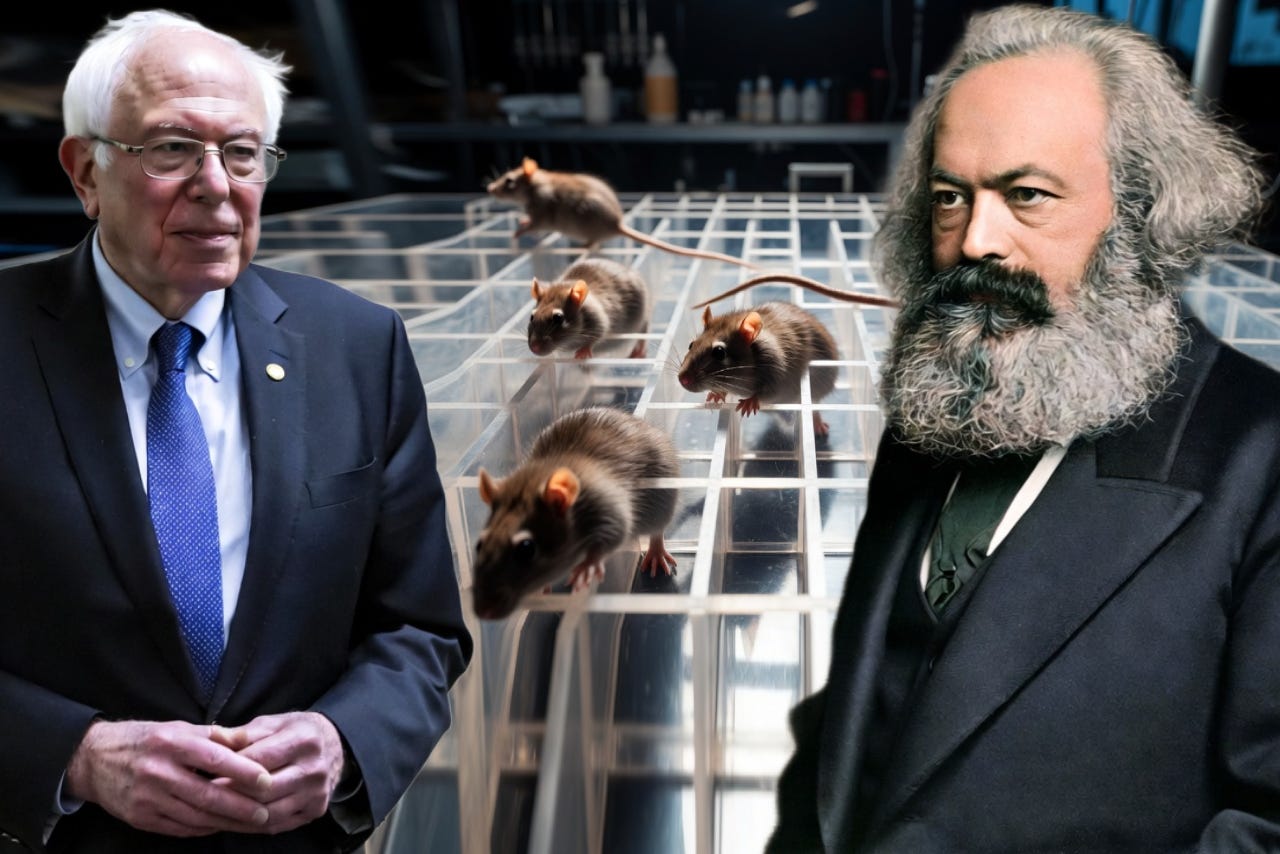
The intellectual bankruptcy of Marxism and its far-Left offspring has been evident from the very beginning. These ideologues, starting with Karl Marx himself, have always peddled grand theories untethered from the messy realities of human nature, incentives, and historical precedent.
They disdain empirical evidence and proven policies that build prosperity through individual effort and limited government. Instead, they treat society as a laboratory, with the masses serving as unwitting lab rats for their utopian experiments. The results, predictably, are failure, dependency, and decay.
Consider the founder himself. Karl Marx never held a successful job in his life. He drifted through existence as a perpetual student and pamphleteer, chronically broke and reliant on handouts. His family endured grinding poverty in London exile, with creditors hounding them and basic necessities often out of reach. Marx survived by borrowing relentlessly—from friends, relatives, and anyone foolish enough to extend credit. His primary benefactor was Friedrich Engels, who funneled money from his own bourgeois enterprises to keep the “revolutionary” afloat while Marx scribbled Das Kapital and The Communist Manifesto.
This was no principled ascetic; it was a man who theorized about the exploitation of the proletariat while personally embodying the freeloading he condemned in others. Marx’s life was a microcosm of Leftist theory: lofty critiques of capitalism from someone who couldn’t manage his own finances or contribute productively to the system he hated.
Engels, for his part, was the ultimate nepo baby. Born into a prosperous Prussian mercantile family that owned cotton mills and factories, he enjoyed the comforts of inherited wealth. His father sent him to manage the family business in England, where he drew a handsome salary and profits from capitalist enterprise—the very system he and Marx denounced as oppressive. Engels used this unearned privilege to subsidize Marx’s idleness and fund their joint ideological crusade.
Far from a rugged worker rising through toil, Engels was a trust-fund radical who rejected his family’s values while living off their success. This pattern of hypocrisy persists among far-Left elites today.
The same contempt for productive work and embrace of theory over results echoes in modern standard-bearers of the far-Left.
Bernie Sanders, the self-proclaimed democratic socialist who has shaped much of today’s progressive agenda, never held a meaningful job outside of politics and activism. After college, he bounced through short stints as a Head Start teacher, psychiatric aide, carpenter, filmmaker, and freelance writer peddling radical materials—none of which built a stable career or demonstrated real-world productivity. Instead, he plunged into endless political campaigns with the obscure Liberty Union Party, losing repeatedly before finally securing elected office as mayor of Burlington in 1981.
He has since spent decades in government: mayor for eight years, then 16 years in the House, and now over 18 years in the Senate. While railing against millionaires and “the rich,” Sanders has leveraged his long tenure in elected office—along with book deals and pensions—to acquire several high-end houses in various locations, including a primary residence in Burlington, a Washington, D.C. property (later sold), and a lakefront summer home on Lake Champlain purchased for $575,000 in cash. This is the lifestyle of a career politician who preaches redistribution while enjoying the fruits of a system he wants to overhaul.
Like Marx, Sanders excels at theory and grievance, not at demonstrating through personal example how his ideas produce broad prosperity.
This preference for untested theory over proven policy runs straight through modern far-Left experiments in America, almost always advanced by Democrats.
The New Deal of the 1930s was foisted upon a suffering nation amid the Great Depression, not because history showed massive government intervention would succeed, but because Franklin D. Roosevelt and his brain trust theorized that centralized planning, public works, and regulatory overload could engineer recovery. Unemployment averaged 17% throughout the decade, never dropping sustainably below double digits before World War II finally mobilized the economy. Industrial production stagnated in fits and starts, and taxes on business and individuals stifled private investment.
New Deal policies prolonged the downturn by distorting labor markets, hiking costs, and crowding out genuine recovery. It was theory in action—Keynesian stimulus on steroids—with real human costs in prolonged joblessness and dependency.
The Great Society programs of Lyndon B. Johnson doubled down on this hubris in the 1960s.
Democrats theorized that expansive welfare, education mandates, and anti-poverty bureaucracies would eradicate destitution and create a utopian “war on poverty.” Trillions of taxpayer dollars later, the official poverty rate has barely budged from its pre-Great Society levels, even after adjustments for transfers, hovering stubbornly between 12% and 15% for decades despite massive spending.
What did succeed was the erosion of family structure, work incentives, and self-reliance, particularly in urban communities. Single-parent households skyrocketed, and dependency became entrenched. The programs didn’t cure poverty; they managed symptoms while fostering a permanent underclass.
Far from a spectacular success, the Great Society decayed under its own weight of unintended consequences, bureaucratic bloat, and misaligned incentives.

Fast-forward to more recent debacles, and the pattern repeats with depressing regularity.
The Department of Education, established in 1979 as a crown jewel of Leftist central planning, has presided over a documented decline in student performance. National Assessment of Educational Progress (NAEP) long-term trends show stagnation or outright drops in reading and math scores across age groups, with recent post-pandemic results revealing even steeper declines—especially among lower-performing students.
Despite ever-increasing federal spending per pupil, outcomes have worsened. Literacy and numeracy suffer while administrative overhead explodes. Theory promised enlightened equity and excellence; reality delivered mediocrity and excuses.
Obamacare (the Affordable Care Act) was sold with the theoretical promise of reducing costs while expanding coverage. Democrats assured the public that mandates, subsidies, and regulations would bend the cost curve downward and protect consumers. Instead, premiums and overall health expenditures continued climbing, with insurers and hospital systems reaping windfalls from taxpayer-funded subsidies and expanded risk pools. Out-of-pocket costs and deductibles ballooned for many, while the law distorted markets, drove up administrative burdens, and failed to deliver universal affordability.
Coverage expanded, yes—but at the expense of choice, innovation, and fiscal sanity. Billions flowed to connected interests, lining pockets while ordinary Americans faced higher bills. The “success” was illusory; decay set in through higher taxes, regulatory capture, and persistent cost inflation.
The Green New Deal, pushed aggressively by far-Left Democrats like Alexandria Ocasio-Cortez and cheered by Sanders-style socialists, epitomized theoretical fantasy.
It envisioned a wholesale transformation of the economy—phasing out fossil fuels, retrofitting buildings, overhauling transportation, and guaranteeing jobs—all while slashing inequality. Proponents theorized that massive government spending and mandates would yield environmental nirvana and economic justice without pain. In practice, it achieved virtually nothing substantial at the federal level beyond symbolic resolutions, scattered state efforts, and billions in rushed Biden-era subsidies to cronies and unreliable projects.
In fact, it threatened to gut entire industries—energy, manufacturing, agriculture—driving up costs for consumers, killing jobs in red states and rural areas, and delivering negligible global climate impact while delivering higher energy prices and unreliable infrastructure. The Trump administration, thank God, scuttled much of the Green New Deal apparatus through executive actions, budget cuts, and cancellations of billions in funding, but not before the damage was done: wasted taxpayer dollars, distorted markets, and entrenched costs from the prior push.
At their core, far-Left Democrats operate from Marxist roots: they trade in abstract theory, not evidence-based policy refined by historical precedent. Free markets, property rights, and limited government have lifted billions out of poverty worldwide through incentives and trial and error. Yet these ideologues dismiss such precedents as “exploitation,” preferring to impose top-down visions where government elites play god. The American people are reduced to lab rats in their mazes—subjected to New Deals, Great Societies, education bureaucracies, healthcare overhauls, and green fantasies that expand state power, erode freedoms, and deliver mediocrity at best, catastrophe at worst.
Enough.
These theorists have failed repeatedly because their models ignore human nature: people respond to incentives, not slogans; innovation thrives in decentralized systems, not commissariats; and prosperity emerges from production, not redistribution. Career politicians like Bernie Sanders embody the disconnect—decades in office preaching against wealth while accumulating multiple properties, all while their theories produce stagnation.
It’s time to sideline the far-Left Democrats and their Marxist theorists. They suck at political theory, and their experiments have cost too much in treasure, opportunity, and liberty. America thrives when it rejects utopian blueprints for pragmatic policies rooted in what has actually worked: individual responsibility, competitive markets, and constitutional restraint.
The lab is closed. The rats deserve better.


