

🎧 LISTEN TO THIS ARTICLE ON THE SUBSTACK APP
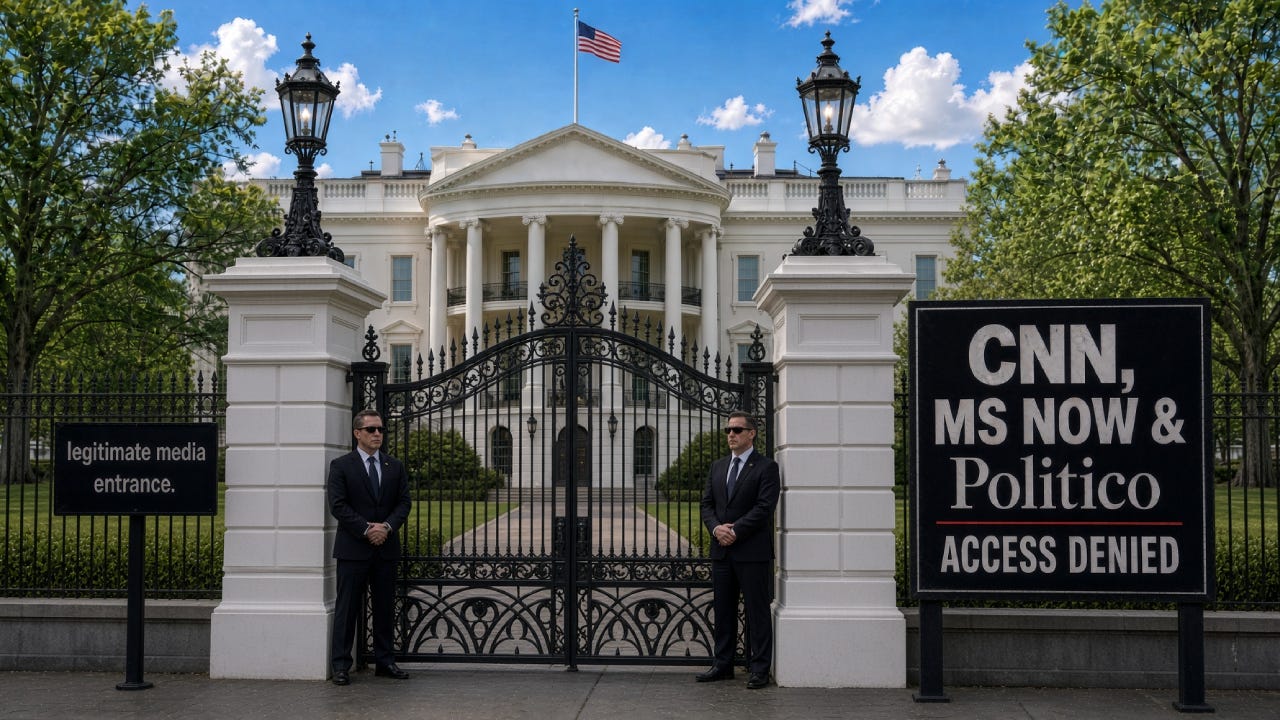
President Trump recently announced that CNN, MS NOW, and Politico were banned from White House grounds, effective immediately, citing what he called their constant reporting of “fake news.” The next morning, reporters from those outlets arrived at the gates, scanned their badges, and watched them fail. Secret Service officers confiscated the credentials. The networks responded with the familiar chorus: an “illegal assault” on the First Amendment, a threat to democracy, and vows to take “any and all steps necessary.”
The disingenuous pearl-clutching by these has-been elite media organizations is nauseating. Access to the White House, the Pentagon, or any other federal department is a privilege, not a right.
The First Amendment protects the press from government censorship of what it publishes. It does not confer an all-access pass to the West Wing, the Oval Office, Air Force One, or the briefing room. CNN, MS NOW, and Politico remain free to report whatever they choose from their studios, sidewalks, and websites. They simply are no longer privileged guests inside the building. Smaller outlets have always operated under those same constraints.
Every administration has decided which journalists receive in-person access and which do not. This isn’t some novel Trump invention:
Woodrow Wilson threatened to shut down presidential press conferences after reporters printed remarks he considered off the record; the White House Correspondents’ Association itself was formed in 1914 partly to police who got in the room.
Richard Nixon converted FDR’s swimming pool into a press briefing room and then ordered that Washington Post reporters be kept out of social events and other White House spaces after Watergate coverage. Nixon’s taped instruction was unambiguous: no Post reporter was ever to be in the White House.
The Obama White House tried to freeze Fox News out of a Treasury Department interview round in 2009. Internal emails later showed officials instructing counterparts to “skip Fox please” and crowing that they had demonstrated the ability to exclude the network. Other networks refused to participate unless Fox was included, so the effort collapsed. That episode didn’t produce a nationwide constitutional crisis. It was treated as ordinary political hardball.
Trump’s first term gave us the Jim Acosta credential fight, after which a court restored the CNN correspondent’s pass.

In Trump’s current term, an appeals court has already held that restricted presidential spaces—including the Oval Office and Air Force One—are not public forums open to private speech. The White House therefore retains discretion over who is admitted to those spaces, even when that decision is based on viewpoint. The East Room, however, was treated differently. That legal distinction matters, whether or not the networks find it convenient to acknowledge.
The current indignation is especially rich when you consider the record these same organizations have compiled. They spent years treating Russiagate as settled fact, Hunter Biden’s laptop as “Russian disinformation,” and questions about COVID’s origin as effectively forbidden. They lectured the public about “threats to democracy” while the Biden administration coordinated with online platforms to suppress disfavored speech.
But when the target is a Republican president they dislike, physical proximity suddenly becomes a sacred constitutional right. When the target is a conservative network—or a story that inconveniences Democrats—access suddenly becomes nothing more than a managerial detail. The double standard is exhausting, obvious, and by now entirely predictable.
The president of the White House Correspondents’ Association, herself a FOX News correspondent, declared that constitutional protection “does not depend on whether the president likes a news organization’s coverage.” Correct. But the Constitution also doesn’t require the president to provide office space, security screening, pool rotations, or a briefing-room seat to organizations he regards as serial fabricators. Plenty of serious reporters cover the administration without holding a hard pass. Wire services, digital outlets, and foreign bureaus manage to do so successfully every single day. Somehow, journalism continues even without a reserved chair inside the building.
Trump said he may ban additional outlets and might also pursue legal action. That’s his prerogative as the building’s occupant, just as the press is free to sue in response. In the end, the whole spectacle is another waste of taxpayer dollars, driven largely by arrogance, ego, and the media’s familiar sense of entitlement.
Courts will keep drawing the lines they have already begun to draw: some spaces are discretionary, while others are not. None of that turns a press badge into a property interest or creates a First Amendment entitlement to stand two feet from the Resolute Desk.
The real arrogance on display is the assumption that elite newsrooms are somehow co-sovereigns of the executive mansion. They are not. They are private businesses that enjoy extraordinary legal protections for the material they print, and those protections matter. But they don’t include a government-issued keycard guaranteeing physical access.
If their reporting is truly as indispensable as they claim, it will survive the short walk from the northwest gate to the nearest available camera stand. And if it can’t survive that modest distance, then perhaps the real problem was never the press badge in the first place. Perhaps it was the elite media’s worn-out belief that access, deference, and institutional privilege are all things it is simply owed.
They are not.
A Note About Subscribing:
At Underground USA, we pride ourselves on being fiercely independent—we only answer to our readers. This independence allows us to tackle tough questions, dive deep into important topics that often get overlooked, and share essays and podcasts, like this one, without asking for anyone’s approval.
Free subscriptions help us connect with a wider audience. They are the vehicle for the wide dissemination of the message. Paid subscriptions are what keep us going. They fund our research, document requests, interviews, fact-checking, and give us the time to dig deeper than just the headlines. Most importantly, they support something that’s getting harder to find: independent analysis that’s not swayed by advertisers, corporate sponsors, or political agendas.


