

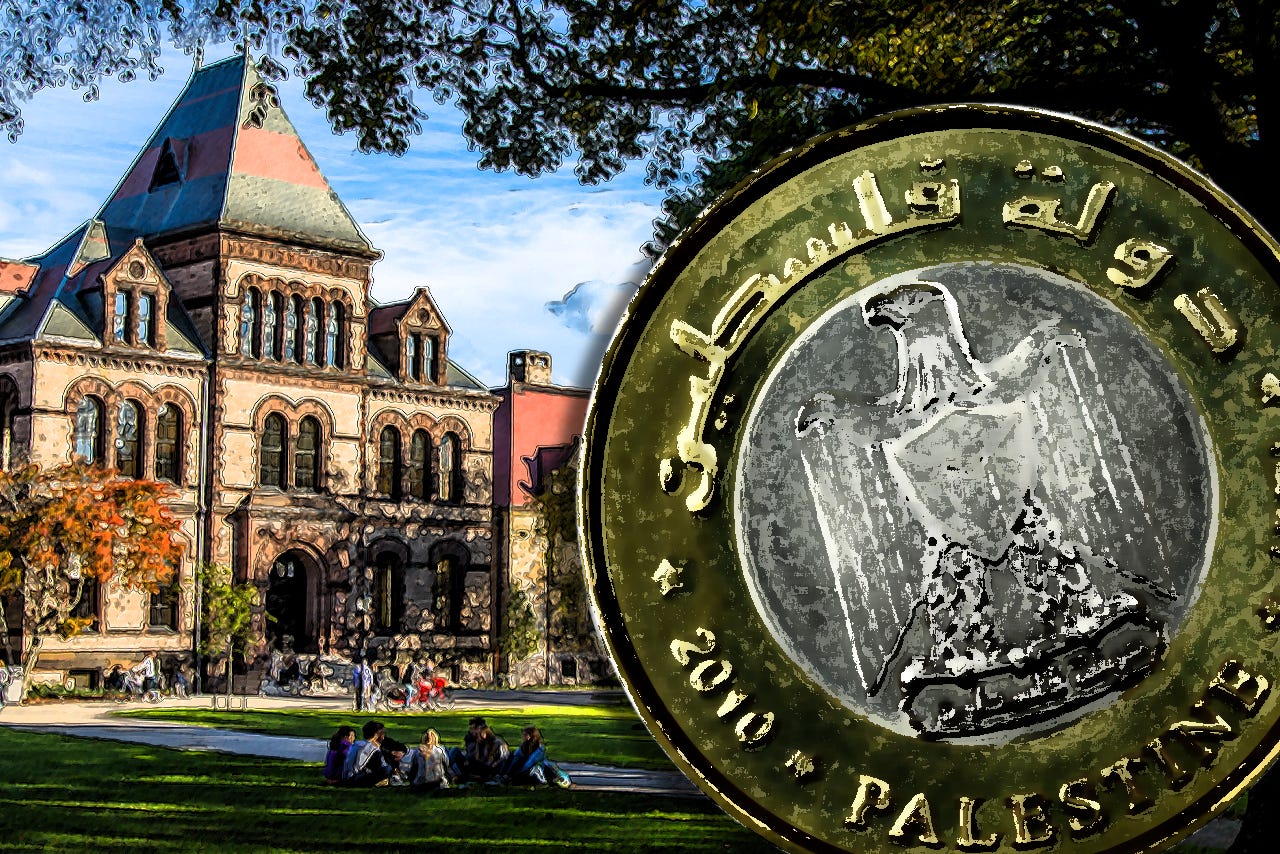
American universities were established to be bastions of intellectual freedom and innovation, fueled by a hybrid combination of public and private funding. However, the rise of foreign funding in recent decades has raised serious concerns and sparked a contentious conversation about its potential impact on academic freedom, national security, and the integrity of higher education.
As violent protests envelop campuses from coast to coast, we must finally scrutinize this multifaceted issue. Examining the case studies of Brown and Harvard Universities alongside the broader trend of Middle Eastern donations initiates exploration into the potential benefits of international collaboration while highlighting the serious concerns surrounding the sources and effects of foreign funding.
Brown University & The Palestinian Studies Professorship
In February 2020, Brown University received a $643,000 donation from a foundation in the "State of Palestine" to establish a professorship in Palestinian Studies. While seemingly innocuous, this gift raised red flags regarding the origin of foreign funding and its potential influence.
As Adam Andrzejewski, CEO of OpenTheBooks.org, states in his recent piece, “$10 Million To Harvard, Brown And Others Flowed From The ‘State Of Palestine’”:
“...‘Palestine,’ as a nation, does not exist. Neither the US State Department nor the United Nations recognize Palestine as a country. The ‘State of Palestine’ is a political fiction that provides cover for numerous terror organizations funded by Iran and others…”
Many who study the issue of Islamofascist violence point out that the “State of Palestine” is not only an unrecognized entity, it is an entity with established ties to organizations deemed terrorist groups by the United States – including Hamas – and other bad actors in the Middle East.
This case raises the specter of "pay-for-slay" policies practiced in the region, where Palestinian authorities compensate families of individuals involved in violence against Israel. The potential misuse of funds channeled through academic institutions to support such activities becomes a major concern.
“Pay-for-Slay” is defined:
“According to Amended Palestinian Prisoners Law No. 19 (2004)...Palestinians and Israeli Arabs who are convicted by Israel of involvement in terror attacks in Israel – “participation in the struggle against the occupation” – are entitled to monthly ‘salaries' commencing with their arrest – and continuing for life for men who serve at least five years and women who serve at least two – along with additional cash grants for such things as tuition fees at government schools and universities, health insurance, and priority civil-service job placements upon their release. The PA law specifies that the financial support is for the ‘fighting sector,’ an ‘integral part of the fabric of Arab Palestinian society.’ Basically, the law dictates that the deadlier the terror attack, the richer the reward…
“In 2016…[t]his sum [was] divided into two separate payments: 1) the Prisoners & Released Prisoners Ministry to administer this program of support, which received a budget allocation of $118 million…; and 2) the Institution for the Care for the Families of the Martyrs to provide for the families of dead terrorists…For individual payments, the salaries start at $400 per month for terrorists incarcerated for up to three years. They rise to $570 per month for those incarcerated for three to five years, and $1,142 per month for five to 10 years. For those serving more than 30 years, the salary is $3,429 per month (the gross national product per capita amount in the West Bank is $258 per month). For one-time grants to released prisoners, these start at $1,500 for terrorists who served one to three years and rise to $6,000 for those with 11-to-15-year terms, and $25,000 for those who served over 30 years. Bonuses are paid if the terrorists are Israeli Arabs or Arab residents of Jerusalem.”
The subsequent appointment of Beshara Doumani, an academic with connections to Birzeit University in the West Bank (known for its links to Hamas), further fueled this anxiety.
A statement issued by Birzeit University's faculty union, declaring 2023 as the year Palestinians “screamed in defense of their homes” against “colonial fascism,” underscores the potential ideological influence foreign funding can exert on American universities. Here, the fear is the potential misuse of academic resources to advance agendas that may not be in the best interests of the United States.
Harvard University: Funding & Collaboration
Harvard University also received significant funding, amounting to $1.6 million, from entities within the “State of Palestine,” with no restrictions on its use. This raises concerns about the indoctrination of students and the possible diversion of funds to support questionable activities.
Additionally, Harvard's collaboration with Birzeit University, using a “decolonial framework,” raises questions about the influence of foreign funding on how the Israeli-Palestinian conflict is presented within American academia.
It can be successfully argued that the denoted bias in curriculum and research, driven by these financial ties, distorts the academic discourse on a sensitive and explosive issue. That explosiveness is being witnessed today on campuses across the United States.
Middle Eastern Funding & Its Geopolitical Implications
The cases of Brown and Harvard Universities are merely microcosms of a larger trend. This trend includes Indiana University of Pennsylvania’s $900,000 “gift” from “Palestinian Territory, Occupied.” IUP describes this funding as related to the “payment of tuition and fees for students from Palestine.”
According to Andrzejewski:
“IUP is connected directly with the West Bank and the Palestinian Authority through its business PhD and MBA programs, offered in association with the Arab American University, the first private university there.
“A spokesperson said, ‘IUP has received instructional agreement income for providing educational programs at various international locations, including one in Palestine, since 2014.’”
Over the past four decades, American universities have received a stupefying $10.3 billion in funding from Middle Eastern countries, particularly Qatar, Saudi Arabia, the United Arab Emirates (UAE), and Kuwait. This includes the non-existent “State of Palestine.”
While these donations often translate into some form of new academic programs, research centers, and professorships, legitimate concerns overshadow the underlying motives. Critics rightly suggest these countries aim to promote their own political and cultural agendas within American institutions. This purposeful manipulation of academic discourse for national gain poses a significant threat to intellectual freedom, not to mention national security.
Furthermore, the influx of substantial foreign funding, coupled with existing federal support, raises concerns about the complete lack of representation of American taxpayer interests. Poll after poll makes it clear that the American people feel deceived – and, in fact, betrayed – when universities prioritize agendas backed by foreign donors over those aligned with the needs and values of Americanism. Additionally, the probability that these funds are being used to foment civil unrest within the United States is a dimension requiring serious consideration.
Squaring Benefits & Risks
Foreign funding for American universities presents a double-edged sword. It offers opportunities for international collaboration, diversification of research, and exposure to new perspectives. However, the overwhelming evidence pointing to an ongoing effort to manipulate and establish ideological bias in our education system – specifically in our universities – and the undermining of academic freedom cannot be ignored. The benefits of allowing both our public and private universities to accept foreign money must outweigh the risks.
Moving forward, universities must either divest from accepting foreign “gifts” and financial donations or implement intensely robust vetting procedures for foreign donations, ensuring transparency in the sources and usage of funds.
Stricter reporting regulations on foreign funding to US universities, similar to those governing political campaigns, should be considered, although even those are not stringent enough.
Additionally, fostering a culture of open discourse and critical thinking within academic communities is crucial to counter any potential attempts at indoctrination. The biased influence of bad-acting foreign entities and ideologies upon our universities in the form of financial infusion breaks the fidelity to that culture of open, honest, and uninfluenced discourse and critical thinking.
The federal government is also culpable. It must establish clear guidelines – as well as harsh penalties – regarding acceptable and unacceptable practices related to foreign funding in order to provide a much-needed boundary framework for universities to navigate this troublesome landscape.
Safeguarding The American Academic Ideal
The influx of foreign funding presents challenges for those who are honest and forthright in American academia. When you examine the state of today’s academia, those numbers can only be described as “very few.”
By mandating and codifying transparency and robust vetting procedures – and establishing a renewed fidelity to open, honest, and unmanipulated discourse, universities – with punitory oversight from the federal and state governments – can ensure that foreign funding is brought to its knees in service to the cause of academic freedom and the advancement of critical thinking.
The notion that this issue is directly related to national security and the survival of both our Republic and Western culture, on the whole, cannot be overstated. We ignore this fact at our own peril.
“If virtue and knowledge are diffused among the people, they will never be enslaved. This will be their great security." – Samuel Adams


Take Back Your Mind
Think For Yourself