

🎧 LISTEN TO THE HEADLINES ON THE SUBSTACK APP
AOC Calls for Networks to Censor Trump Speech on Election Integrity
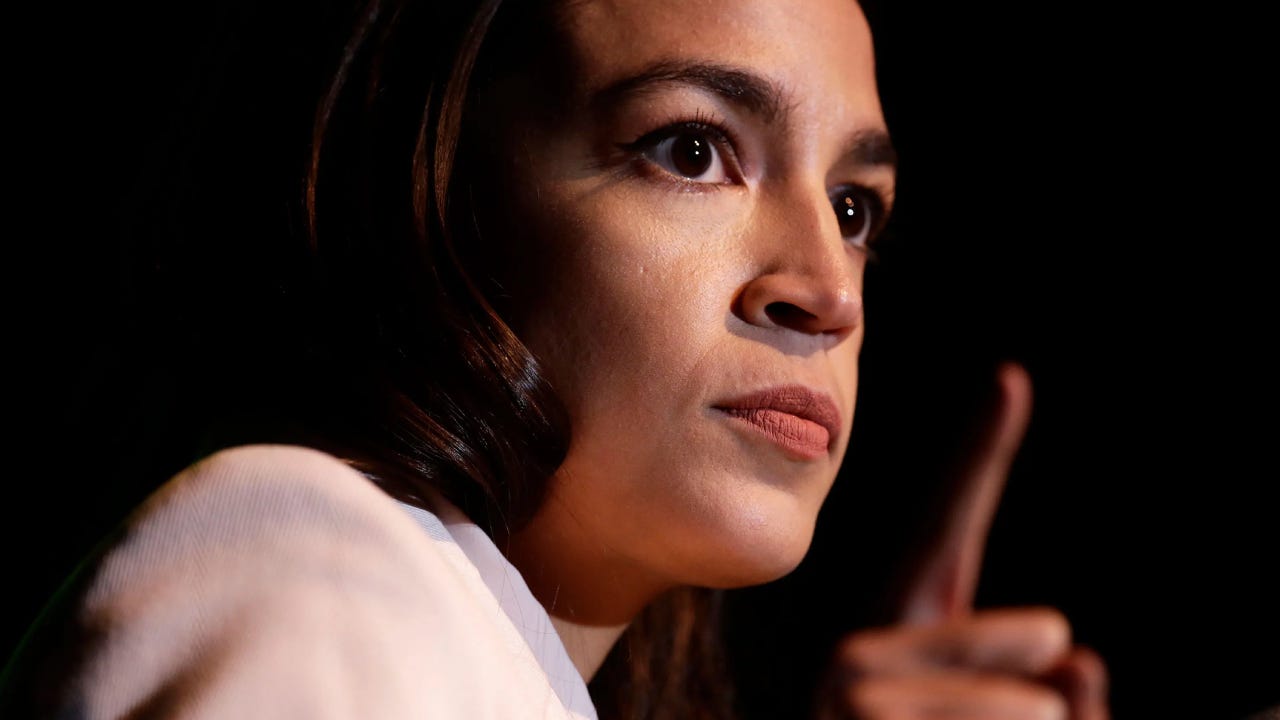
Rep. Alexandria Ocasio-Cortez (DS-NY) stated on Tuesday that television networks have an ethical obligation not to air President Trump’s upcoming address if it includes statements about elections that she views as not grounded in evidence or facts. She told reporters on Capitol Hill that media outlets should review transcripts in advance and avoid platforming what she described as lies about the election. Ocasio-Cortez added that the decision would depend on the speech’s contents. Trump confirmed earlier that day his prime-time speech on Thursday night would focus heavily on free and fair elections and related issues. He described it as really big news, essential to the country, because without fair elections, there is no country. Reports indicate the address may highlight reexamined government findings on election infrastructure vulnerabilities, including potential foreign access to voter data.
🏛️ News & Politics
Speaker Mike Johnson Warns of Communist Threat From Rising DSA Candidates
House Speaker Mike Johnson (R-LA) issued a pointed warning about the dangers of communism during a House Republican leadership press conference. He highlighted the growing influence of Democratic Socialists of America-backed candidates across the country, describing their agenda as a direct assault on American freedoms that echoes the deadly failures of the ideology throughout the 20th century. Johnson noted that these radicals seek policies such as defunding the police, abolishing prisons, eliminating the Senate, packing the Supreme Court, and granting government control over production, calling them a serious danger to families and the constitutional republic. He emphasized that this is not the Democrat Party of old but one increasingly dominated by Marxists who have brought the fight for such ideas to American shores, urging voters to recognize the stakes ahead of the midterms.
House GOP Releases Blueprint for 95 Billion Dollar Reconciliation Package
House Republicans released a budget blueprint on July 15, 2026. The measure would enable a third reconciliation bill to allocate $95 billion for defense, farm aid, and state efforts to implement voter ID requirements. It directs $73 billion toward defense and intelligence activities amid the conflict with Iran, $12 billion toward agricultural support, and $10 billion toward election integrity measures. Both chambers must approve identical budget resolutions to proceed with reconciliation, which permits passage of qualifying fiscal legislation by simple majority and bypasses the Senate filibuster. The House Budget Committee plans a markup on July 16. Committees on Armed Services, Administration, Intelligence, and Agriculture will develop the underlying legislation. The resolution lacks specified pay-fors for the new spending. This follows two prior reconciliation packages, one making 2017 tax cuts permanent with border security elements and another funding ICE and Border Patrol. President Trump has urged swift action on a third package incorporating the SAVE America Act.
Trump Reverses DHS Pause Orders ICE to Resume Vehicle Stops
President Trump directed the Department of Homeland Security to reverse a one-day pause on most ICE vehicle stops, calling the tactic one of the agency’s most important crime-fighting tools. The temporary halt followed two fatal shootings during vehicle stops in Texas and Maine within the past week, where agents fired on drivers, one of whom authorities said attempted to ram officers. DHS Secretary Markwayne Mullin had implemented the indefinite pause pending new training, limiting stops to targets with serious or violent criminal histories except in specific cases. Trump pushed back via social media, stating that halting the practice would play into criminals’ hands and that agents must remain strong, fair, and smart in their operations while emphasizing that crime is down significantly. The White House confirmed the reversal, with Trump noting the need to remove unvetted individuals allowed entry under the prior administration.
Senate Hearing on Taxpayer Fraud Exposes Democrat Absence as Whistleblowers Demand Action
Democrats failed to attend a Senate Homeland Security & Governmental Affairs Committee hearing on taxpayer fraud held on July 15, 2026, leaving their seats empty while independent journalist Nick Shirley and activist James O’Keefe testified. Sen. Rand Paul (R-KY), who chaired the session, highlighted the vacant Democrat spots and questioned their lack of interest in addressing the theft of funds from American taxpayers. Shirley, describing himself as a 100 percent independent journalist focused on serving the people, emphasized that fraud steals money from hardworking citizens regardless of party affiliation and that the dollars involved have no political labels attached. He detailed his investigations that have uncovered billions in fraud, including schemes in Minnesota, California, and New York City where government-funded programs like adult daycares allegedly misused funds for activities such as ping-pong and Tai Chi for elderly participants. Shirley noted his prior work led to over 30 bills in Congress and the formation of a fraud task force, and he urged lawmakers to crack down on the issue to put Americans first.
House Passes Trump-Backed Measure Ending Clock Changes
The House of Representatives voted 308-117 on July 14 to approve the Sunshine Protection Act, which would make daylight saving time the permanent standard across most of the United States. The legislation ends the twice-yearly practice of adjusting clocks, keeping the current March-to-November schedule year-round unless individual states opt out through their legislatures before the law takes effect. President Trump has publicly supported the bill, calling the seasonal clock changes a ridiculous twice-yearly production that wastes time and money while urging Congress to pass it as a win for the Republican Party. The measure now heads to the Senate, where a similar version stalled in the past due to concerns from lawmakers like Sen. Tom Cotton (R-AR) about late winter sunrises in some regions.
Listen to Underground USA’s podcast:
⭐ Iran’s Hollow ‘Reformers’ vs. the Mullah-IRGC Mafia: A Poisoned Power Struggle
BE SURE TO LIKE THE ARTICLE & SHARE IT WIDELY
📢 The American Fifth Column
New Hampshire Democrat Lawmaker Claims Constitutional Shield After Speeding Ticket
New Hampshire state Representative Ellen Read, a Democrat from Newmarket, was clocked driving 107 miles per hour in a 65-mile-per-hour zone on Interstate 93 in Windham on December 2, 2024. Authorities say she was traveling away from the State House toward her job in Woburn, Massachusetts, at the time rather than heading to legislative duties. Read faced a second speeding citation for 92 miles per hour on the same highway in June 2025. She has argued in court that legislative privilege under the New Hampshire Constitution prevents officers from stopping or charging her while traveling to or from the Legislature. A judge rejected the claim in her first case, where she was found guilty of negligent driving and fined $1,240 with a potential license suspension for future violations. The New Hampshire Supreme Court declined to hear her appeal in June 2026.
Wisconsin Elections Panel Refers Elon Musk Bribery Complaints to Prosecutors
The Wisconsin Elections Commission voted five to one in a closed session to forward two complaints alleging that Elon Musk violated the state’s election bribery law by offering one million dollar payments to voters ahead of the 2025 Wisconsin Supreme Court election. The bipartisan panel determined there was probable cause that Musk’s social media post and related actions with his America PAC sought to induce people to vote in the race between conservative Brad Schimel and liberal Susan Crawford. Musk had handed out the large checks at a Green Bay rally and offered smaller incentives tied to a petition opposing activist judges as part of broader efforts that poured tens of millions into the contest. Prosecutors in Brown County now have forty days to decide on potential charges for what amounts to a Class I felony under Wisconsin law prohibiting anything of value given to encourage voting.
Med School Deans Dodge Basic Biology Questions in House DEI Hearing
Two medical school leaders from the University of California system struggled to answer straightforward questions about biological reality during a House Education and Workforce Committee hearing on DEI initiatives in medical education. When asked who can have babies, UCSF Chancellor Dr. Sam Hawgood acknowledged that the vast majority of pregnancies occur in women but equivocated on whether non-biological women have ever given birth, emphasizing care for transgender patients instead of a direct response. UCLA School of Medicine Dean Dr. Steve Dubinett similarly avoided confirming that a person with a uterus is a woman, citing compliance with laws and institutional materials that discourage assuming gender identity.
Black Historian Blames Racism for Scrutiny After Scholars Flag Errors in Her Prize-Winning Book
Kerri Greenidge, a Black historian formerly at Tufts University, faced criticism from fellow scholars for significant problems in her 2022 book “The Grimkes.” Reviewers identified factual errors, unsubstantiated claims, missing endnotes, and citation issues in the work about a slaveholding family and its abolitionist descendants. Retired professor Myra Glenn highlighted these flaws in a 2024 review, noting a lack of evidence for major assertions. Tufts conducted a peer review that confirmed multiple errors and citation problems, leading to Greenidge’s departure from the university. Her publisher removed the book from its site, and another of her works now draws similar questions. Greenidge responded by claiming the criticism represents an attack on Black women academics, expressed heartbreak over the treatment, and acknowledged possible misattributed citations while denying fabrication or plagiarism.
Americans Lose Further Confidence in Higher Education
Public confidence in American higher education has slipped once again after a short-lived recovery, with only 38 percent of U.S. adults now expressing a great deal or quite a lot of trust in the institution. This marks a decline from 42 percent last year and reflects a steep drop from 57 percent in 2015, as skepticism grows over partisan indoctrination on campuses, soaring costs that deliver questionable returns, and failure to equip students with practical job skills in an AI-driven economy. Gallup researchers noted that 31 percent of doubters point to political bias, 30 percent to excessive expenses, and 25 percent to inadequate workforce preparation, with Democrats fueling much of the recent downturn. The results highlight ongoing public frustration with an industry that once enjoyed broad respect but now struggles to justify its value to everyday Americans.
🌐 International
US Iran Clash Enters Fifth Day With Trump Threatening Power Plant Strikes
The United States and Iran continued trading heavy strikes for a fifth straight day as American forces targeted Iranian military sites including coastal infrastructure and a barracks while Iran launched retaliatory attacks on US positions in the Gulf region. US Central Command reported launching waves of strikes to degrade capabilities used against commercial shipping in the Strait of Hormuz, with one wave lasting seven hours overnight and another 90 minutes the following day. President Trump warned that failure to negotiate would lead to escalated action next week, including strikes on power plants and bridges, stating that Iran better make a deal or risk having nothing left. Iranian officials reported at least 30 civilians killed and over 260 wounded from the recent US strikes, along with damage to sites such as a maritime control tower in Chabahar and a military barracks. Iran’s IRGC claimed hits on US-linked bases in Bahrain, Kuwait, and Jordan, with reports of drones and missiles causing damage and injuries.
EU Advances Largest Enlargement Push in Decades on Super Tuesday
Four candidate countries made notable progress toward European Union membership on July 14-15, 2026, in what officials described as a Super Tuesday for enlargement—the most significant single-day advancement in over two decades. Ukraine and Moldova opened negotiations on a key cluster covering external relations, security, defense, trade policy, and humanitarian aid, building on the fundamentals discussions that began in June. Albania began closing chapters on education, culture, science, research, and external relations, while Montenegro, the frontrunner, provisionally closed additional chapters on competition policy and customs union, pushing it past half of its negotiating chapters complete. The moves reflect renewed momentum following shifts in Hungarian leadership that eased prior vetoes, amid ongoing requirements that candidates align with the EU’s 35 policy chapters on the rule of law, the economy, and more. Full accession remains years away and requires unanimous member state approval, but the steps highlight Brussels’ push to counter external influences through expansion.
Dark Web Leak Exposes Files From India Nuclear Power Project
A ransomware group called World Leaks published over 19,000 files on the dark web allegedly stolen from Reliance Group, a contractor involved in India’s largest nuclear facility at Kudankulam in Tamil Nadu. The documents include engineering drawings for ventilation and cooling systems, control room floor plans, equipment inspection reports, supplier and vendor lists, insurance documents, and internal meeting records related primarily to Units 3 and 4, which are under construction and slated to begin operations by 2027. The files do not contain reactor core designs or critical nuclear technology from Russia’s Rosatom. Reliance confirmed a partial data breach on a third-party server hosted by Yotta and notified the government. India’s Computer Emergency Response Team and the Nuclear Power Corporation of India are investigating. Cybersecurity experts note that while core reactor operations appear unaffected, the information could help hostile actors map support systems, identify access points, and target supply chains.
China Sees Slowest Economic Growth in Three Years Despite Export Surges
China’s economy expanded by 4.3 percent in the second quarter of 2026 compared to the same period a year earlier. This marked the weakest quarterly pace in more than three years and fell short of expectations as well as the lower end of Beijing’s annual target range of 4.5 to 5 percent. The slowdown came despite a strong export performance that saw shipments jump 27 percent in June and 17.6 percent in the first half of the year. Property sector woes continued to weigh on investment, which dropped sharply, while domestic consumption remained subdued, with retail sales showing only modest recovery in June. Officials acknowledged external uncertainties and domestic supply-demand imbalances but described the overall first-half performance as operating within a reasonable range, with first-half GDP growth at 4.7 percent.
Canadian Wildfire Smoke Drifts Across Multiple US States
Smoke from wildfires burning in Ontario, Canada, and northern Minnesota is drifting eastward across large portions of the United States, affecting air quality in numerous states. The National Weather Service has tracked the plume, which by Friday afternoon is forecast to cover or impact all or parts of Connecticut, Delaware, Illinois, Indiana, Maine, Maryland, Massachusetts, Michigan, Minnesota, New Hampshire, New Jersey, New York, Ohio, Pennsylvania, Rhode Island, Vermont, Virginia, and Wisconsin. Superior National Forest in Minnesota reports 17 active wildfires burning approximately 33,000 acres near the Canadian border. Officials warn that the combination of smoke and extreme heat poses health risks, as fine particles can aggravate asthma, reduce lung function, irritate airways, and contribute to heart problems, particularly for vulnerable populations. Meteorologists note that smoke settling closer to the ground could create the worst conditions in areas such as northern Michigan and western New York, with advisories urging residents to limit outdoor activity and stay indoors where possible.
