

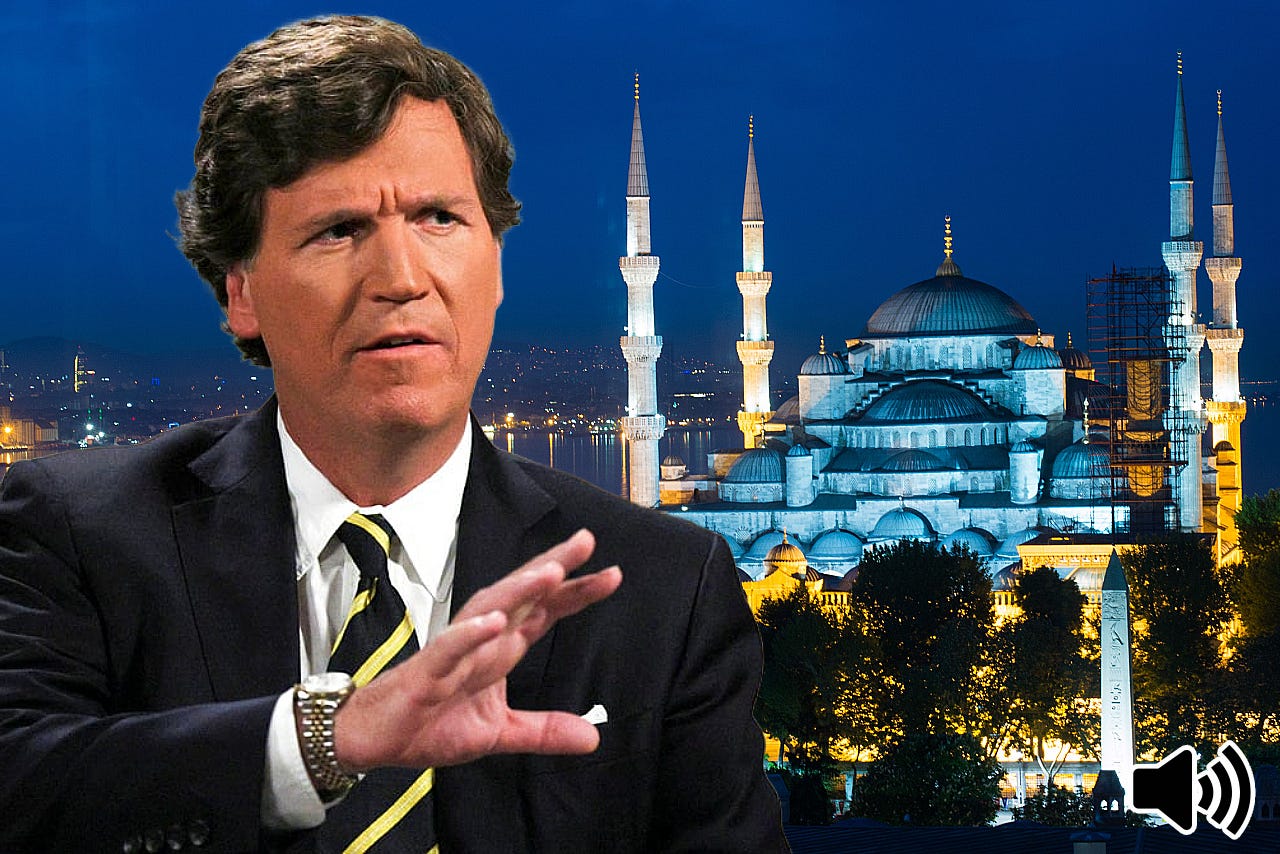
It’s hard to overstate just how jarring Tucker Carlson’s recent rhetoric has become. Once the sharpest populist voice in American media—a man who tore through both neoliberal and neocon orthodoxies with surgical precision—Carlson has suddenly started speaking as though he moonlights as a Qatari press attaché.
His now-infamous claim that “Islamofascism is less of a threat to the West than OnlyFans” didn’t just disturb his conservative base—it detonated it. The outrage was less about prudish moralizing and more about disbelief: when did Tucker Carlson, of all people, start downplaying a totalitarian religious movement that literally burns homosexuals and stones women?
To dismiss this shift as mere contrarianism is naïve. Carlson’s pattern of commentary over the past year shows a deliberate, consistent softening toward the ideological regimes of the Middle East—most notably those orbiting Qatar and its wealthy Islamofascist allies. And the timing is impeccable for Doha’s global media strategy, which is aggressively investing billions in Western media ecosystems to “humanize” Islamofascism, rehabilitate its image, and subtly attack its two favorite enemies: Israel and the West.
What better vehicle for such propaganda than a once-beloved right-wing populist now spurned by American corporate media—someone whose credibility among millions rests on his seeming independence?
Let’s talk about Qatar. This is a country that has spent decades laundering its authoritarian ideology through institutions that Western elites mistake for academic and journalistic philanthropy. The Qatari government bankrolls think tanks, buys media stakes, and funds universities with one hand, while promoting Islamofascist political movements throughout the Arab world with the other.
Its greatest export isn’t liquefied natural gas—it’s moral inversion. The idea that rigid theocracy is preferable to decadent individualism. That submission is order, and freedom is chaos. It’s a message tailor-made for a West exhausted by its own nihilism.
Carlson’s newly Islamofascist-friendly messaging fits this playbook too neatly to ignore. His post-Fox ventures are remarkably well-funded for an “independent journalist.” Lavish travel across continents, smooth production, global exclusives with controversial heads of state—yet his revenue sources remain clandestinely opaque. Various financial trackers and independent investigators have noted loose ties between some of Carlson’s production operations and foreign financial entities linked to Gulf intermediaries.
But nothing definitively proves a direct wire from Doha, of course—if you know how modern propaganda markets function, you know that raw bribery is passé. Influence is purchased by ecosystem, not by envelope.
What we’re witnessing is the Islamofascist narrative disguised as moral realism.
Carlson’s brand has always relied on moral conflict narratives—he pits the spiritual sickness of liberal elites against some vision of prelapsarian order. But lately he has recast the Islamofascist model—theocratic submission through violence—as the moral antidote to Western degeneracy.
When Tucker tells you that OnlyFans is more dangerous than Islamofascism, he’s not making a religious argument. He’s offering a false dichotomy: that your choices are between soulless consumerism or pious tyranny. That moral order requires uniformity of thought and suppression of freedom. It’s the same rhetoric that Qatari-aligned media platforms like Al Jazeera Arabic have pushed for decades—always cloaked in “moral clarity,” always demonizing Western liberty as sexual chaos dressed up as tolerance.
The eeriest part isn’t that Carlson flirts with that narrative—it’s that he seems to believe he’s still being simply contrarian.
Another thread in his transformation is impossible to ignore: Carlson’s creeping antisemitism, couched in pseudo-intellectual populism. His recent insinuations about Jewish influence over global finance and American foreign policy echo the oldest fascist tropes on record.
Once, Carlson criticized Israel the way a serious commentator might criticize any ally—based on policy. Now he joins the Islamofascist chorus accusing the Jewish people, collectively, of masterminding global immorality and media corruption. These ideas are not original; they are imports. They flow directly from the same ideological streams that run beneath Qatari mosques, Iranian propaganda outlets, and Turkish state media. The same narratives were prevalent in 1939 Germany.
It is not coincidental that Islamofascist regimes have long tried to translate their own antisemitic propaganda into language digestible by the Western Right: moral discipline, family values, economic honesty—twisted into theological antisemitism camouflaged as cultural critique.
It’s important to realize that today’s propaganda doesn’t leave a paper trail.
The modern influence industry is not crude bribery—it’s soft corruption through circles of access and affirmation. Invitations, partnerships, funding deals, reputational networks. Give a man a global stage, frame his next documentary, and he’ll convince himself he’s independent.
Carlson is now immersed in precisely that ecosystem. Surrounded by financiers sympathetic to Islamofascist regimes, applauded by Qatari-friendly editorial networks, and embraced by global-state-funded “counter-establishment” figures, he is, effectively, domesticated propaganda. He isn’t even cajoled into saying what they want him to say anymore. The message now flows smoothly through him.
He has become, perhaps unwittingly, the West’s most trusted messenger for Islamofascism’s rehabilitated image: the idea that moral sanctity must come by authoritarian religion rather than individual virtue.
So, let’s be clear: Tucker Carlson’s pivot is not simply a man evolving. It’s a brand being retooled for strategic value abroad.
When he suggests that Islamofascism is less dangerous than Western moral decay, he’s effectively saying that censorship, violence, and theocratic control are preferable to liberty’s excesses. And make no mistake—Doha loves that message. It validates the Islamic totalitarian model by borrowing the rhetoric of Western decline. It sells submission as sophistication.
If that stance wins him a few petrodollars and elite invitations, that’s just the exchange rate.
Carlson used to argue that the biggest threat to the West was the corporate media complex—the machine that sells narratives as truth for profit. He was right. He just forgot that he was part of it too.
Now, whether consciously or cynically, he stands atop an ideological laundering operation that trades in the moral currency of the exhausted West, converting frustration into sympathy for tyranny.
So yes, Tucker Carlson may believe he’s exposing hypocrisy. But anyone half awake can see who benefits from his recent sermons about Western decadence and “the misunderstood Islamic world”: The same regimes that imprison cartoonists, publicly whip dissidents. Throw homosexuals from rooftops, and stone women. The same elites whose fortresses gleam from Qatari gas wealth, while their citizens live under medieval laws.
He is preaching to a Western audience that doesn’t recognize the trap—one that mistakes submission for salvation.
The only mystery left isn’t why this transformation happened. The incentives are clear. The question now is simpler, sharper, and infinitely more embarrassing:
How long has Tucker Carlson been buyable?
When we come back, our segment on America’s Third Watch, broadcast nationally from our flagship station WGUL, AM860 and FM93.7 in Tampa, Florida.
In Closing…
Tucker Carlson: What we’re watching isn’t free thought — it’s ideological laundering dressed up as independence.
Carlson, once the hammer of the powerful, now hums along to the tune of Islamofascist propaganda financed by the same oligarchs he once exposed. The man who preached skepticism has become its victim, repeating the moral justifications of regimes that would silence him first.
This isn’t righteous rebellion; it’s rented conviction. The dollar signs just happen to be written in Arabic. Thus, the question that hangs over it all — the one Carlson can’t answer: when did truth start carrying a price tag?
Until next time…


