

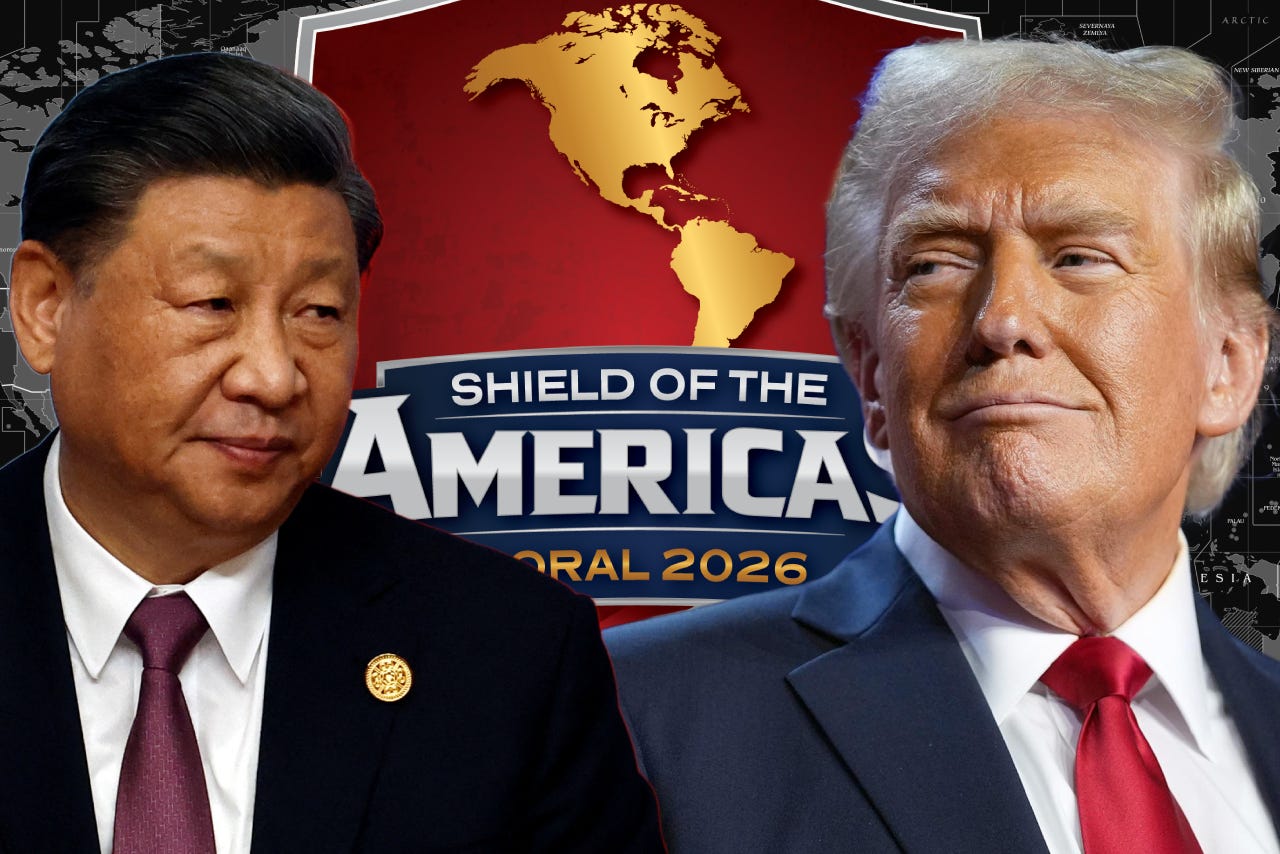
In a world increasingly menaced by the predatory ambitions of the Communist Chinese, President Trump’s strategic maneuvers in early 2026 stand as a beacon of resolute American leadership. The Shield of the Americas initiative, launched amid fanfare in Miami on March 7, 2026, is no mere regional pact against drug cartels—it’s a calculated thrust against Beijing’s insidious global expansionism. Coupled with the swift renewal of U.S.-Venezuela relations following the daring capture of Nicolás Maduro, and the joint U.S.-Israeli airstrikes on Iran’s tyrannical Islamofascist rulers starting February 28, these actions form a multifaceted offensive to dismantle the Chinese Communist Party’s web of influence.
Far from isolated events, Trump’s moves expose the Chinese Communist Party’s (CCP) aggressive playbook: economic coercion, military bullying, and alliances with rogue states that threaten free nations everywhere. And let’s not forget the spotlight he is shining on the shameful chorus of CCP apologists in the United States—elites in academia, business, and politics who parrot Beijing’s propaganda for a quick buck, undermining American sovereignty in the process.
The Shield of the Americas, proclaimed by Trump as a “brand-new military coalition to eradicate the criminal cartels plaguing our region,” assembles 17 nations in a hemispheric bulwark against narco-terrorism. But peel back the layers, and it’s clear this is Trump’s “Trump Corollary to the Monroe Doctrine,” explicitly designed to purge Chinese meddling from Latin America. Beijing has poured billions into the region via its Belt & Road Initiative (BRI), ensnaring countries in debt traps while flooding markets with fentanyl precursors—chemicals that fuel the very cartels the Shield targets.
In 2025 alone, China’s aggressive encroachments included ramming Philippine vessels in the South China Sea and unsafe intercepts of Australian aircraft, tactics that mirror their subversion in the Americas. Trump’s coalition, by coordinating intelligence and military operations, not only disrupts cartel networks but also secures critical supply chains for rare-earth minerals—resources the CCP hoards to dominate global tech. Critics like those in the U.S. who decry “imperialism” are often the same voices echoing CCP-funded think tanks, naively or corruptly advocating for “engagement” that only empowers Beijing’s tyrants.
This anti-CCP pivot gains sharper focus with the U.S.’s renewed ties to Venezuela, announced on March 5, 2026, just days before the Shield summit. After U.S. forces ousted Maduro in a January raid, interim leader Delcy Rodríguez’s government swiftly agreed to reestablish diplomatic relations, paving the way for American access to Venezuela’s vast oil reserves and gold mines.
For years, the CCP propped up Maduro’s regime with loans and investments, turning Venezuela into a Belt & Road Initiative beachhead to siphon resources and export instability northward. Beijing’s $60 billion in Venezuelan debt was a stranglehold, enabling the flow of illicit gold and oil that bypassed U.S. sanctions while funding CCP aggression elsewhere.
Trump’s move flips the script: by normalizing relations, the U.S. not only stabilizes the region but starves China of a key ally in its resource-grab strategy. Venezuelan oil could now undercut Beijing’s energy stability, especially as China escalates grey-zone coercion in the Taiwan Strait and Yellow Sea.
Yet, domestic CCP sympathizers—think Silicon Valley tycoons hooked on Chinese manufacturing and Ivy League professors on Beijing’s payroll—whine about “interventionism,” ignoring how their advocacy emboldens the regime that spies on Americans and steals our tech.

The pièce de résistance is the U.S.-Israeli onslaught against Iran’s mullahs, a regime Trump aptly labels “Islamofascist.” On February 28, 2026, joint airstrikes obliterated key nuclear sites, missile facilities, and leadership compounds, culminating in the death of Supreme Leader Ali Khamenei. This wasn’t just about curbing Tehran’s nuclear ambitions; it was a direct hit on the CCP’s axis of autocrats.
Iran, a linchpin in China’s Belt & Road Initiative, receives billions in arms and investment from Beijing, forming a “no-limits” partnership with Russia to challenge U.S. hegemony. Chinese drones and missiles bolster Iran’s attacks on Gulf states, while Beijing uses Iranian ports to project power into the Middle East and Africa.
The US-Israeli strikes, hitting over 4,000 targets in days, disrupt this unholy alliance, forcing China to divert resources from its Indo-Pacific bullying. Trump’s open-ended campaign—”whatever it takes”—signals zero tolerance for regimes that enable CCP expansion. Meanwhile, Iran’s retaliatory strikes on U.S. bases highlight the stakes, but they pale against Beijing’s broader aggression: in 2025, PLA propaganda depicted Taiwan’s president as a “parasite,” foreshadowing potential blockades that could ignite global war.
These initiatives aren’t disparate; they’re threads in Trump’s grand strategy to encircle and contain the CCP’s rapacious empire-building. From Latin America’s cartels to Venezuela’s resources and Iran’s proxies, each move severs Beijing’s tentacles, reducing its ability to wage economic warfare or military coercion worldwide.
China’s 2025 antics—standoffs with South Korea, collisions in disputed seas—reveal a regime drunk on power, unrepentant about Tiananmen Square or Uyghur genocide, and hell-bent on “national rejuvenation” at humanity’s expense. Trump’s actions reclaim U.S. primacy, countering the Belt & Road Initiative’s debt diplomacy, which has left nations from Africa to the Pacific in debt.
Yet, as many in history have predicted, the real betrayal comes from within: CCP advocates in the U.S., from Wall Street financiers chasing cheap labor to Hollywood moguls censoring films for Beijing’s approval, weaken our resolve. These enablers, often funded by Confucius Institutes or shady investments (think Neville Roy Singham), dismiss China’s threats as “racist scaremongering,” even as Beijing’s spies infiltrate our universities and hack our elections. Their appeasement echoes Neville Chamberlain’s folly, inviting aggression that Trump’s initiatives boldly repel.
In sum, the Shield of the Americas, Venezuelan rapprochement, and Iranian strikes are masterstrokes against communist China’s global assault. By securing the Western Hemisphere, tapping resource lifelines, and dismantling Beijing’s rogue alliances, Trump fortifies freedom against tyranny.
As China ramps up harassment—from Taiwan’s encirclement to East Asian tensions—the world watches: will we stand firm, or let CCP puppets in our midst pave the way for domination?
Trump’s vision is clear: America first, and the red menace contained.


