

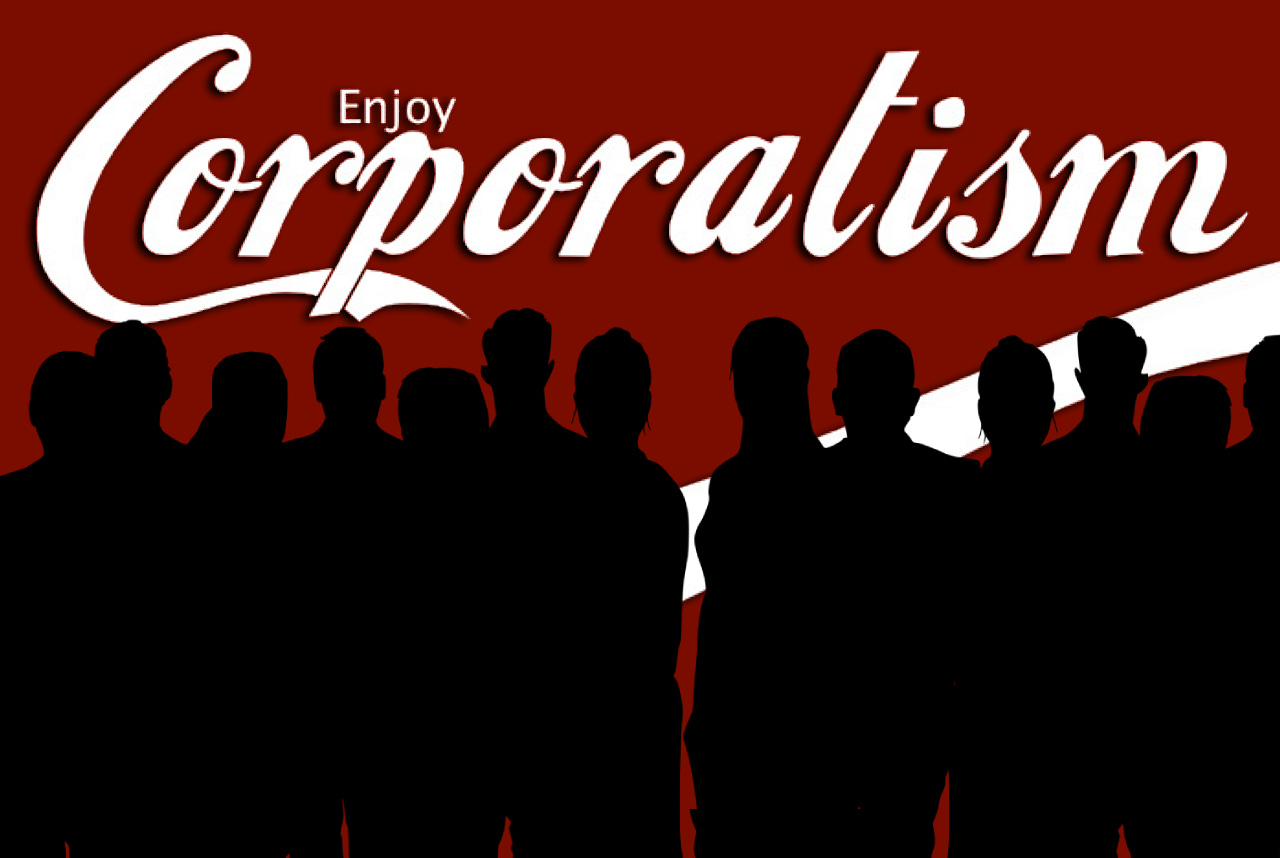
Suppose you can get past the hateful throngs of ideologically brainwashed antisemitic protesters on college campuses and in our urban areas. In that case, you will find yourself at the second layer of the indoctrination onion which compels today’s youth to believe that we both live in a capitalist society and that capitalism is evil.
I know this will come as a shock to those who have contemporary college degrees in “Anti-American Studies,” but – by definition and in practice – we do not live in a country that employs a free-market capitalist system. We live in a nation that employs an unholy hybrid of capitalism, corporatism, and neo-fascism on a full-gait march to democratic socialism.
And make no mistake, once the United States and the West arrive at the state of democratic socialism, we will have lost the sovereignty of nations, which means the right to own property and exist as individuals will be a thing of the past. Upon the free world’s arrival at democratic socialism, the globalists will have won. We will be back to lords and serfs.
Capitalism
Capitalism is defined as “an economic system characterized by private or corporate ownership of capital goods, by investments that are determined by private decision, and by prices, production, and the distribution of goods that are determined mainly by competition in a free market.”
But, the genesis of capitalism in the United States can be traced back to “The Age of Reason (Enlightenment)” and the early colonial period. Thinkers like John Locke and Adam Smith advocated the concepts of individual rights, private property, and free markets. These ideas resonated with the American colonists, providing intellectual underpinnings for the development of a capitalist system based on individual liberty and economic self-interest.
The eventual embrace of self-governance and the establishment of our representative form of government further bolstered the conditions for capitalism. This establishment of our original form of government created a favorable environment for economic freedom and individual initiative – devoid of government interference, thus engraining individualism and reward for hard work into the American ethos.
It wasn’t until the Industrial Revolution that the concept of New World corporations arrived on the scene, and with it a slippery slope to corporatism.
Greedy Robber Barons Facilitate The Demise Of Capitalism
The Industrial Revolution, a period marked by rapid industrialization, economic expansion, and profound social transformations, saw the United States undergo a dramatic shift from our agrarian roots to industry. This facilitated the rise of powerful corporations and corporate leaders (read: robber barons), both of which played a pivotal and sometimes damaging role in shaping the economic and political landscapes.
The late 19th century witnessed the emergence of industrial giants in sectors such as steel, oil, and finance, led by figures like Andrew Carnegie, John D. Rockefeller, and J.P. Morgan. These magnates amassed vast wealth and influence, contributing to the concentration of economic power in the hands of what we, today, call “the elite.” The era was characterized by laissez-faire capitalism, with practically no government intervention in business affairs.
However, as the negative consequences of unbridled capitalism became evident, public outcry for reform grew louder. “Progressive movements” (read: socially engineered government intervention) emerged, advocating for changes to address “social and economic inequalities.” In response to mounting pressure, the federal government began to take a more active and intrusive role in regulating business practices, marking the beginning of a new era in American corporatism.
Corporatism
Corporatism is defined as “the organization of society into industrial and professional corporations serving as organs of political representation and exercising control over persons and activities within their jurisdiction.”
This authoritarian evolution laid the dark foundation for the modern corporatist system – the system that moved us away from capitalism; the collusive cronyist system that has captured American society and economics today. And with the robber barons of the Gilded Age holding great influence in the halls of government, not only did these unelected tycoons manipulate the elected class to practically own the governmental process, but they were also key in establishing both governmental cronyism and the multi-headed hydra of federal government bureaucracy (read: the Deep State).
President Theodore Roosevelt (1901-1909), was a key figure in the metamorphosis from laissez-faire, free-market capitalism (pure capitalism) to untamed corporatism. He embraced a "Square Deal" approach that sought to balance the interests of labor, business, and the public by initiating the execution of government-led antitrust actions against monopolistic corporations.
The corporatist trend was further advanced during the Woodrow Wilson administration (1913-1921). The Federal Reserve Act of 1913 and the Clayton Antitrust Act of 1914 were landmark pieces of legislation that targeted the excesses of corporate power. Additionally, the creation of the Federal Reserve System marked a significant step toward a more government-controlled financial system.
With World War I, corporatism was accelerated, as the federal government sought to control economic activities under the guise of “supporting the war effort.” The War Industries Board exemplified this unholy marriage between the government and private-sector corporations, thus bringing together government officials and business leaders to collude on private-sector production.
The 1920s saw an explosion of regulatory measures. It also saw the establishment of the Bureau of the Budget (today’s Office of Management & Budget), codifying the government's heavy hand in economic planning. And, with the Great Depression, President Franklin Roosevelt (1933-1945) executed substantial and transformative interventions with his New Deal policies (read: socialist policies) solidifying the corporatist framework.
The Dangers Of Corporatism
With the move from free-market capitalism to the soft fascism of corporatism, the federal government (and this can be applied to state governments as well) has opened the door to utilizing private-sector corporations as social engineers; their reward being tax breaks, favored status in government procurement, and profits.
Whether you understand it or not, today we live in a society that exists under the coercive totalitarianism of corporatism. If only for a moment, consider how almost every entertainment venue bullies its preferred message into movies, TV shows, song lyrics, fashion, and marketing, to name just a few of the arrows in their quivers. And then there is the preferred narrative editorialization ideologically weaponized by the West’s mainstream news media. These preferred messages – these preferred narratives – almost always align with those championed by the opportunistic politicians who feed influentially and financially from the government trough of the Deep State.
Disingenuous economists bully the idea that the root of all evil is not set in the greed of the global elites (read: 21st-century robber barons), but, instead, they disingenuously place the blame for every societal malady at the feet of capitalism. These neo-robber-barons harness the ignorance of gargantuan ignoramuses like Alexandria Ocasio-Cortez, Elizabeth Warren, and the “dolt in chief” – Bernie Sanders, to screech their advocacy for how capitalism should be rendered to the ash heap of history. The fact of the matter is this. They are railing on about corporatism, not capitalism.
When detractors condemn corporate money in politics, or corporate influence in government, or the evils of the Military-Industrial Complex, they are inaccurately – and to an incredible degree – claiming that capitalism is responsible when, in fact, it is corporatism that is the cause of their angst. People like AOC, Warren, and Sanders deceitfully portray successful capitalists as manipulative and greedy corporatists.
Capitalism v. Corporatism
There is a gulf, albeit with a narrow bridge, between capitalism and corporatism. Where true capitalists have engaged in the exchange of compensation for a product or service, corporatists oversee a labyrinth dedicated to acquiring power, market share, and influence and are always dedicated to expanding all three. Capitalists are centered on the product-compensation exchange. Corporatists are centered on power and the elimination of competition. One is free and individualistic. The other is totalitarian and lethal to individualism.
The world witnessed a chief danger in corporatism during the COVID pandemic. Then, corporatist actions foreshadowed the soft-fascism that many would begin to caution would lead to neo-fascism; the unholy and totalitarian alliance between powerful private-sector corporations and government.
During the COVID “pandemic,” the federal government (and several state governments) abused its relationship with the corporatists by using both the Deep State apparatus and private-sector corporations – like Disney, Walmart, McDonald’s, Google, Pfizer, etc. – to enforce unlegislated mandates upon people; mandates they were incapable of legislating into law. This private-sector coercion on behalf of the government forced people to choose between the sovereign right to make their own medical choices and their ability to make a living.
Ask yourself this. Did the major corporations in the United States (and in the case of COVID, the world) disappear from the face of the earth during the COVID lockdowns? Or was it the small businesses, partnerships, and sole proprietorships that took that punch directly in the teeth?
We see this preferential coercion in every category of business.
Is it the agro giants like Cargill and Monsanto that are being suffocated by volumes of federal government regulations? Or is it the family farmer? Is it the health insurance-backed mega medical organizations that are being run out of business or the individual family doctor? Is it the deep-pocketed patent mills that are forced to shoulder the burden of the bureaucracy? Or is it the independent inventor? Is it the public education system that has to jump through hoops to exist? Or is it the private school that – almost 100% of the time – produces superiorly educated graduates?
In The End
Corporatism’s unlawful coercion of the public illustrates the very dangerous natural progression from corporatism to neo-fascism.
Neo-fascism is defined as “a political philosophy, movement, or regime that exalts nation and often race above the individual and that stands for a centralized autocratic government headed by a dictatorial leader, severe economic and social regimentation, and forcible suppression of opposition.”
The natural progression from corporatism to neo-fascism – of which we stand on the precipice – sets the stage for an almost immediate progression to democratic socialism.
Democratic socialism is defined as, “a political movement advocating a gradual and peaceful transition from capitalism to socialism by democratic means.”
So, as the ignoramuses of GenZ and the duped social warrior class vomit their faux moral superiority, inaccurate diatribes, and lust for democratic socialism, aware and thinking Americans – and cognizant and thoughtful people around the free world – must wake up to the fact that pontificating about the problem has achieved no solutions. It is time to dedicate our efforts towards securing the future for individuals, not corporations.
Corporatism is closing the pathway back to true, freedom-producing capitalism and the sanctity and sovereignty of the individual; bleeding us of our rights only to serve the 21st-century robber barons of the World Economic Forum…forever.
“There are many forms of tyrants, but there are none so terrible as those stifling their own people in the name of freedom.”
― E.A. Bucchianeri


Take Back Your Mind
Think For Yourself
Support Independent Journalism
This is an absolutely brilliant article. The analysis is clear, concise, and should be required for every American who can still read! BRAVO!!
Missing is the point yes Corporate capitalisms but the greatest 3 criminals were Steel, oil and banking in the early years . But the wars being funded by one family of both sides. Then opening the door to control the money supply to the very people funding both sides of wars is or was the ultimate destruction of countries. The Federal Reserve (AKA Rothschilds & Warburg I'm missing one) then the Rockefellers, Carnegie and J.P. Morgan Is chump change compared to the Rothschilds. The 4 own the congress and deep state. These are the real issues not the concept but the greed. No one person should be allowed to collect that much wealth. Rothschilds are worth Trillions it's said 20 plus Trillion