

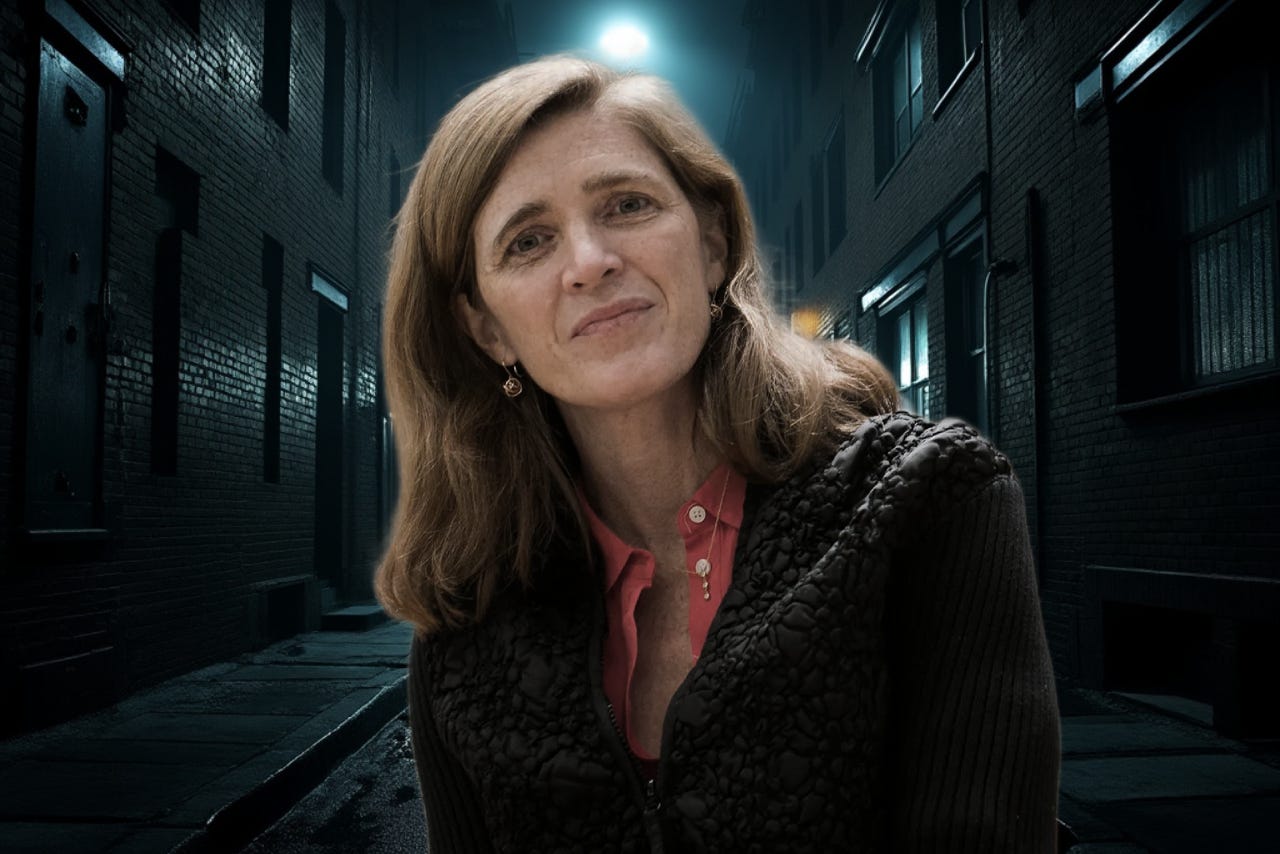
This is the first in a series of biographical exposés titled The Usual Suspects, available in a library form to premium members. The purpose of these exposés is to put faces and names to the shadowy apparatus of the Deep State. When we understand who they are, we are better able to expose their actions and the damage they do to our Republic.
Samantha Power, an influential figure in American foreign policy, has often been critiqued for her ideological leanings that many argue veer into neo-Marxism and globalism, with a particular disdain for traditional American values and nationalism.
As a former US Ambassador to the United Nations under the Obama administration, Power has championed policies that critics claim prioritize internationalist agendas over American sovereignty. Her advocacy for interventions in foreign conflicts, often framed within a narrative of humanitarianism, is seen by detractors as a mask for promoting global governance structures that diminish US autonomy.
Her writings and public statements frequently emphasize the need for America to atone for past actions, a stance perceived by some as an implicit critique of American exceptionalism and an embrace of a worldview where national interests are subservient to a globalist ideology that seeks to redistribute power and influence on an international scale. This perspective has led to accusations that her policies and rhetoric subtly undermine the foundational principles of American identity and strength.
Background & Career
Samantha Power, born in 1970 in Ireland, immigrated to the United States at the age of 9. She earned her law degree from Harvard Law School in 1999. Her career has spanned journalism, academia, and government service.
Power's most notable work includes her Pulitzer Prize-winning book, "A Problem from Hell: America and the Age of Genocide," which examines the United States' response to genocide.
She served in several roles within the Obama administration, notably as US Ambassador to the United Nations from 2013 to 2017. After leaving government service, she returned to academia as a professor at Harvard Kennedy School and Harvard Law School.
Power's husband is Cass Sunstein known for his work in constitutional law and behavioral economics. He has served in various governmental roles, including as Administrator of the White House Office of Information & Regulatory Affairs under President Barack Obama. He is the author of “Nudge,” a book centered on the use of psyops for political purposes.
Power’s Tenure With USAID
Power's tenure as head of the United States Agency for International Development (USAID) from 2021 to 2025 has been marked by significant controversy and criticism, reflecting on her leadership style, policy priorities, and the agency's direction under her stewardship.
Power's appointment was contentious from the start, given her previous roles under the Obama administration, notably as UN Ambassador, where she was accused of being involved in the "unmasking" of Trump officials, raising concerns about political bias. Her tenure at USAID was seen by critics as an extension of this political maneuvering, with allegations of using the agency as a "slush fund" for liberal priorities, as noted in various posts on X. This perception was fueled by her interactions with influential liberal foundations, including meetings with George Soros' Open Society Foundations and the Bill and Melinda Gates Foundation, which critics argue might have influenced USAID's agenda.
Critics have pointed out that under Power's leadership, USAID's funding was directed towards programs that some viewed as politically motivated rather than purely developmental. For instance, there were claims of funding for the Wuhan Institute of Virology and supporting LGBT programs in countries with conservative views on such issues, suggesting an imposition of a particular ideological framework rather than focusing solely on aid effectiveness or recipient nations' priorities.
Financial mismanagement has been a recurring theme during Power's time. The agency was accused of not only reckless spending but also potential corruption, with a notable example being the diversion of US aid to terrorist groups in Syria. Senator Tom Cotton's (R-AR) concerns about the misuse of aid in Gaza further underscore the criticisms regarding financial oversight and accountability during her tenure.
Power aimed to leverage USAID for strategic competition against China and Russia, yet her tenure saw increased propaganda from these nations against USAID, suggesting that her strategies might not have been as effective as intended. Her focus on integrating USAID into the National Security Council's framework was seen by some as an attempt to politicize aid, potentially at the expense of development goals.
As Power prepared to hand over the agency to the Trump administration, her legacy was framed by some as having turned USAID into a tool for "geopolitical projects" rather than humanitarian aid. Her departure was marked by the placement of all USAID direct hire personnel on administrative leave, except for essential staff, signaling a significant overhaul or re-evaluation of the agency's direction.
In summary, Power's leadership of USAID has been criticized for being politically charged, potentially mismanaging funds, and not effectively navigating the complex landscape of international aid and diplomacy. Her tenure is seen by many as one where ideological battles overshadowed the core mission of USAID, leading to internal and external tensions, and undermining the agency's global reputation and effectiveness.
Political Philosophy
Samantha Power's political philosophy, particularly as articulated through her writings and actions, is rooted in a blend of idealism and liberal interventionism, which has drawn significant critique from various quarters.
Power's early work, most notably her Pulitzer Prize-winning book "A Problem from Hell: America and the Age of Genocide," showcases a fervent idealism, in which she argues passionately for the US to take an active role in preventing and responding to genocides, emphasizing the moral imperative of "Never Again."
Critics argue that her idealism often lacks a nuanced understanding of realpolitik. Some see her advocacy for military intervention as a solution to human rights crises as overly simplistic, ignoring the complex geopolitical, cultural, and historical contexts that cannot be neatly resolved by external military force. The transition from her critique of US inaction in "A Problem from Hell" to her role in the Obama administration, where she often defended inaction or minimal action in crises like Syria, underscores this critique.
Power championed the concept of humanitarian intervention, advocating for the use of American military power to halt atrocities. Her philosophy here intertwines with the Responsibility to Protect (R2P) doctrine, which posits a collective international responsibility to intervene in cases of severe human rights violations.
The application of her ideas, particularly in cases like Libya, where intervention led to long-term instability, has been criticized for its naivety regarding the aftermath of such interventions. Her support for military actions has been labeled as militaristic by some, suggesting that her solutions might replace one "Hell" with another. There's an argument that her approach might bolster US military hegemony under the guise of humanitarianism, potentially serving strategic interests rather than purely ethical ones.
As a human rights advisor and later as UN Ambassador, Power transitioned from an outsider critic to an insider policymaker. Her influence was evident in policy decisions like the intervention in Libya, which was initially framed as a humanitarian mission but led to significant chaos.
Some have seen the shift from critiquing US policy to defending it under Obama, even when outcomes were less than ideal, as a compromise of her initial ideals for political expediency. Her memoir "The Education of an Idealist" is critiqued for presenting this transition as a learning curve rather than an ideological shift, which might obscure the less flattering realities of policy implementation.
Power's approach has been accused of moralism—a fervent belief in the moral superiority of one's own actions, which can sometimes ignore the nuanced morality of outcomes. Critics point out that while her intentions might be noble, the execution often falls short of moral expectations due to political and practical constraints.
There's a contention that her philosophy, while rooted in human rights, often fails to grapple with the unintended consequences of intervention or the legitimacy of state sovereignty versus international action. Her tenure is sometimes seen as emblematic of how liberal interventionism can morph into a rationale for maintaining US global dominance under a human rights banner.
Power's journey from a critic of US foreign policy to a key figure in its implementation shows a side where idealism meets the harsh realities of governance. This transition has led to accusations of hypocrisy or, at least, a significant dilution of principles once faced with the complexities of power. Her own admission in later writings about the over-reliance on military force in US foreign policy reflects an acknowledgment of these criticisms, but perhaps too late for those affected by policies she supported.
In summary, Samantha Power's political philosophy is one of liberal interventionism cloaked in idealism, which has been critiqued for its potential to justify American military actions under humanitarian pretexts, its sometimes myopic focus on intervention without adequate post-conflict planning, and the ideological compromises made when transitioning from critique to policy implementation. Her work has significantly shaped debates on U.S. foreign policy but also invites scrutiny for its practical outcomes and philosophical consistency.
Notable Quotes About Samantha Power
"When US gov't mouthpiece The New York Times says Samantha Power is an 'unabashed human rights and democratization activist,' it means unabashed war hawk who uses these as excuses to bomb the world.
— Ben Norton, journalist and analyst on geopolitics, international political economy, and US foreign policy
"Samantha Power advocated for the bombing of Libya. Samantha Power supported the Saudi-led war on Yemen. Samantha Power encouraged US intervention in Syria."
— CodePink
“On her influence in the Obama administration: "A big role in BOs foreign policy disasters.”
— X influencer C3
"A RADICAL Leftist... Illegally unmasked 100s of Americans in 2016. Part of the COUP & needs to be punished.
— X influencer C3
Conclusion
In summary, Samantha Power has carved out a controversial career marked by a blend of idealism and perceived hypocrisy.
Rising to prominence with her Pulitzer Prize-winning book "A Problem from Hell," which critiques the US response to genocides, Power initially positioned herself as a critic of US foreign policy inaction. However, her subsequent roles within the Obama administration, including as US Ambassador to the United Nations, have been seen by critics as a departure from her earlier stances.
At the UN, she was accused of selectively championing human rights, notably silent or supportive of actions by allies like Saudi Arabia, while vocally condemning adversaries.
Her tenure has been criticized for endorsing policies that arguably contributed to crises, such as in Libya and Syria, where the outcomes contradicted her advocacy for humanitarian intervention.
Power's shift from outsider critic to establishment figure has led to accusations of pragmatism over principle, with her influence seen more in bureaucratic maneuvering than in substantive policy change.
Her role in the US Agency for International Development (USAID) under Biden further cements this image, where critics argue her efforts are overshadowed by broader US strategic and special interests rather than genuine humanitarian outcomes.


