

From the sands of Arabia to the blood-soaked streets of Beirut, Baghdad, Damascus, and beyond, the Middle East has known little peace for fourteen centuries. The primary engine of this perpetual violence has not been some abstract clash of civilizations or external meddling alone, but Islam itself and the devout who take its commands literally.
While apologists twist history into pretzels of moral equivalence, the record is clear: Islam was forged in war, spread by the sword, and sustained by doctrines that sanctify domination over the unbeliever. This is no aberration; it is the faith’s founding dogma.
Even during the lifetime of Muhammad, Islam revealed itself as a religion of violent conquest. The Prophet’s early Meccan period emphasized preaching amid persecution. Yet once he migrated to Medina and gained military strength, the revelations shifted decisively toward jihad.
Muhammad’s forces fought the Battle of Badr in 624 CE, raided caravans, and conquered Mecca in 630. The Ridda Wars, immediately after his death, crushed apostate tribes, enforcing submission. Islamic armies then swept out of Arabia, toppling the Sassanid Persian Empire and seizing vast Byzantine territories by the mid-7th century. North Africa, Spain, and parts of India followed in rapid, brutal succession. These were not defensive struggles but campaigns of expansion explicitly justified by faith. Mosques rose on the ruins of churches, synagogues, and Zoroastrian temples. Populations faced conversion, jizya tax, or death.
The Quran itself provides the doctrinal fuel—and the plausible deniability Islamists exploit:
Surah 9:5 – the “Sword Verse,” commands: “When the sacred months have passed, kill the polytheists wherever you find them and capture them and besiege them and sit in wait for them at every place of ambush. But if they should repent, establish prayer, and give zakah, let them [go] on their way.”
Surah 9:29 – “Fight those who do not believe in Allah or in the Last Day and who do not consider unlawful what Allah and His Messenger have made unlawful and who do not adopt the religion of truth from those who were given the Scripture—until they give the jizyah willingly while they are humbled.”
Apologists cite earlier Meccan verses calling for patience, such as 2:256 (“There is no compulsion in religion”), to claim Islam is peaceful. Yet the mechanism of naskh—abrogation—renders this hollow. Later Medinan verses, revealed amid conquest, supersede the earlier ones. Classical Islamic scholarship, from Ibn Kathir to modern Salafists, affirms this hierarchy. The words are Allah’s verbatim, eternal, and unchallengeable.
This literalism explains why so many in the Islamic world pursue religious advancement through violence. Unlike the great Western traditions—Christianity and Judaism—which evolved beyond scriptural calls to holy war, mainstream Islam clings stubbornly to its founding text.

The Gospels record Christ rebuking violence (“Put your sword back into its place. For all who take the sword will perish by the sword,” Matthew 26:52). Centuries of Christian history include crusades and inquisitions, yet the faith ultimately abrogated temporal conquest as a religious duty. Enlightenment values and secular governance further distanced the West from theocratic expansion.
Islam, by contrast, enshrines Muhammad as the perfect model (uswa hasana). His wars, executions of critics like the poets of Banu Qurayza, and subjugation of non-Muslims remain exemplary. The infidel—kafir, one who covers or conceals truth—embodies rejection of Allah’s final revelation. Quranic contempt for kafirs (e.g., 98:6, calling them “the worst of creatures” destined for Hell) justifies perpetual hostility.
Where Western religions internalized reform, Islam’s orthodox streams—Sunni and Shia alike—treat the Quran as an immutable blueprint. This produces generations primed for jihad, from the early caliphates to the Ottomans’ devshirme and genocides, to 20th-century Arab nationalism laced with Islamist revival, to today’s Hamas, Hezbollah, ISIS, Houthis, and other Iranian proxies.
The body count across the region—Armenian Genocide, Assyrian massacres, Lebanese civil war, endless Israel-Arab conflicts, Iraq-Iran war, Syrian slaughter, Yemen’s proxy fights, Sudanese jihads—reveals a pattern. Sectarian Sunni-Shia bloodshed, honor killings, blasphemy mobs, and terrorist spectaculars flow from the same well: a worldview dividing humanity into Dar al-Islam (house of submission) and Dar al-Harb (house of war). Peace exists only where Islam dominates or where Muslims are too weak to enforce supremacy. Treaties and truces are tactical, per the Prophet’s example at Hudaybiyyah.
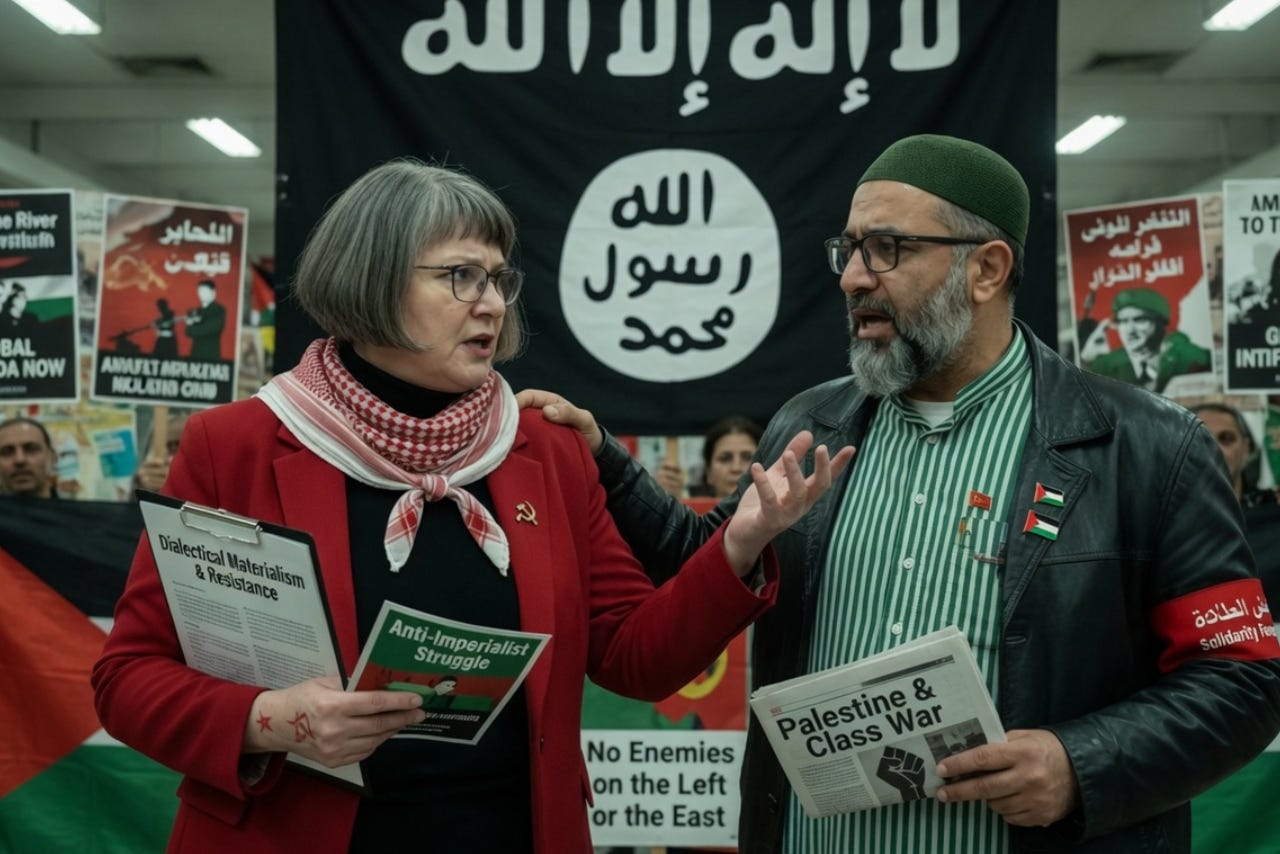
Far-Left activists protesting Israel grasp none of this. Their “Red-Green” alignment—socialists and Islamists marching together—rests on profound ignorance. They frame every conflict through colonial guilt, ignoring that Islamic imperialism predates and outlasted European empires. They champion “resistance” without acknowledging that Hamas’s charter, Hezbollah’s ideology, and Palestinian rejectionism recycle Quranic anti-Jewish tropes (e.g., 5:60, apes and pigs; hadiths on killing Jews hiding behind rocks).
This coalition is suicidal. Islamists tolerate useful idiots only until power is seized. History in Iran in 1979, Afghanistan, and every Islamist enclave shows the pattern: leftists, feminists, and secular liberals are among the first liquidated or forced into subservience—veiled, dhimmi, or dead. The Green swallows the Red.
None of this depends on one’s view of Israel, Zionism, or Judaism. Israel is a liberal democracy defending itself amid enemies sworn to its destruction. Yet the deeper truth stands independent: Islamists remain the primary source of generations of regional violence and death. From Muhammad’s era through the Umayyads, Abbasids, Mamluks, Ottomans, to modern theocracies and jihadi groups, the ideology of supremacist conquest persists.
Apologists invoke poverty, colonialism, or “geopolitics,” yet Muslim-majority societies untouched by those factors—Gulf petro-states, Pakistan—export terror and intolerance. Where Islam encounters weakness, violence follows. Where it encounters strength, it retreats only to regroup.
Reformers do exist, as do peaceful Muslims. But they swim against fourteen centuries of orthodoxy. Until the Islamic world confronts its scriptural roots in conquest and discards literalist abrogation, the cycle will continue.
The blood on Middle Eastern sands testifies not to endless victimhood, but to a faith that refuses to sheathe its sword. The region’s future hinges on whether its people choose submission to ancient commands or embrace something closer to genuine coexistence. History suggests the former remains far more probable.


