

The idea of globalism is often demonized because it is misunderstood. It is misunderstood because two different demographics with incredibly different mindsets on the concept pursue two very different goals. One of those demographics uses the clouded, dual-meaning of the word to obfuscate in its quest for power; for global control.
Truth be told, there are two approaches to the idea of globalism. One centers on economic globalism or the laissez-faire approach to the free market. The other centers on the establishment of control and, through that, the acquisition of power.
To be certain, one is good and the other is bad. Economic globalism, when balanced and free from manipulative government intervention, is good. Political globalism is bad, very bad.
Get To Know Ludwig von Mises
The differentiation between economic and political globalism was put succinctly in the article, The Difference Between Good Globalism & Bad Globalism, by Ryan McMaken of the Mises Institute, an organization that teaches about the Austrian School of Economics (laissez-faire free market politics as opposed to the failed Keynesian economic theory):
“It’s essential to make these distinctions. Economic globalism brings wealth. Political globalism brings poverty.
“Economic globalism is about getting government out the way. It’s about laissez-faire, being hands-off, and promoting the freedom to innovate, trade, and associate freely with others. Political globalism, on the other hand, is about control, rules, central planning, and coercion.”
Of course, there are elements and variables to each approach to globalism that make it more or less capable of achieving those ends, but as a rubric this is a good way to juxtapose the two mindsets.
McMaken goes on to say:
“...economic globalism is a force for enormous good in the world, but political globalism is primarily a tool for increasing the power of states.
“As to economic globalism, we can see that again and again that the free flow of goods and services, unimpeded by states, improves international relations and increases standards of living. Where governments have increasingly joined the ‘globalized’ economy, extreme poverty declines while health and well being increases. Latin American states that have embraced trade and freer economies, for example, have experienced growth. Those states that stick to the regimented economies of old continue to stagnate. These benefits, however, can be – and have been – achieved by decentralized, unilateral moves toward free trade and deregulated economies. No international bureaucracy is necessary.
“This is economic globalization: opening up the benefits of global trade, entrepreneurship, and investment to a larger and larger share of humanity.
“Meanwhile, political globalization is an impediment to these benefits: Political globalists at the World Health Organization, for example, spend their days releasing reports on how people shouldn't eat meat and how we might regulate such behavior in the future. Political globalists hatch new schemes to drive up the cost of living for poor people in the name of preventing climate change. Meanwhile, the World Bank issues edicts on how to ‘modernize’ economies by increasing tax revenues – and thus state power – while imposing new regulations.”
One Theory That Has Failed In Dramatic Fashion
Political globalists insist that the commingling of economies through free trade to the point of dependence is an incentive to avoid conflict. In a purest adherence to the theory it is a plausible point. But in reality it cannot exist.
In 2004, Erich Weede, a professor of sociology at the University of Bonn in Germany, insisted, “Critics of globalization forget that free trade fosters prosperity and know almost nothing about its most important benefit – its tendency to prevent war.”
In 2009, Jong-Wha Lee, the head of the Asian Development Bank’s Office of Regional Economic Integration, stated, “...an increase in bilateral trade interdependence reduces the probability of inter-state military conflict between the two partners.”
They based their beliefs on a study that examined inter-state military conflict between over 200,000 country pairs from 1950 to 2000. That study concluded that “the higher the interdependence in bilateral trade between the country partners, the lower the chance of military conflict.”
What Prof. Weede and Mr. Lee both fail to calculate into the equation are both human nature and human history.
The two deadliest and most destructive wars in history – World War I and World War II, saw nations with strong economic ties clash on the battlefields of Europe. Germany and Britain were deeply economically interdependent prior to both conflicts. If interdependency through trade were a viable concept it would have made the idea of war between the two nations unthinkable.
Yet, within a few years after the turn of the 20th Century, Britain and Germany were engaged in battle in the First World War. Just 20 years later, the two powers would again engage in bloody conflict. To conclude that globalization and increased bilateral trade leads to peace simply doesn’t bear out according to history.
Another reason to demand a return to teaching contemporary history – with fidelity to the facts and truth – in our schools, but I digress.
Political Globalism & The Power-Junkies
Dispensing with the debunked argument that global interdependence promotes peace, we can now view organizations like the United Nations, the World Economic Forum, and all of their many offshoot wannabe global governmental authorities (i.e The World Health Organization, the International Monetary Fund, The World Bank, The World Trade Organization, etc.) for what they really are: unelected, self-appointed potentates and toothless organizations that seek to establish a global government and one that necessarily circumvents the sovereignty and authority of nation states.
The original charter for the United Nations, according to History.com, exclusively tasked the organization to achieve four enumerated goals:
Maintain international peace and security;
Develop friendly relations among nations;
Achieve international cooperation in solving international problems; and
Be a center for harmonizing the actions of nations in the attainment of these common ends.
To say that the United Nations has failed on each of its charter objectives would be a grotesque understatement, yet the organization continues to expand and claim more authority for itself with each passing day.
In fact, at no time since its creation has the world been free of conflict for the efforts of the United Nations. In fact, their failure to quell conflict has actually seen the organization purposely ignore multiple genocides (*) and languishing conflicts between nations and factions around the world, including the:
Kashmir dispute (1948-Present)
Cambodian genocide (1975-1979)*
Somali civil war (1991-Present)
Bosnian genocide (1992-1995)
Rwandan civil war (1994)
Srebrenica Massacre (1995)
Massacres of Hutus (1996-1997)*
Effacer le Tableau, Democratic Republic of the Congo (2002-2003)
Darfur conflict in Sudan (2003-Present)*
Syrian civil war (2011-Present)
South Sudan conflict (2013-Present)
Genocide of Yazidis by the Islamic State (2014-2019)*
Rohingya Crisis, Myanmar (2017-Present)
Uselessness and incompetence appear to be the only things the unelected of the United Nations organization excel at.
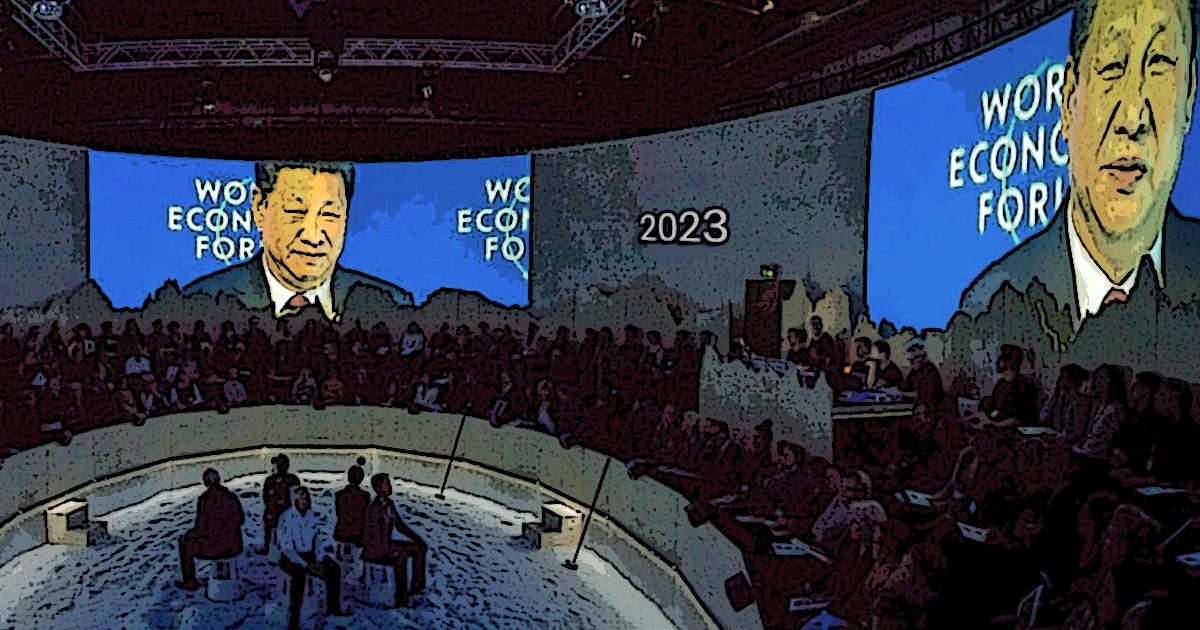
And then we have the snobbishly-arrogant elite global power-junkies of the World Economic Forum whose leader, Klaus Schwab (his father was a Nazi collaborator by the way, much like George Soros), introduces WEF members as “so many Kaisers,” asking “what does it mean to be masters of the future?”
These self-anointed “masters of the future” are not shy about what they want to achieve. Their mission statement, per their own website, is stated as:
“...committed to improving the state of the world by engaging business, political, academic, and other leaders of society to shape global, regional, and industry agendas.”
One of the ways they intend to “improve the state of the world” is to force the abandonment of true economic globalism. In fact, their bloodlust for global governmental power includes a future where “you’ll own nothing…and you’ll be happy.”
As I wrote in January of 2022:
“If we have learned nothing else from the last two years of COVID authoritarianism, we must all acknowledge that the political and global elite cannot be trusted to act in the best interests of anyone but themselves. This includes the greed-merchants and those addicted to control who count themselves among the Davos crew.
“The idea that an organization – helmed by the world’s most ruthless people and shopping a global economic revolution – would be, first of all, able to produce an unbiased report, and then likely to produce a report that is unbiased and not self-serving defies reality. In fact, it exhibits a debilitating naivety.
“The WEF’s Great Reset is an attempt by the global elites to transition from true capitalism to the Communist Chinese hybrid of Stakeholder capitalism…”
It’s All About Balance
While I believe that political globalism is, as they said in the movie Time Bandits, “pure concentrated evil” at every level and all of its efforts, I support a balanced, equitable, and unmanipulated system of global trade. But what do I mean by “Balanced”?
The United States – and in fact all the countries of the world – cannot be “dependent” on any other country; we cannot depend on foreign nations or entities to achieve a secure present and future for our country…ever.
We must be able to produce the food and medicine we need to survive during the worst of times. And we must be able to produce – domestically – any necessary tools of war for use in our defense. To exist in any other state is to exist as vulnerable to the nefarious forces of the world.
Not until we achieve a state of self-sufficiency should we be engaging in the foreign trade of those products and commodities that make us self-sufficient. Seeking self-sufficiency first and engaging in trade where the excess of those staples are concerned denies no one anything, yet protects our nation, again, during the worst of times.
That is balance in economic globalism and it is smart.
Today, the polluted notion of free trade is exemplified by the dependency the United States has in the continent of Asia and, specifically, our dependence on Communist China for products we need to maintain our way of life. This dependence includes a need for critical elements that go into producing our defense capabilities.
Additionally, as the political globalists celebrate the Communist Chinese economic model – a hybrid of Communism and Capitalism that not only allows for the coercive manipulation of people’s money and the worth of money in general, but also a disciplinary apparatus for social engineering, Communist China continues its practice of intellectual thievery at the corporate and governmental levels around the world and especially in the United States.
Yet the Communist Chinese are still courted by multinational corporations – some based in the United States – because of their emerging market even as those multinational corporations turn a blind eye to the slavery that fuels the Chinese economy, all while counting China among the members of another sovereignty-killing global government entity: the World Trade Organization, which has, ironically, also failed at its mission statement of producing prosperity for all.
So, I sign on to Mr. McMaken’s observation with a simple caveat. Balanced economic globalism is good. Political globalism is, well, just evil, plain and simple.


