

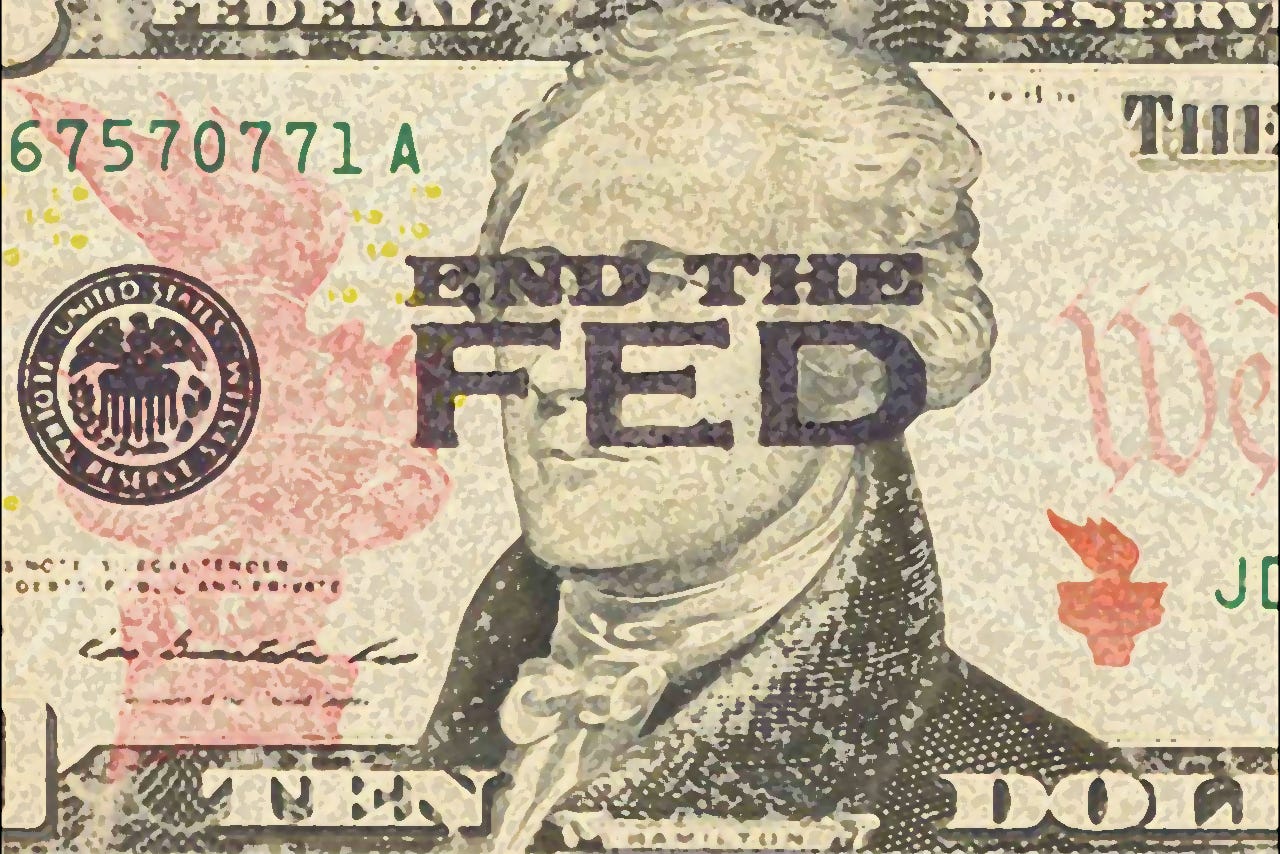
Since its establishment in 1913, the Federal Reserve System has been involved in numerous economic downturns and crises, leading some to argue that its very existence poses a threat to the United States' financial stability.
As we navigate through another inflationary crisis, one that is diminishing the value of Americans' savings and earnings, it is important to consider the role of the Federal Reserve (Fed) in our recurring economic crises and the feasibility of the increasing movement to abolish the Fed.
The Origins Of Central Banking
The concept of central banking dates back to the founding of the Bank of England in 1694. The bank's primary purpose was to provide inexpensive money to the British government, which it achieved through the hidden tax of inflation. By lending money it didn't have, the bank created an explosion of money in the British economy, leading to a boom-bust cycle that would become a recurring theme in the history of central banking.
Three central banks were established in the United States before the Federal Reserve: the First Bank of the United States (1791-1811), the Second Bank of the United States (1816-1836), and the National Banking System (1863-1913).
All three were eventually dismantled due to concerns over their potential for abuse and their negative impact on the economy.
The Creation Of The Federal Reserve
The Federal Reserve System was created in 1913 by a group of powerful bankers at a secret meeting on Jekyll Island, Georgia. The Fed was designed to provide stability to the US financial system by acting as a lender of last resort and regulating the money supply. However, since its inception, the Fed has been at the center of multiple boom-bust cycles and economic crises.
The Federal Reserve has faced significant criticism for its role in causing and worsening economic crises. The Fed's low interest rates contributed to the dot-com bubble of the late 1990s, the housing bubble of the 2000s, and the 2008 global financial crisis. These crises have had devastating consequences for millions of Americans, leading to job losses, foreclosures, and a significant decrease in the value of the US dollar.
Due to the Fed's response to the COVID pandemic, an "everything bubble" has emerged. This has led to stagflation and bank collapses as inflation rises and the financial system weakens.
Since its creation, the Federal Reserve has stolen 98 percent of the value of a dollar, using the profits to transfer trillions to the federal government, special interests, and wealthy borrowers. This has eroded the purchasing power of the average American, making it increasingly difficult for families to make ends meet.
The Movement To Abolish the Fed
In reaction to the Federal Reserve's harmful policies, Representative Thomas Massie (R-KY) has introduced the "Federal Reserve Board Abolition Act," also known as the "End the Fed" bill, which seeks to abolish the Federal Reserve System. This legislation aims to disband the Board of Governors and the Federal Reserve banks and to repeal the Federal Reserve Act.
Mr. Massie has criticized the Fed's monetary policies for record-high inflation and blamed the Fed for colluding with the executive and legislative branches, as well as Wall Street, for the financial problems Americans are now facing. If enacted, the bill will allow one year for the Fed to be shut down and will repeal the Federal Reserve Act.
In addition to the End the Fed bill, Mr. Massie has also introduced the Federal Reserve Transparency Act of 2023, which would require a full audit of the Federal Reserve. This would provide much-needed transparency and accountability for the Fed's operations and help prevent future economic crises.
The movement to abolish the Federal Reserve has garnered support from prominent economists and politicians, such as Milton Friedman and, more recently, Mohamed A. El-Erian and Argentine President Javier Milei.
Last year, Milei, an economist, made headlines with his promise during his presidential campaign to abolish the country's central bank. He called it "the worst garbage that exists on this Earth" and "one of the greatest thieves in the history of mankind."
These critics argue – and have argued – that the Fed's policies have been ineffective and that its existence poses a direct threat to the financial stability of the United States and the world.
As the Fed's policies continue to wreak havoc on the US economy, it is time for a serious discussion about the future of central banking and the possibility of a world without the Federal Reserve's destructive influence.


Take Back Your Mind
Think For Yourself