

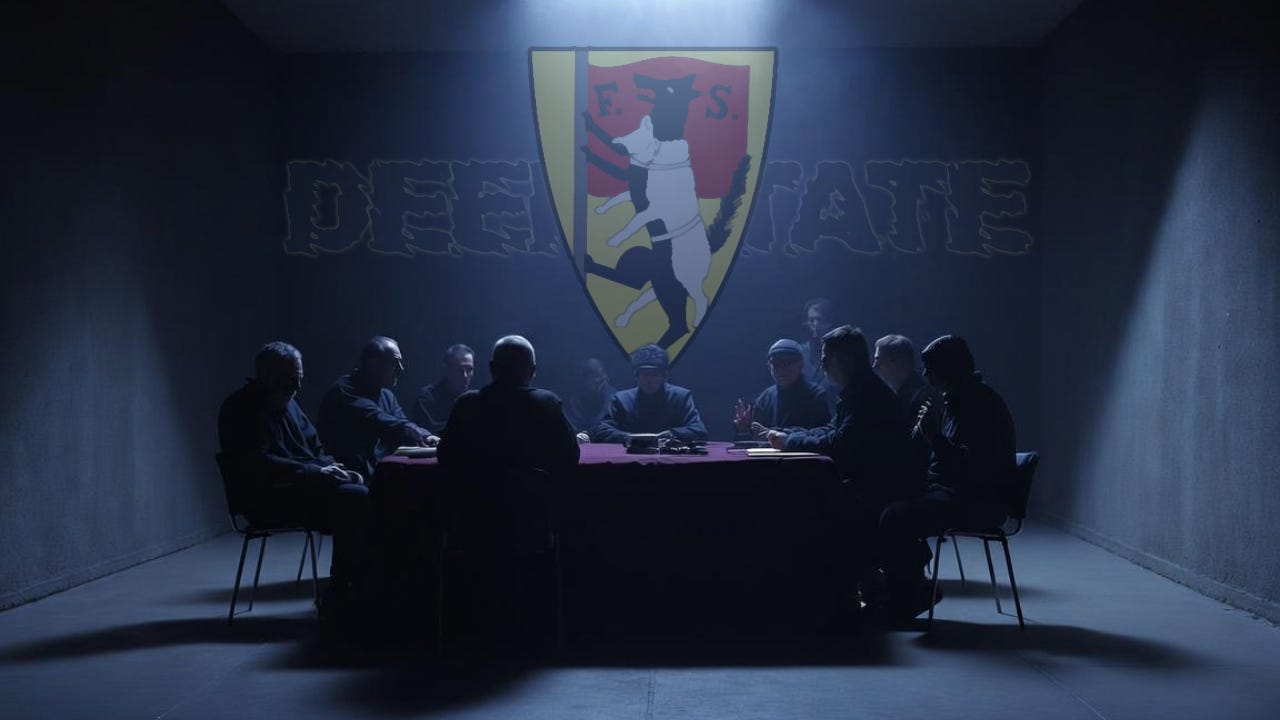
A century and a half ago, a cabal of elite British intellectuals arrogantly decided that the public was too ignorant to govern itself. They set out to strangle democracy—not through revolution, but by creating a patient, smiling bureaucracy of so-called “experts.” They called themselves the Fabian Society, adopted the wolf in sheep’s clothing as their emblem, and embarked on a mission to capture every institution that influences a free society. Their strategy worked so well that most Americans remain blissfully unaware that they are living under its sinister American incarnation: the Deep State.
The Fabian Society was founded in London on January 4, 1884, as a splinter group from the Fellowship of the New Life. Its early members included Sidney and Beatrice Webb, George Bernard Shaw, and Graham Wallas. They rejected the violent and dramatic approaches of Marxist revolution, opting instead for a more strategic method known as gradualism. Rather than attempting to seize power through force, they aimed to infiltrate the institutions responsible for running a country—such as schools, universities, the civil service, journalism, the legal system, and political parties—and slowly reshape society from within.
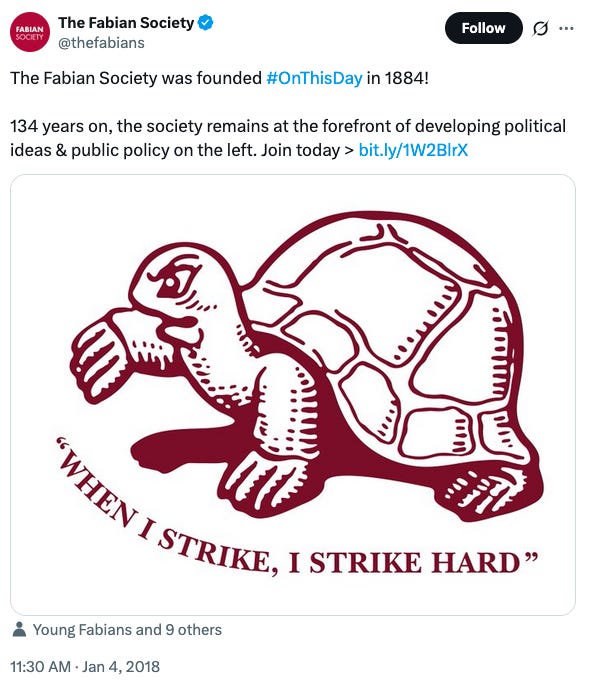
Their symbols reflected this approach. A tortoise represented patient, almost imperceptible progress. Their original coat of arms was even more revealing: it depicted a wolf in sheep’s clothing. Although that emblem was later discarded for public relations reasons, the underlying strategy of gradualism has persisted.

The Fabians recognized that elections are temporary, but institutions remain. Their aim was never simply to elect politicians who shared their views. Instead, they sought to train teachers, shape journalists, credential civil servants, advise bureaucrats, and redefine what the public would come to accept as normal
Over the decades, the “Society” became the intellectual driving force behind the British Labour Party. Almost every Labour prime minister since Clement Attlee has been associated with it. Britain’s modern administrative state—extending into healthcare, education, housing, energy, communication, and everyday economic life—was constructed over time, through committees, regulations, and generations of experts. This same approach spread outward through the English-speaking world and influenced the post-1945 international structure established by the United Nations and its specialized agencies.
That method crossed the Atlantic and found fertile ground in the Progressive Era. Woodrow Wilson, though never a formal member of the London society, became its most effective American apostle. He insisted that public administration must be professionalized and insulated from the messy accountability of elected representatives, senators, and even presidents. Experts, he argued, should draft the policies and write the regulations because modern society had grown too complex for mere politicians. Congress, increasingly content to outsource the hard work of legislation, obliged. The result was the steady transfer of real power from the people’s representatives to an unelected administrative class. What began as progressive reform metastasized into a permanent bureaucratic layer that answers primarily to itself.

In the United States, the Fabian Society has never needed its own flag. Its American counterpart is more commonly known as the Deep State: a complex network of career officials, regulatory agencies, influential foundations, university departments, and semi-independent commissions that continue to govern long after any specific election. This system doesn’t rely on overt socialist rhetoric. Instead, it functions through the same gradual tactics perfected by the original Fabians—through standards boards, accreditation bodies, civil service protections, and the quiet expansion of regulatory authority that was once solely held by Congress.
The far-left movements that identify as Progressive or Democratic Socialist are not independent phenomena. Instead, they serve as the public-facing, facilitating arm of the same broader initiative. Whether they promote ideals of “equity,” a climate emergency, or democratic socialism, their practical impact aligns closely with the goals of the Fabian program: to expand the administrative state, prioritize credentialed expertise over democratic consent, and gradually redefine private property, free speech, and individual rights as privileges granted by the managerial class. The Democratic Socialists of America and their progressive allies provide the energy and moral fervor, while the permanent bureaucracy offers continuity and institutional power. Together, they advance the long journey that Sidney Webb began along the “Fabian Freeway.”
True representative government, as designed by the Framers, is based on the idea that power is delegated for limited periods to officials who can be removed by voters. However, the concept of the “Deep State” undermines this idea. Increasingly, policy decisions are made by individuals who cannot be held accountable through elections, operating under frameworks that the public has never approved, and enforced by experts who view democratic opposition as a minor hurdle. Thus, restoring constitutional order requires more than just winning elections; it necessitates dismantling the bureaucratic machinery that has spent a century insulating itself from democratic processes.
The Trump administration has started to address the size and regulatory overreach of the administrative state, albeit to a limited extent. This is why the establishment, the permanent bureaucracy, and the far-left proponents react with intense hostility. They recognize that the Fabian agenda can only thrive when institutions remain controlled, and the public is distracted by partisan politics. By challenging these institutions directly, the real issues are brought to light.
The original Fabians were patient because they understood that institutions outlast politicians. The American response must be equally insightful: the only true victory is to restore genuine authority to the people’s elected representatives and diminish the unelected systems that have spent generations undermining it. Anything less leaves the tortoise still crawling toward the finish line.


