

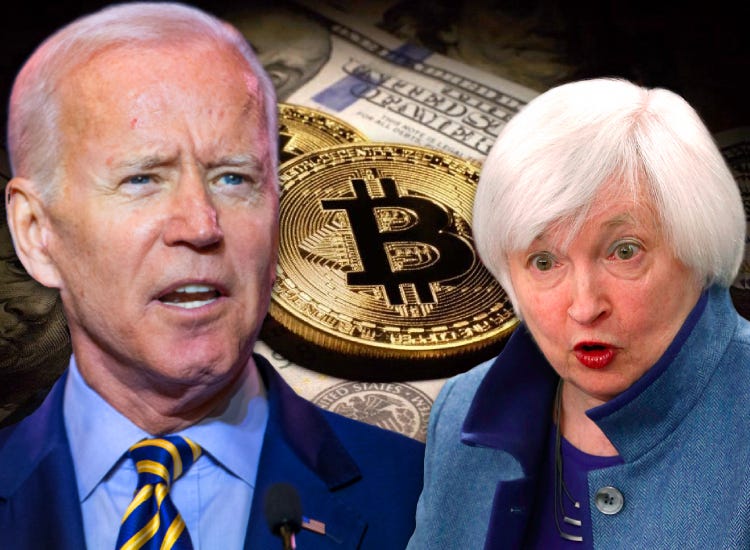
Cryptocurrencies and decentralized finance are striking fear into the souls of the financial elite. From the US federal government to the Federal Reserve and the Security & Exchange Commission, the International Monetary Fund to the World Bank, the manipulators of currencies and economies are in a terror about how cryptocurrencies threaten their dominions.
The US Securities & Exchange Commission (SEC), announced Tuesday that it has doubled the size of its Division of Enforcement’s unit. This unit is responsible for “protecting investors” in crypto markets and from cyber-related threats.
The expanded unit will focus on existing securities law violations because, as of yet, the SEC hasn’t any concrete regulatory structure – and as far as many can see, authority – over the crypto markets. Yet, the new unit’s purview will encompass crypto asset offerings, crypto exchanges, lending, and staking products, decentralized finance platforms, non-fungible tokens (NFTs), and stablecoins.
“By nearly doubling the size of this key unit, the SEC will be better equipped to police wrongdoing in the crypto markets while continuing to identify disclosure and controls issues with respect to cybersecurity,” SEC Chair Gary Gensler said.
Ali Khawar, Acting Assistant Secretary of the Labor Department’s Employee Benefits Security Administration issued a less than free-market warning about Fidelity Investments’ decision to allow investors to put up to 20 percent of their 401(k) savings and contributions into Bitcoin.
Khawar explained the Labor Department believes (speaking as if it is a living being) that Fidelity allowing savers to put Bitcoin into their 401(k) accounts risks the retirement security of Americans. “The US Department of Labor has serious concerns about Fidelity’s decisions to expose participants to direct investments in cryptocurrencies or related products, such as NFTs, coins, and crypto assets,” he said.

The Executive & Legislative Branches Attempt To Co-Opt The Sphere
In January, US Rep. Jim Himes (D-CT), joined in introducing the America COMPETES Act, which – in the fine print of the bill – gave the least educated public official on cryptocurrencies, US Treasury Secretary Janet Yellen, “unchecked and unilateral power” to ban cryptocurrency transactions.
Jerry Brito, executive director of Coin Center, a crypto advocacy organization, said of the proposed legislation, “If adopted into law...It empowers the Secretary to prohibit any (or indeed all) cryptocurrency transactions – or any other kind of transaction – without any process, rulemaking, or limitation on the duration of the prohibition.”
In March, President Biden signed an executive order on government oversight of cryptocurrency that urges the Federal Reserve (the Fed) to explore whether the central bank (not a direct ward of the US federal government as you will find out later) should jump in and create its own digital currency.
His order also directed the US Treasury Department and other federal agencies to study and report on the impact of cryptocurrency on financial stability and national security.
The Concern Is International As Well
The International Monetary Fund (IMF) is unwittingly transparent in its desperation to co-opt and control the cryptocurrency sphere.
Shortly after El Salvador adopted Bitcoin as its official currency of legal tender, the IMF issued panic warnings about how the crypto sphere is in immediate need of comprehensive international regulation.
According to three “analysts” from the IMF – as written in an issued white paper, there is justification for the IMF to assume regulatory control over the crypto sphere because cryptocurrencies’ “cross-sector and cross-border financial transactions” limit the effectiveness of national approaches.
The paper concluded that there is "an urgent need for cross-border collaboration and cooperation to address the technological, legal, regulatory, and supervisory challenges,” inferring that only the IMF was equipped to establish such a “comprehensive, consistent, and coordinated regulatory approach to crypto.”
The authors added, “But if we start now, we can achieve the policy goal of maintaining financial stability while benefiting from the benefits that the underlying technological innovations bring.” (emphasis mine)
Even in the face of country after country moving toward accepting the crypto sphere as a mainstay, the IMF continues to saber-rattle doom.
After the Central African Republic announced its adoption of Bitcoin as legal tender, an IMF spokesman said, “The adoption of bitcoin as legal tender in the Central African Republic raises major legal, transparency, and economic policy challenges.”
And the World Bank – joined at the hip with the IMF – is no different.
The unelected, non-representative world financial institution heads refused to engage with El Salvador after its adoption of Bitcoin as legal tender saying it couldn’t support the move due to “environmental and transparency” concerns.

The FED: Not What You Think It Is
It is incredibly important for people to understand that the US Federal Reserve, and the Federal Deposit Insurance Corporation (FDIC), and not part and parcel of the US government. They are a creation of the private sector banking system and are a congressionally sanctioned private-public abomination.
The Fed serves the US banking community, not the people of the United States. Every decision they make is to the benefit of the banks, not the American people. This sheds light on the reasoning for a plethora of actions – and inactions – executed (or not) by the central bank.
In 1910, six people, representing a full quarter of the world’s wealth, assembled for a hyper-secret meeting at Jekyll Island, Georgia, to discuss the creation of the country’s first central bank. Those six people were:
Nelson Aldrich: Republican US Senator from Rhode Island (Rockefeller) and Chair of the National Monetary Commission
A. Piatt Andrew: Assistant Secretary of the Treasury and Special Assistant to the National Monetary Commission
Henry Davison: Senior Partner at J.P. Morgan (Chase)
Benjamin Strong: Vice President of Bankers Trust and First Federal Reserve Bank Governor of New York
Frank Vanderlip: Former Assistant US Treasury Secretary & President of National City Bank (Citibank)
Paul Warburg: Partner at Kuhn, Loeb & Co. (Lehman Brothers) and Board Member of the Wells Fargo & Company
They established five goals for their new private-sector institution:
Stop new banks from threatening their business
Obtain the right to create money out of nothing
Get control over all banks’ reserves so that reckless ones wouldn’t be exposed and cause panic in other banks
Convince Congress that this was done for the “public good”
Set up a taxpayer-funded safety net to shield them against any incurred losses
Everything they sought to accomplish came to fruition in the Federal Reserve Act, signed into law by none other than Woodrow Wilson, the first truly fascist US president.
The Federal Reserve Act created a system of private and public entities consisting of regional Federal Reserve banks with various branches, a board of directors, and district boundaries. Governing this private-public partnership (a specific tool of fascism) is the Federal Reserve Board, consisting of seven members, each appointed by the President and confirmed by the US Senate.
Also created was a 12-member Federal Advisory Committee (non-binding) and a single new United States currency: the Federal Reserve Note (US Dollar).
Under the authority created by Congress through the Federal Reserve Act, all nationally chartered banks were/are required to become members of the Federal Reserve System and were/are required to purchase specified non-transferable stock in their regional Federal Reserve banks. They are also required to set aside a specified amount of non-interest-bearing reserves with their authoritative regional reserve banks.
Since 1980, all depository institutions – regardless of charter – are required to set aside reserves with the Federal Reserve.

The Worth Of The Federal Reserve Note
In the beginning, the US Dollar (Federal Reserve Note) was rooted in the gold standard and then the gold exchange standard, the latter meaning the Fed guaranteed that all currencies pegged to the US Dollar (USD) had a fixed value in terms of gold.
But, in August of 1971, President Nixon closed the “gold window,” ending the ability of foreign governments to redeem dollars for gold (US citizens had that right stripped in 1933). This was primarily due to the Fed’s inflationary monetary policy during the 1960s. Foreign governments redeemed dollars for gold for their financial benefit and threatened exhausting US gold holdings. President Nixon decided to close the gold window, severing the final link between the US dollar and gold.
The removal of this restraint – needing to hold gold for redemption – allowed the Fed to engage in more flagrant inflationary monetary policy. This has led to the gradual – and sometimes abrupt – devaluation of the USD, the effects of which we are feeling today.
It can be argued, and rightly so, that because the USD is not tethered to anything tangible – like gold, silver, diamonds, or rubies, the Fed is really creating money out of thin are, and that means the entirety of the banking system’s financial basis is a creation, not a true valuation.
To that end it is important to understand that it isn’t that the prices of goods are going up, it’s that the USD – because of the Fed’s inflationary policies over the last 20 years – has been devalued in its ability to buy those goods.
Why The Establishment Hates Cryptocurrencies
Simply put, the financial elites – the Fed, IMF, the US Treasury, and the World Bank, chief among them – hate cryptocurrency because it is decentralized.
Decentralized finance, or “DeFi,” is the financial applications ecosystem being built with blockchain technology. DeFi protocols are built on public blockchains, the unmanipulatable basis for this new financial system.
These blockchains are run by thousands of nodes around the world – computers running the blockchain’s software – that are almost impossible to censor or stop. No centralized party or authority (read: the elite financial establishment entities) can unilaterally take control of funds or change the rules of the game.
The DeFi system removes the controls banks and other financial institutions have on money, financial products, and financial services.

A Very Elementary Explanation Of BlockChain
As explained by Investopedia (and this is one of the most user-friendly explanations I have come across):
“Cryptocurrencies use blockchain technology. A blockchain is a distributed and secured database or ledger...
“In the blockchain, transactions are recorded in blocks and then verified by other users. If these verifiers agree [testify, witness] to the transaction, the block is closed and encrypted, and another block is created that has information about the previous block within it.
“The blocks are chained together through the information in each proceeding block, giving it the name blockchain. Information in previous blocks cannot be changed without affecting the following blocks, so there is no way to alter a blockchain. This concept, along with other security protocols, provides the secure nature of a blockchain.”
Why The Fed, IMF, Treasury & World Bank Want To Kill Crypto
By now it has become apparent, or at least it should be, as to why people like Jerome Powell of the Fed, US Treasury Secretary Janet Yellen, and the IMF’s Kristalina Georgieva, take every opportunity to disparage cryptocurrencies. They can’t control it. The financial innovation strips them of their power over the people and forces – forces – the traditional banking system to own what it has done to the economy.
Cryptocurrencies, through the use of decentralized financial blockchain technology:
Eliminate the fees banks and other financial companies charge for using your money
Allow you to hold on to your money through the use of an owned digital wallet, eliminating your reliance on the banking institution “making available” your deposited funds
Opens up the world of finance and investment to anyone with an internet connection thus providing financial “equity” to every person on the face of the planet
Given the crippling diminishment of power and authority that decentralized finance and the crypto sphere represents to the power-greedy status quo, it’s no wonder they are nervous. It outs them as disingenuous when it comes to the idea that their actions are always to advance the “common good.” It makes it transparent that our government – and in fact, almost all governments of the world and the global economic cabal – is first and foremost a special interest-oriented entity for which the people come last.
I’d say decentralized finance and cryptocurrencies have come just in time.

Today’s Headlines
Domestic Terror-Leaning Abortion Rights Group Doxxes SCOTUS Justices; Offers Stipends For Protests
Imbecile Schiff: ‘Codifying Roe Isn’t Enough; We Must Expand the Court’
Ohio Senate Dem. Candidate Tim Ryan Won’T Accept Any Limits On Abortion, Even Late-Term
Biden Disinformation Czar Dismissed Fears Of Critical Race Theory In Schools As 'Disinformation'
Musk's $44 Billion Twitter Buyout Faces FTC Antitrust Review
Dow Drops 1,000+ Points, Nasdaq Down 4.6%, As Fed Scrambles To Correct Its Mistakes
Lawmakers, SEC Commissioner Slam Chair Gensler For Focusing On Crypto Enforcement
IMF Expresses Concern Over Central African Republic’s Bitcoin Adoption
Australia Pledges $2 Billion Into XL-Sized Underwater Drones Amid Beijing Threat
Judge Rips Wisconsin 2020 Election Investigator For Destroying Records
After Outcry, Administration Ditches Plan To Send VA Staff To Help At Border
Doctors File Civil Rights Lawsuit Against HHS Over ‘Anti-Racism’ Incentives In Healthcare Industry
Lawmakers Want Updates To TV Rating System Citing Disney’s LGBT Contents For Children
Oregon Forces All Schools – Elementary And Up – To Put 'Menstrual Products' In Boys' Bathrooms
