

🎧 LISTEN TO THIS ARTICLE ON THE SUBSTACK APP
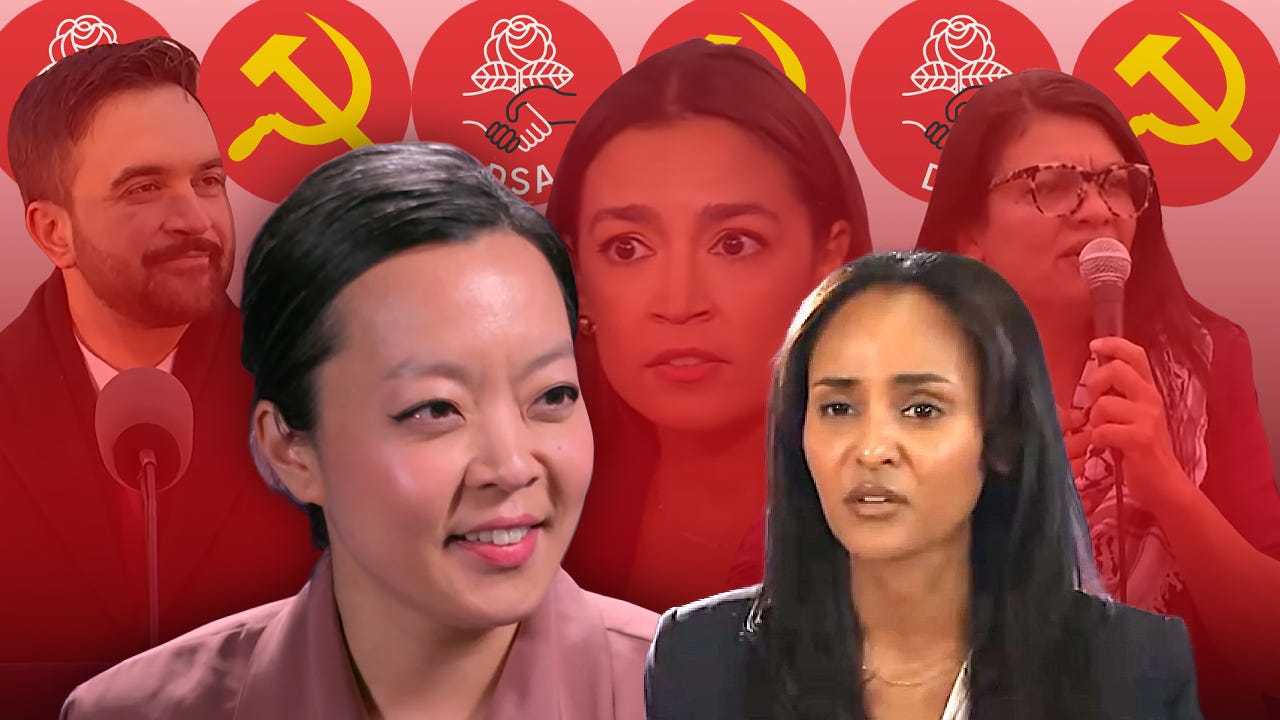
Many members of the Democratic Socialists of America (DSA) proudly claim dual membership in the Democrat Party. They run for office as Democrats, join forces with Democrats, and accept the party’s branding, fundraising capabilities, and institutional support. However, the DSA maintains its own distinct party platform—one that isn’t merely a slight variation on mainstream liberalism but rather a complete rejection of the constitutional order, market economy, and national sovereignty that even traditional Democrats once defended.
This situation isn’t an example of coalition politics; it resembles ideological occupation. The question is no longer whether this arrangement is coherent; rather, it is when Democrat leadership will finally acknowledge that their so-called “big tent” has collapsed into a self-destructive alliance and sever the ties that are gradually undermining the party’s credibility and the country’s stability.
The power imbalance is crucial. The DSA relies on the Democrat Party far more than the Democrats rely on the DSA. Without access to the Democrat ballot line, donor networks, media amplification, and institutional support, the DSA would diminish to what it fundamentally is: an insignificant fringe group with minimal influence. Its membership constitutes only a small fraction of the broader electorate, and its most idealistic messages tend to poll poorly outside of activist circles.
The DSA’s candidates typically succeed by winning low-turnout primaries within the Democrat Party, rather than by convincing the general public of their ideas independently. If the Democrat Party were to sever ties and exclude the DSA, the organization would lose its primary means of relevance almost instantly. The fact that Democrat leaders have not taken this step either indicates significant weakness or an underlying complicity.
The DSA is transparent about its ambitions. Its platform calls for the abolition of capitalism, the nationalization or social control of major industries, and open borders as a principle. It also advocates for the defunding and eventual dismantling of policing as it currently exists, as well as a foreign policy that sees the United States as a primary obstacle to global justice rather than a guarantor of it. These objectives aren’t even remotely aligned with the goals of the New Deal or the Great Society. Instead, they reflect a Marxist movement that views the American founding as a crime and considers liberal democracy merely a temporary obstacle. When DSA members win Democrat primaries and promote these positions under the Democrat label, they’re not expanding the party; they’re effectively hollowing it out from within while depending entirely on the party’s structure to achieve their aims.
Democrat leadership pretends that this is manageable diversity, but it isn’t. A party that claims to represent working-class Americans seeking secure borders, rising real wages, and safe streets can’t also accommodate a faction that treats those same voters as the enemy. Every time party leaders refuse to draw a clear distinction, they signal that the DSA priorities—whether related to crime, energy, gender ideology, or Israel—will be prioritized over mainstream concerns.
The outcome is predictable: policy positions alienate the very voters that Democrats once relied upon, followed by surprise when those voters defect. The party bears the political cost while the fringe retains a pseudo-moral high ground it could never achieve on its own.
The practical consequences of recent policies are already becoming apparent. Cities and states led by progressive Democrats and their DSA allies have implemented soft-on-crime measures, sanctuary policies, and expansive welfare programs that attract illegal immigration. The negative effects—such as increased disorder, strained public services, and diminished trust—are disproportionately felt by the working-class and minority communities that Democrats claim to support.
At the same time, this ideological group advocates for strict climate policies that drive up energy costs and impose manufacturing restrictions, leading to job losses. They do all this while lecturing the public about equity. This reflects a systematic prioritization of ideological purity over tangible results, enabled by the Democrat Party’s endorsement of a movement that would otherwise remain marginal.
The “big tent” rhetoric once served a purpose. It allowed Democrats to unite Cold War liberals, pragmatic labor leaders, and moderate civil rights advocates under one umbrella while competing for power. That tent is now gone. What exists today is a coalition where the activist Left sets the moral standards, and the institutional party provides the votes and funding. Primary challenges, donor pressures, and social media enforcement ensure that dissenters on issues like immigration enforcement, biological sex in sports, or support for Israel are treated as heretics rather than legitimate members of the coalition. The party’s leadership has consistently opted for accommodation instead of confrontation, believing that the energy and organization of the socialist Left outweigh the potential electoral risks.
This calculation becomes more reckless with each election cycle and is increasingly unnecessary, considering how little the DSA actually contributes compared to the damage they cause.
The idea of severance isn’t a radical idea; it is the minimum requirement for intellectual honesty and political self-preservation.
A political party is defined by the principles it chooses not to abandon. If the Democrat Party refuses to abandon policies such as open borders, leniency toward crime, or the notion that acknowledging biological reality is an act of bigotry, then it has effectively adopted the Democratic Socialists of America framework in practice. Continuing to deny this reality only prolongs the damage.
Voters are aware of the disconnect between rhetoric and reality. They notice when Democrat officials fail to enforce immigration laws while simultaneously demanding more resources to address the consequences. They observe when the same voices that once defended free speech now support the cancellation of dissenting opinions. They are also aware when national security is compromised in favor of the preferences of an activist base that views American power as inherently illegitimate.
Democrat leaders still have the option to take a different approach. They could unequivocally state that the DSA platform is incompatible with the party’s responsibilities to the country. They could enforce party rules that prohibit dual loyalty to a competing ideological organization. They could focus on competence and results rather than the emotional satisfaction of radical posturing. Expelling the DSA wouldn’t create a crisis for the Democrats; rather, it would reveal the DSA’s true size and limited appeal.
The decision not to take this action isn’t neutral; it is an active choice to maintain the current arrangement, even as it distances the party from the average American voter and from the institutional norms that once limited Left-wing extremism.
The current arrangement is dangerous because it sacrifices long-term legitimacy for short-term activist energy, particularly for a faction that is dependent on the main party. A party that fails to manage its own extremes loses its ability to govern a diverse and economically driven republic. It becomes a platform for constant ideological conflict rather than a contender for power within a shared constitutional framework. The Democratic Socialists of America recognize this dynamic and take advantage of it. Meanwhile, Democrat leadership either doesn’t grasp this reality or has deemed the potential consequences as acceptable. Either scenario is problematic.
Until the Democrat Party’s leaders find the courage to take a definitive stance, the “big tent” approach will continue to serve as a cover for an ideological takeover by a faction that would otherwise be politically insignificant.
Democrat leaders know exactly what the DSA is and what it wants. Yet, they keep the arrangement anyway. That isn’t out of an abundance of caution or coalition-building, and it surely isn’t because they are “scared” of the radical Left. It’s cowardice dressed up as strategy, and it is accelerating the party’s irrelevance while the fringe rides free on its coattails.
The public already sees through the act. The only remaining question is how much further Democrats are willing to sink before they finally cut the dead weight.
A Note About Subscribing:
At Underground USA, we pride ourselves on being fiercely independent—we only answer to our readers. This independence allows us to tackle tough questions, dive deep into important topics that often get overlooked, and share essays and podcasts, like this one, without asking for anyone’s approval.
Free subscriptions help us connect with a wider audience. They are the vehicle for the wide dissemination of the message. Paid subscriptions are what keep us going. They fund our research, document requests, interviews, fact-checking, and give us the time to dig deeper than just the headlines. Most importantly, they support something that’s getting harder to find: independent analysis that’s not swayed by advertisers, corporate sponsors, or political agendas.


