

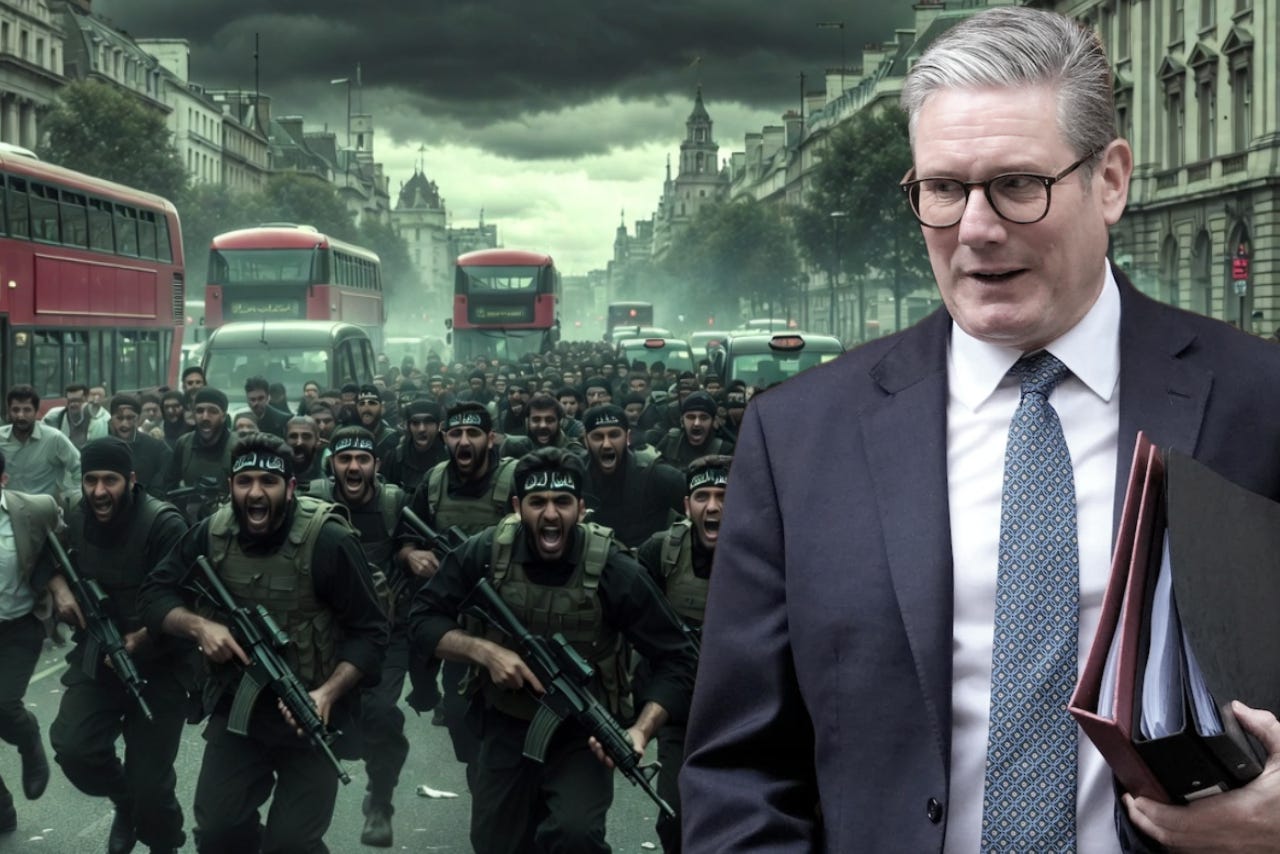
UK Prime Minister Keir Starmer recently stated that the conflict involving Iran “is not our war” and emphasized that the United Kingdom “won’t be dragged into“ it. During a national address amid rising tensions, Starmer aimed to reassure the public that Britain would avoid direct involvement, portraying the situation as unrelated to British national interests.
While this perspective may resonate with war-weary voters, it dangerously minimizes a long-standing reality: the Islamist regime in Tehran has consistently targeted Europe—including the UK and other NATO nations—through assassinations, bombings, and plots carried out by its proxies and intelligence services. Rather than being “not our war,” Iran’s campaign of transnational terror has turned every European capital into a potential battlefield since the 1979 Islamic Revolution.
A comprehensive dataset tracking Iranian external operations—such as assassinations, surveillance, abductions, and related plots—documents a total of 218 incidents worldwide since 1979, with 102 of these occurring in Europe. Notably, over half of the European plots (at least 54) occurred between 2021 and 2024, indicating a significant escalation rather than a mere historical footnote. These operations are often directed by Iran’s Ministry of Intelligence and Security (MOIS) or the Islamic Revolutionary Guard Corps (IRGC), and they frequently utilize proxies like Hezbollah, which receives Iranian funding, training, weapons, and logistical support.
The regime increasingly hires criminal networks—drug traffickers, gang members, and smugglers—to carry out violence for plausible deniability, turning European streets into extensions of Tehran’s covert operations.
This pattern began almost immediately after the revolution:
In December 1979, assassins linked to Iranian-backed elements shot dead Shahriar Shafiq, nephew of the deposed Shah, in Paris.
The 1980s saw a wave of violence in France, including the 1984 assassination of former Iranian General Gholam Ali Oveisi and his brother, and a series of bombings from 1985 to 1986 attributed to a Hezbollah-linked network with Iranian logistical backing. Those attacks killed around 12–14 people and wounded over 200, targeting civilian sites as retaliation for French support of Iraq during the Iran-Iraq War.
In 1989, Kurdish leader Abdul Rahman Ghassemlou and two aides were gunned down in Vienna during talks with Iranian officials; Austrian authorities issued warrants for Iranian agents.
The 1991 stabbing death of former Iranian Prime Minister Shapour Bakhtiar near Paris and the 1992 Mykonos restaurant massacre in Berlin—where four Iranian-Kurdish opposition leaders were killed—further demonstrated Tehran’s reach. A German court explicitly ruled that the Mykonos killings were ordered by Iranian intelligence with high-level approval.
Europe has not been spared mass-casualty proxy attacks either.
On July 18, 2012, a suicide bomber targeted a bus carrying Israeli tourists at Burgas Airport in Bulgaria. The attack resulted in the deaths of five Israelis and one Bulgarian driver, while injuring many others. Bulgarian authorities, supported by the European Union and other entities, attributed the attack to Hezbollah, which was operating with Iranian backing. Subsequently, two operatives were convicted in absentia for their involvement.
This was not an isolated incident; Hezbollah, Iran’s primary proxy, has maintained extensive operations across the continent. These include the surveillance of Israeli and Jewish targets, as well as the stockpiling of explosives. In Cyprus, authorities disrupted several plots that involved tons of ammonium nitrate intended for attacks on Jewish or Israeli sites, with connections to the supply chain of the Burgas bombing.
The 2010s and 2020s have witnessed an intensification, often blending direct regime involvement with criminal cutouts.
In June 2018, Iranian diplomat Assadollah Assadi, who was stationed in Vienna, provided explosives for a plot to bomb a large gathering of the Iranian opposition group NCRI/MEK near Paris. The device had the potential to cause mass casualties among the thousands of attendees, including dignitaries. Assadi and his accomplices were convicted in Belgium.
Denmark foiled an Iranian intelligence plot to assassinate an opposition figure that same year.
Recently, plots have targeted journalists and dissidents in the UK, including the 2024 stabbing of Iranian journalist Pouria Zeraati in London. This incident is part of a broader campaign against regime critics who are broadcasting from exile.
UK intelligence has been particularly vocal about the threat.

In 2025, MI5 Director General Ken McCallum reported that authorities had tracked over 20 potentially lethal plots backed by Iran in the previous year. This follows a history of at least 20 disrupted plots dating back to 2022. These attempts include surveillance and assassination efforts targeting dissidents, journalists, and individuals viewed as enemies of the regime, which pose risks of collateral damage to British citizens.
Plots have also targeted Israeli embassies and Jewish sites, using criminal networks like those linked to the Foxtrot gang or Hells Angels affiliates for grenade attacks, arson, and reconnaissance.
In May 2025, UK counterterrorism operations arrested several Iranian nationals following reports of a plot against the Israeli embassy in London. Parliamentary reports reveal that Iran employs transnational repression tactics, including intimidation of families in Iran, to silence exiles living in the UK.
Similar patterns afflict other NATO and European nations.
In the Netherlands, authorities have linked Tehran to assassination attempts in Haarlem as well as against a Spanish politician. Germany has experienced plots involving criminals hired by the IRGC (Islamic Revolutionary Guard Corps) targeting synagogues and Jewish institutions, resulting in convictions for firebombings. France, which has been a repeated target, continues to uncover surveillance activities aimed at Jewish and Israeli interests. Additionally, Albania expelled Iranian diplomats due to threats against MEK (Mujahedin-e Khalq) exiles. Across the continent, the use of criminal proxies has decreased the threshold for violence while complicating attribution; however, intelligence services consistently trace the direction of these activities back to Tehran.
Starmer’s assertion ignores this empirical record. By claiming Iran poses no direct threat warranting British engagement, the statement risks signaling weakness to a regime that views Europe not as a neutral bystander but as a theater for its global jihadist ambitions. Iran’s strategy combined ideological export of the revolution with retaliation against perceived enemies—dissidents, Jews, Israelis, and Western supporters of its opponents. Hezbollah’s European networks and the IRGC’s Unit 840, tasked with overseas operations, treat NATO soil as fair game. Foiled plots reveal intent for indiscriminate harm; a successful large-scale attack could kill dozens or hundreds, as nearly happened in Paris in 2018.
Dismissing Iran’s ongoing campaign of violence on European soil as “not our war,” as Prime Minister Starmer has done, is not only historically inaccurate but also strategically shortsighted. The historical record—ranging from the 1979 assassination of Shahriar Shafiq in Paris, to the bombings in France during the 1980s, the Mykonos massacre in Berlin, the 2012 Burgas attack, and a surge of over 50 plots in Europe since 2021—clearly shows that the Islamist regime in Tehran has long considered NATO and EU nations to be legitimate targets in its hybrid war. European lives have been lost, dissidents have been hunted, and Jewish and Israeli communities have faced constant threats from Iranian-directed or -backed operatives and proxies. Ignoring this reality projects weakness and invites further aggression rather than deterring it.
President Trump and Secretary of State Marco Rubio are right to pose a pointed question in response: If NATO and the EU won’t act decisively against Iran even when much of the heavy lifting against the regime has already been shouldered by the United States, why should America continue bearing disproportionate costs in the alliance?
Trump’s long-standing criticism of unequal burden-sharing within NATO has taken on new urgency due to recent tensions related to Iran. Senator Marco Rubio has suggested that the United States may need to reassess its role in NATO if European allies do not take significant action. This viewpoint highlights an important fact: alliances must be reciprocal. When European capitals face direct Iranian threats on their own soil but primarily respond with quiet diplomacy, selective sanctions, and occasional expulsions, while the United States confronts the Iranian regime more aggressively, they weaken the very collective defense that NATO is supposed to represent.
Britain and its European partners have several options to address the threat posed by Iran. These include fully designating the Islamic Revolutionary Guard Corps (IRGC) as a terrorist organization, increasing intelligence sharing and disrupting Hezbollah networks, and cracking down more effectively on the criminal proxies used by Tehran. Additionally, they can provide tangible support—whether diplomatic, economic, or military, including access to strategic military bases—when the U.S. or other nations take stronger measures in response to Iranian aggression. However, Starmer’s approach may inadvertently reinforce a pattern of dependency, where Europe benefits from American security commitments without demonstrating a similar resolve against shared threats, such as the Iranian regime’s transnational repression and terrorist infrastructure.
The actions of the Iranian regime, especially now that their backs are against the wall, thanks to the United States and Israel, represent an ongoing hybrid war against the West, one that has resulted in the loss of European lives and continues to pose a threat to them. From the Paris bombings in the 1980s to the London stabbings and the attack in Burgas, Tehran has turned Europe into its battleground. Ignoring this reality, as Starmer suggests, only invites further aggression by creating the illusion of disengagement.
Britain and its European partners must confront this reality with robust intelligence cooperation, designations of the IRGC where appropriate, support for dissidents, and a clear-eyed policy that recognizes the regime’s threat–and the sustained threat posed by a splintered IRGC–transcends distant conflicts.
Iran’s war has long been on European shores—ignoring it will not make it disappear. Failing to do so only lends credence to the American question: if Europe won’t defend itself vigorously against a foe already under pressure, why should the US indefinitely subsidize the alliance?
True partnership demands reciprocity, not rhetoric that treats direct attacks on European soil as someone else’s problem.


