

Recently, The View’s Sunny Hostin displayed her questionable intellect when she called the United States a “failed experiment.” Aside from the fact that those with functioning Grey matter understand The View as nothing more than a gaggle of has-beens struggling for relevance in a world that has already passed them by, Hostin’s ignorance of the founding ideals of the United States opens the door for a teachable moment.
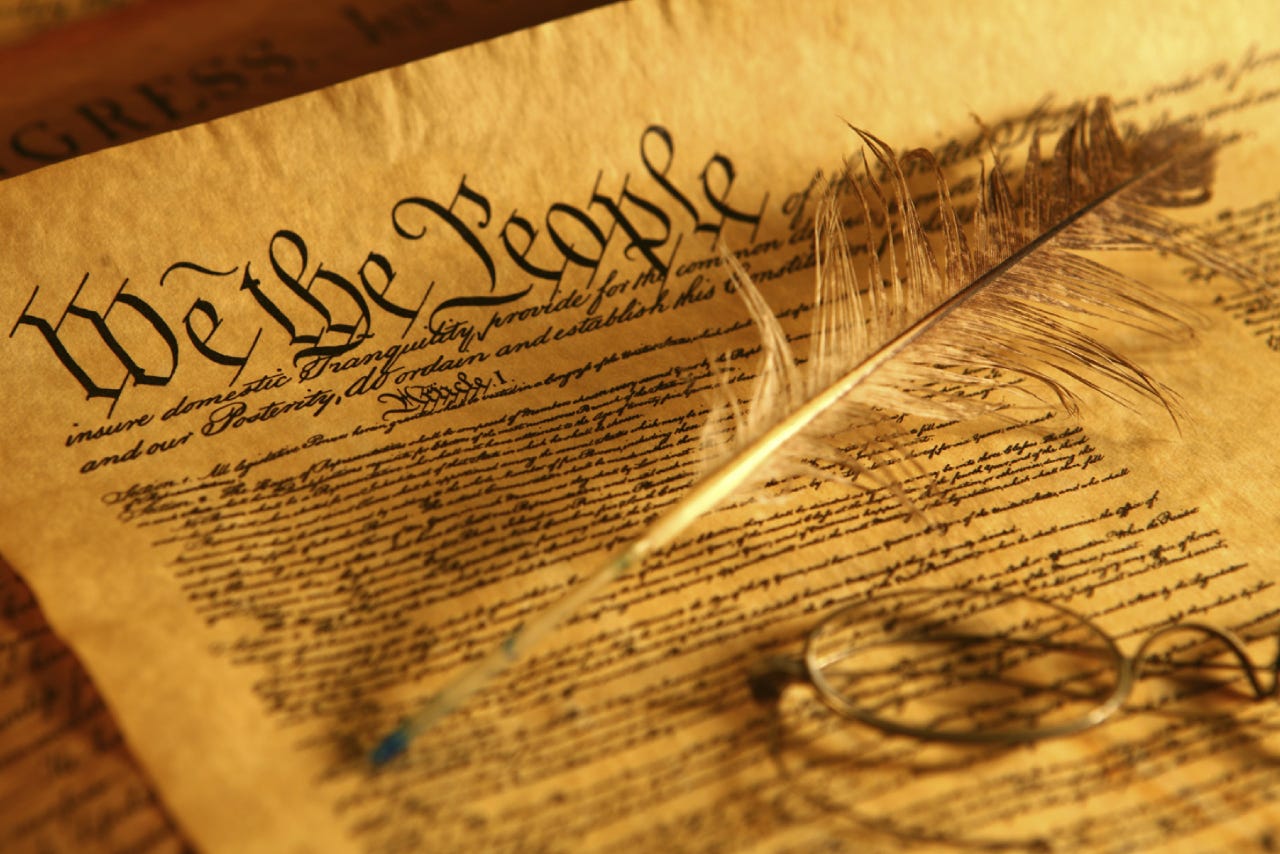
The Preamble to the United States Constitution opens with a radical declaration of purpose:
“We the People of the United States, in Order to form a more perfect Union, establish Justice, insure domestic Tranquility, provide for the common defence, promote the general Welfare, and secure the Blessings of Liberty to ourselves and our Posterity, do ordain and establish this Constitution for the United States of America.”
“In order to form a more perfect Union.” This phrase is not just decorative; it captures the essence of the American experiment. It honestly acknowledges that the Union, established in 1787, was flawed from the beginning, yet intentionally designed for ongoing improvement. America is not a finished product but a work in progress, where each generation bears the responsibility to strive toward that “more perfect” ideal.
This aspirational vision sharply contrasts with the corrosive cynicism of today’s far-Left critics, like Hostin and the rest of the harpies at The View, who use every historical flaw, policy failure, or cultural conflict as evidence of the nation’s irredeemable decay. In their eagerness to condemn, they overlook—or, most likely, intentionally obscure—the Constitution’s fundamental insight: imperfection should not be seen as an indictment but rather as an invitation to grow and improve.
The Framers of the Constitution were not idealistic visionaries who overlooked human imperfections. After experiencing the failures of the Articles of Confederation, they crafted a document grounded in the reality of power, factions, and ambition. They specified limited federal powers, divided authority among branches of government, and included mechanisms for amendments because they understood that perfection is unattainable in a flawed world.
The phrase “more perfect” represents a direction towards improvement rather than a final goal—it serves as a guiding principle for gradual progress achieved through deliberation, debate, and democratic consent, rather than through revolutionary upheaval. This framework has enabled America to navigate significant challenges, including a bloody Civil War that abolished slavery, waves of immigration that increased the citizenry, constitutional amendments that secured voting rights for women and minorities, and economic transformations that lifted billions out of poverty worldwide, often under American leadership.
Consider the trajectory of the nation. In 1787, the Union accepted slavery—a moral compromise made by the Framers at the nation’s founding, with the expectation that future generations would confront it. They did so. The 13th, 14th, and 15th Amendments, along with the Civil Rights movement a century later, advanced the idea of a more perfect union through law, sacrifice, and moral persuasion, rather than through imported ideologies. This same principle applies to women’s suffrage, the dismantling of Jim Crow laws, and the ongoing expansion of opportunities for all.
America’s strength lies in its ability to self-correct without leading to self-destruction. Property rights, free speech, religious liberty, and due process are not just remnants of a flawed founding; they are tools for continual improvement. They empower individuals to innovate, express dissent, and build a better society, transforming potential divisions into dynamic strengths.
Yet, far-left voices, like those of Hostin, are influenced by Marxist ideas and postmodernist theories that dismiss America’s achievements as irrelevant. To them, America is not seen as an aspirational Republic but rather as a system defined by “systemic” and “structural” issues, characterized by original sin. They view every disparity as evidence of ongoing guilt and every historical error as a permanent stain that undermines the entire nation. This perspective tends to cherry-pick real, exaggerated, or even fabricated faults while ignoring essential context, trade-offs, and the significant progress made over time.
While slavery was a widespread practice in many civilizations for millennia, America fought a Civil War to abolish it and has dedicated generations to addressing its legacy. Segregation was dismantled here through constitutional means rather than in opposition to them. The far-Left narrative simplifies this complex history into a caricature of continual oppression, conveniently overlooking how the principles of the Constitution provided the moral and legal foundation for reform.

This condemnation reflects not just a lack of historical understanding; it embodies a strategic form of nihilism. By rejecting the premise of a “more perfect Union,” they twist the Framers’ humility into arrogance. While the Constitution entrusts “We the People” with the responsibility to govern and improve, the far-Left seeks top-down transformation through expert elites, bureaucratic mandates, and cultural pressure.
Their proposed solutions—such as identity hierarchies, speech restrictions, wealth redistribution, and weakened borders—promise an ideal society through the exertion of power, yet they lead to division and decline. Consider the record of cities that have been under one-party progressive control for years: rising crime rates, failing schools, homelessness crises, and poor fiscal management. These are not movements toward perfection but rather regressions, justified by the same rhetoric that portrays America as irredeemable.
The far-Left’s posture reveals a deeper contempt for the American character. They dismiss the Constitution as a “dead” or “white” document, ignoring how its universal principles of natural rights have inspired global liberty movements. They decry “inequality” while living in the most prosperous and mobile society in history, where opportunity correlates more with family structure, education, and behavior than with immutable identity. Every generation’s striving—pioneers settling frontiers, immigrants chasing the dream, entrepreneurs disrupting industries, and reformers expanding the franchise—embodies the Preamble’s mandate.
America’s faults are not unique; what sets it apart is its response to those faults. The far-Left, by focusing solely on the nation’s shortcomings without recognizing its efforts to improve, disconnects America from its own capacity for growth and renewal. They don’t provide a path toward constructive change, but instead, promote a continuous cycle of atonement based on an ever-changing standard that aims to maintain their hold on power.
This dynamic is clearly evident in contemporary debates. Critics loudly argue about “systemic racism” and “late-stage capitalism” despite the fact that Black and Hispanic wealth is increasing, minority entrepreneurship is thriving, and constitutional protections allow dissent against progressive ideas. They romanticize foreign systems, particularly socialist experiments that ultimately failed, leading to poverty and authoritarianism, while they dismiss America’s combination of liberty and ordered governance.
The wisdom of the Preamble highlights their mistake: creating a more perfect Union requires loyalty to foundational principles rather than their complete rejection. We need amendment, not abolition; refinement, not revolution.
Every generation faces this challenge. Ours must reject the counsel of despair promoted by academics, media, and activists who benefit from ongoing outrage. Instead, we should renew our commitment to the constitutional order, which directs human ambition toward collective improvement. We must secure our borders to preserve the Union, reform entitlements and regulations that hinder opportunity and facilitate corruption, and protect free expression so ideas can compete. It is essential to teach an honest history that acknowledges both sacrifices and progress. These actions are not nostalgic gestures; they are active steps to fulfill the charge of the Preamble.
The United States Constitution doesn’t promise a perfect society. Instead, it provides a framework for a free people to pursue that ideal, even if imperfectly, from generation to generation. Those who criticize America as a whole for its shortcomings reveal their own narrow perspective. They focus on flaws while patriots recognize a noble, ongoing endeavor.
The quest for a “more perfect Union” continues not because we have achieved it, but because we persist in striving toward it—through debate, innovation, resilience, and an unwavering love for our country. This pursuit is America’s greatest strength. To abandon it in favor of ideological condemnation is to betray the very document that allows such striving to exist.
We the People must renew our commitment to this quest as we approach the 250th anniversary of the founding of our Republic, undeterred by those who would rather discard the path than follow it.


