

🎧 LISTEN TO THIS ARTICLE ON THE SUBSTACK APP
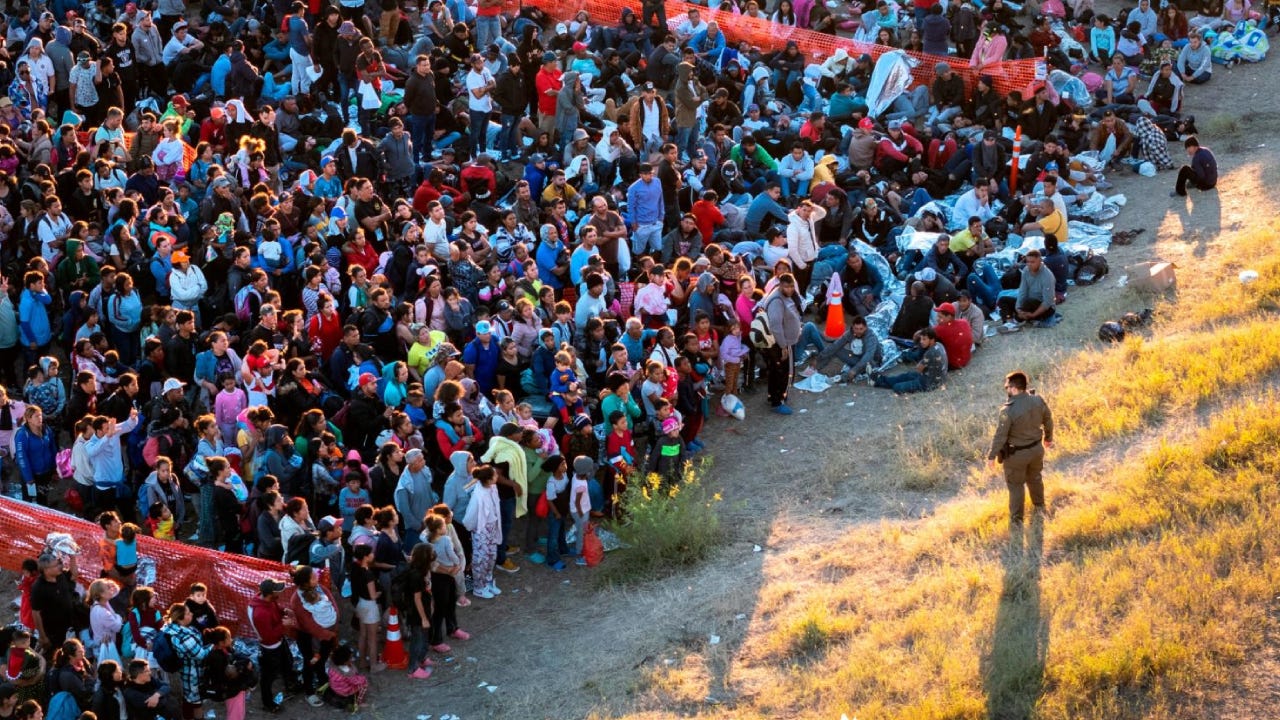
Large-scale migration without assimilation is not necessarily enrichment. Many people see it instead as demographic pressure that can reshape a country’s culture. When newcomers reject the host nation’s language, laws, customs, and core values while building parallel structures, it often feels less like integration and more like colonization. And when a host society stops insisting on assimilation, it can weaken its own cohesion, security, and sense of identity. Recent events have made that concern harder to ignore.
Consider what happened in Ceuta in late July 2026. Tens of thousands of people—mostly young men—crossed from Morocco into the Spanish enclave, with estimates ranging from 50,000 to as many as 80,000 people entering a city of about 84,000 residents. Some swam around barriers, while others pushed through the fence in chaotic waves. Dozens, and possibly well over a hundred, died in the crush or by drowning.
Spain responded with military and police, and many, but not all, of those who entered returned to Morocco over the following days. But the impact was immediate: the enclave was overwhelmed, and the political shock spread across Europe. This wasn’t just a small number of desperate people looking for a better life. It was a sudden mass breach that made Spanish territory look open to the taking.
Events like this show how fragile borders can become when political resolve weakens or outside actors take advantage. They also show how quickly large-scale uncontrolled entry can overwhelm a community and its institutions.
Europe has moved beyond polite denial.
Denmark’s Prime Minister, Mette Frederiksen, has repeatedly warned that mass migration threatens social cohesion. She has argued for value-based assimilation, saying newcomers must accept democratic norms, gender equality, and the primacy of Danish law and culture in public life rather than importing incompatible practices. Her government has pursued some of Europe’s strictest policies because, in its view, both data and experience show that concentrated non-Western—particularly Muslim—immigration can correlate with higher crime rates among certain cohorts, the growth of parallel societies, and public-space intimidation. Other leaders have voiced similar concerns.
In places where large inflows refuse integration, welfare systems strain, trust declines, and native populations can feel culturally displaced in their own cities. The refusal to confront cultural incompatibility—especially around secular law, women’s rights, free speech, and religious supremacy—has, for many critics, allowed the problem to grow for decades.

A similar dynamic can be seen in the United States. Some areas have seen the deliberate development of Muslim-majority or Muslim-centered enclaves with limited assimilation:
Hamtramck, Michigan, became the first U.S. city with an all-Muslim city council and mayor; the call to prayer is broadcast there, and local practices increasingly reflect Islamic norms rather than broader American ones.
Rural settlements such as Islamberg in New York and similar communities in other states operate as insular, group-owned villages centered on Islamic identity and leadership.
Planned developments like EPIC City near Dallas have sparked intense debate over whether they could create exclusive zones shaped by Sharia-influenced social rules.
In Minneapolis’s Cedar-Riverside neighborhood, sometimes called Little Mogadishu, Somali clan networks have been linked to documented issues such as welfare fraud, clan-based governance, and recruitment pipelines that once fed foreign jihadist groups.
Supporters of this argument say these are not simply ethnic neighborhoods that gradually Americanize. They see them, instead, as concentrations where religious and cultural loyalty can take precedence over the host society’s constitutional order.
Host nations, in this view, have to expect and demand assimilation. Arriving on a nation’s shores doesn’t automatically give anyone the right to remake that nation. Language acquisition, acceptance of equal legal status for women and non-believers, rejection of supremacist ideologies, and participation in a shared civic culture are seen as non-negotiable. Without those things, migration can create dual societies: one governed by the formal laws of the state, the other shaped by imported codes that treat the host population as secondary.
Crime statistics in multiple European countries are often cited as showing disproportionate involvement by certain immigrant groups in violent and sexual offenses. Demographic change can accelerate when birth rates diverge and chain migration continues. Public space becomes more contested, free expression can be chilled by threats of offense or violence, and political parties that point to these patterns are often smeared rather than answered with data.
The dangers of non-assimilation, supporters argue, are concrete. Parallel societies can incubate radicalization and weaken the state’s monopoly on legitimate force. Welfare systems built for high-trust, reciprocal populations can buckle under permanent net dependency. Already-low native birth rates may face further pressure from cultural insecurity. Over time, the host culture is seen not just as diluted, but displaced in places where it once shaped everyday life.
Advocates of this view argue that history offers no successful example of a high-trust, liberal society absorbing large numbers of people from culturally distant, low-assimilation groups without serious friction or lasting change. From that perspective, pretending otherwise isn’t compassion—it’s negligence.
In the end, sovereignty requires both the will to control borders and the clarity to insist that those who stay adopt the host culture rather than reshape it. Anything less risks surrendering the inheritance of generations to demographic and cultural forces, often by totalitarian ideologies.
Simply put, mass and sudden migration is nothing less than a conquest, an invasion; the colonization of the host nation. And we don’t hear the far-Left acknowledging this reality.
A Note About Subscribing:
At Underground USA, we pride ourselves on being fiercely independent—we only answer to our readers. This independence allows us to tackle tough questions, dive deep into important topics that often get overlooked, and share essays and podcasts, like this one, without asking for anyone’s approval.
Free subscriptions help us connect with a wider audience. They are the vehicle for the wide dissemination of the message. Paid subscriptions are what keep us going. They fund our research, document requests, interviews, fact-checking, and give us the time to dig deeper than just the headlines. Most importantly, they support something that’s getting harder to find: independent analysis that’s not swayed by advertisers, corporate sponsors, or political agendas.


