

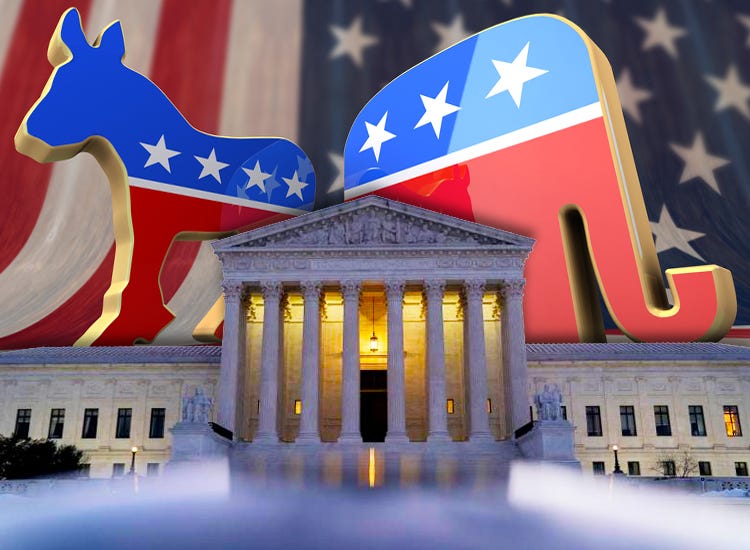
Over that last century – and dating back specifically to the New Deal era – the United States Supreme Court has shed its constitutional mandate to be non-partisan and non-politicized, devolving into yet another disingenuous playground populated by the very political factions that Washington warned us about in his Farewell Address.
In another example of how far removed the US Supreme Court (SCOTUS) has traveled from the original intent of its creation, the High Court Tuesday rejected – without explanation – a renewed bid to block the Biden administration’s use of the Transportation Security Administration (TSA) to enforce its mask mandate on commercial airlines.
The application to stay the mask mandate, brought via two lawsuits claiming the need for medical exemptions, was denied by the court after a referral by Justice Neil Gorsuch and just weeks after Chief Justice John Roberts rejected an earlier application.
The High Court refused to provide an explanation for either rejection, even as it issued a ruling last week blocking the Biden administration’s use of the Occupational Safety & Health Administration (OSHA) to enforce a COVID vaccination, masking, and testing mandate on businesses with 100 or more workers.
The TSA has extended the mandate – which also applies to some buses and railroads, through March 18, 2022, saying the requirements would “help prevent further spread of COVID and encourage a unified government response.”

Why This Is Important
First – and this is documented to the point that even the Centers for Disease Control & Prevention (CDC) has embraced this truth, cloth masks do nothing – tantamount to zero – to prevent both the infection and transmission of COVID. Anyone insisting that they do is either grossly misinformed, propagating false-narrative propaganda, or both. There are too many studies corroborating this fact and, again, even the CDC acknowledges cloth masking is, for all practical purposes, useless.
But back to the point on the SCOTUS being politicized to the point of dysfunction.
Article III, Section 2 of the US Constitution states:
“The judicial Power shall extend to all cases, in law and equity, arising under this Constitution, the laws of the United States, and treaties made, or which shall be made, under their authority;...to Controversies between two or more States; between a State and Citizens of another State, between Citizens of different States, between Citizens of the same State claiming Lands under Grants of different States, and between a State, or the Citizens thereof, and foreign States, Citizens or Subjects.”
The US Constitution makes clear that matters coming before the SCOTUS must have a limited constitutional basis and result in a decision on the matter’s constitutionality. Before the bastardization of the Commerce Clause, the tasks at hand for the SCOTUS were intellectually based in the Constitution.
But as the Tenth Amendment Center states:
“Despite the words that make up the Commerce Clause and Necessary and Proper Clause remaining constant over the past two centuries, the Supreme Court’s interpretation of their meaning and reach has not. Over the years, the SCOTUS has used the clause to vastly expand federal power.
“The Commerce Clause delegates to Congress the power to regulate interstate commerce. As originally understood, the power was rather limited. At the time of the drafting of the Constitution, commerce was understood to pertain to trade, or the act of exchanging goods. Commerce power also extended to regulation of the transportation system, shipping, and interstate and international waterways. But the Commerce Clause was never intended to give the federal government the power to regulate manufacturing, agriculture, labor laws, healthcare, or a host of other activities claimed by progressives.
“However, the Supreme Court has erroneously found that the Commerce Clause, working in conjunction with the Necessary and Proper Clause, allows Congress to regulate certain types of intrastate activity.”
It is through this unconstitutional expansion of federal power that the SCOTUS opened the federal judiciary up to overt and debilitating politicization. From that point on, politicians – from both the Executive Branch and the Legislative Branch – looked to the political make-up of the court in considering nominees rather than honestly trying to find the best constitutional minds so as to protect the Constitution from the factions of partisanship (read: politics).
We have witnessed politicized decisions and non-decisions emanating from the High Court in recent years.
The decision on the Affordable Healthcare Act (Obamacare) was so incredibly convoluted and contorted politically that the High Court literally failed to decide the argument before it and, instead, legislated from the bench to impose a socialist-based entitlement on the nation, an entitlement with no basis in constitutionality.
As an aside, had the Wilsonian fascists not succeeded in passing the 17th Amendment to facilitate the unconstitutional direct election of senators, the US Senate – assembled as a body strictly seated to defend the best interests of each state through its senators – would have never agreed to pass the AHA.
Then we have the non-decisions in the 2020 General Election where states and state legislatures – empowered specifically by the Constitution – sued to enforce Article I, Section 4, which states:
“The times, places, and manner of holding elections for senators and representatives shall be prescribed in each state by the legislature thereof; but the Congress may at any time by law make or alter such regulations, except as to the places of chusing senators.”
The states that brought suit against both their own state executive branches and other states, argued that because election law was usurped by the executive branches of the offending states – and not enacted through the legislatures – to facilitate voting during the COVID apocalypse, Electors to the Electoral College from those states should not be certified.
Stunningly, even though the suits were squarely and without question within the SCOTUS’s purview, the justices punted using the unconstitutional excuse of “standing” to reject the cases without comment, thus allowing for a politically hijacked election process in the offending states.
The Legal Information Institute of the liberal Cornell University, explains “standing”:
“At the federal level, legal actions cannot be brought simply on the ground that an individual or group is displeased with a government action or law. Federal courts only have constitutional authority to resolve actual disputes (see Case or Controversy).
“In Lujan v. Defenders of Wildlife (90-1424), 504 U.S. 555 (1992), the Supreme Court created a three-part test to determine whether a party has standing to sue: 1) The plaintiff must have suffered an ‘injury in fact,’ meaning that the injury is of a legally protected interest which is (a) concrete and particularized and (b) actual or imminent; 2) There must be a causal connection between the injury and the conduct brought before the court; 3) It must be likely, rather than speculative, that a favorable decision by the court will redress the injury.”
The SCOTUS created their ability not to hear cases under their purview by setting a standard so general that any plaintiff could be construed as not possessing standing to come before the High Court. This was not a legal move. It was a political move, coming to be at the beginning of the Clinton administration.
Further, the SCOTUS acquired intellectual “cover” when prestigious Ivy League law schools at Harvard, Yale, Princeton, and others, started weighing heavily in favor of precedent law based on stare decisis (Latin: “let the decision stand”) and moving away from basing every decision on the Constitution as the overriding law of the land. It isn’t uncommon to hear a sitting US Supreme Court Justice mention stare decisis in a justification of manipulating what would otherwise be obvious under a strict reading of the US Constitution or the Bill of Rights. A good example would be the false-flag notion that healthcare is a “right.” Nowhere is that declaration made in the Bill of Rights, yet it is assumed under the notion of “the common good.”
At a time when far-Left politicians have moved to openly embrace fascism in the United States, even as they position our nation’s economic system to cede sovereignty to the globalist control facilitated by the World Economic Forum’s Great Reset, Americans desperately need a de-politicized judiciary; one that will have exclusive fidelity to the US Constitution and Bill of Rights; one that turns its back on politics, ideology, and politically opportunistic special interest.
That can be achieved by embracing the strict meaning of Article III, Section 1 of the US Constitution, which reads in part:
“...The judges, both of the supreme and inferior courts, shall hold their offices during good behavior...”
This means US Supreme Court Justices, should they rule politically instead of in the best interest of protecting the US Constitution, can be impeached.

Today’s Headlines
Democrats Begin Show Debate on Election Power-Grab Legislation Poised for Defeat
Virginia Governor Begins Withdrawing State From 10-State Cap-and-Trade Scheme
BlackRock CEO Gaslights Investors on Accusations It Is Pushing ‘Woke’ Stakeholder Capitalism
Misleading Memo for US House Hearing on Bitcoin & Ethereum Mining Includes 'Basic Errors'
California Single-Payer Healthcare Proposal Could Double State's Taxes
UK to Scrap All COVID Laws, Regulation; Moves to Accept Virus Is Like the Endemic Flu
UN's Secretary-General Steps Outside the Organization's Charter to Socially Engineer
NATO’s ‘Space Policy’ Outlines Readiness to Jointly Respond to Attacks in Space
Texas Synagogue Terrorist Was on British MI5 Radar, Supported Pro-Palestinian, Jihadi Causes

