

As elected officials in Blue states–predominantly Minnesota, New York, and Illinois–act as apologists for a religion of conquest and the enclaves they have established, it is well past time to stop lying to ourselves about the realities of Islam and the Islamic culture.
It’s time to dispense with the polite fiction of “radical Islam.” This phrase, so beloved in Western discourse, serves only to obscure an uncomfortable truth: By the benchmarks of liberty, equality, and secularism that define our civilization, a devout Muslim—one who takes the Quran and the Prophet’s example seriously—is precisely what we would call “radical.” The distinction between “moderate” and “extremist” is largely a Western construct, designed to avoid grappling with the religion’s foundational calls for supremacy. Authentic adherence to Islam, as its texts demand, places it in irreconcilable conflict with the pluralistic values of the West.
At the heart of this lies the Quran itself, viewed by the faithful as the eternal, literal word of God—immutable and beyond reform. Passages such as 8:39 urge believers to “fight them until there is no fitnah and the religion, all of it, is for Allah,” envisioning a world where Islam reigns supreme. Similarly, 9:29 commands combat against non-believers “until they pay the jizyah willingly while feeling subdued.” These are not relics of a bygone era but explicit mandates for domination, often interpreted as the duty to establish a global caliphate where others submit.
The means to this end are flexible and comprehensive. Violent jihad finds exaltation in verses like 9:5, the “sword verse,” calling to “kill the polytheists wherever you find them,” and 2:191-193. Deception, rooted in concepts like taqiyya (drawn from 3:28 and 16:106), allows falsehood when it serves the faith. Demographic expansion follows the model of hijra—migration followed by proliferation—encouraging believers to multiply and settle, gradually transforming host societies.
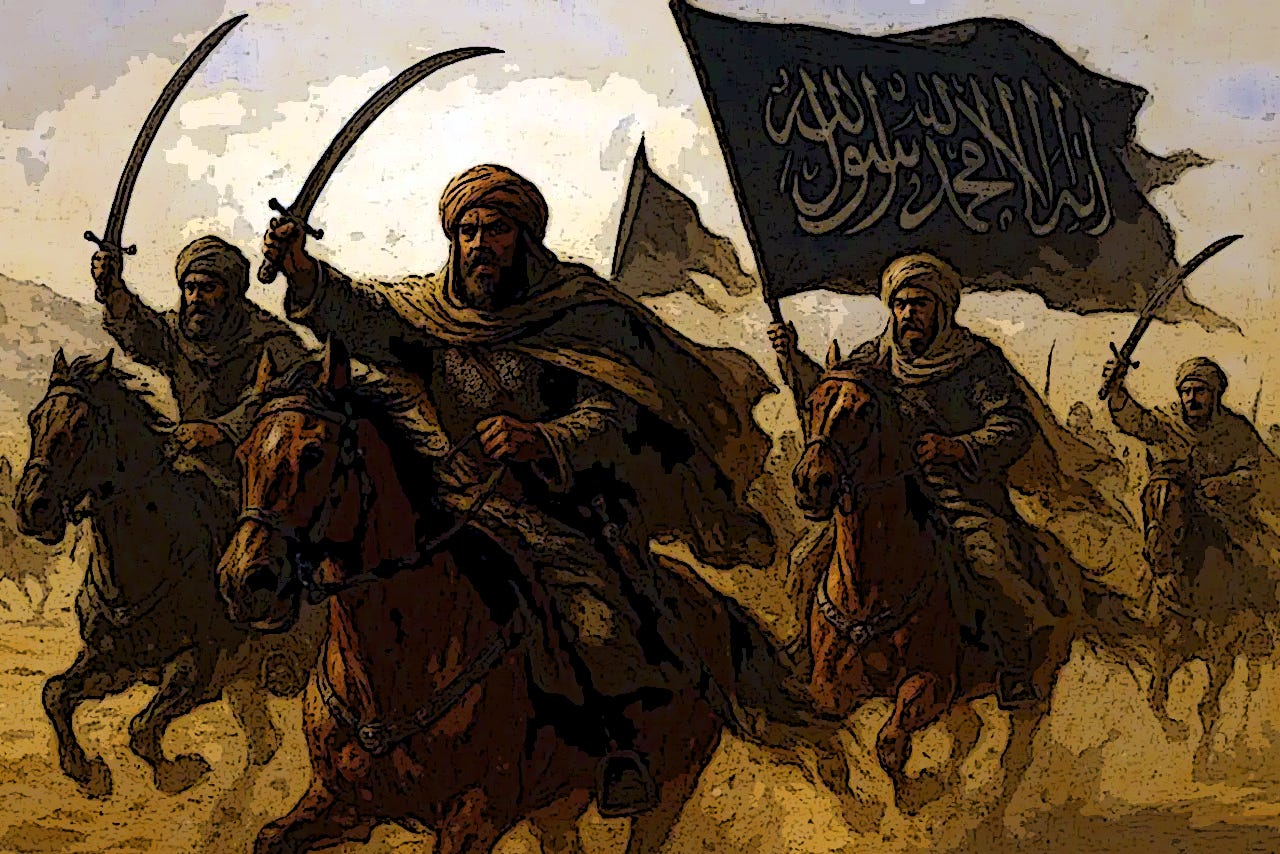
History offers stark confirmation. From the late 7th century, Islamic forces erupted from Arabia, conquering the Byzantine Levant and Egypt in the 630s-640s, obliterating the Sassanian Empire by 651, sweeping North Africa in the 670s-700s, and invading Spain by 718. The Umayyads pressed into France, stopped only at Tours in 732, while eastern campaigns subsumed Central Asia and India. These were not mere defenses but aggressive campaigns to spread the faith, imposing conversion, subjugation, or death. The Christian Crusades, often maligned as unprovoked, were in fact a delayed counteroffensive against centuries of Islamic expansion that had already consumed much of the Christian East and North Africa.
🍾SPECIAL HOLIDAY SUBSCRIPTION OFFER🥂
SUBSCRIBE NOW and receive a 25% discount on monthly & annual subscriptions:
❄️ $3.75 per month instead of $5 per month (1/4 the cost of a cup at Starbucks)
❄️ $33.75 annually instead of $45 annually (the price of a meal at McDonald’s)
This conquest continues today through quieter vectors: immigration and higher birth rates. Europe’s Muslim population has reached approximately 46 million—about 6% of the continent—as of late 2025, fueled by migration and fertility gaps. Enclaves in France, Sweden, Belgium, and Germany frequently resist assimilation, creating parallel societies that press for accommodations to Islamic law. The Middle East’s own history illustrates the process: Ancient Persia, a Zoroastrian powerhouse, fell to Arab conquest in the 7th century, with gradual Islamization culminating in the 1979 revolution that entrenched Shia rule. In Asia, centuries of Mughal dominance brought widespread conversion and cultural upheaval in India.
The pattern has crossed the Atlantic. In the United States, Muslim communities are growing in key urban centers, including Dearborn, Michigan—a hub for Arab Americans—and particularly Minneapolis, where the Somali population in the Twin Cities metro area is estimated at around 84,000 as of late 2025, forming vibrant but often insular neighborhoods like Cedar-Riverside. Similar dynamics play out across North, Central, and South America via migration channels.
Yet we persist in framing this shift as a triumph of “diversity” and “tolerance”—a profound miscalculation. Western principles of free speech, gender equity, and church-state separation clash directly with Quranic prescriptions on blasphemy, inheritance, and governance. Indiscriminate openness to a doctrine that tolerates no rivals risks hollowing out the very freedoms it exploits, paving the way for societies where local norms give ground to imported ones.
The rising voices of resistance in the West deserve commendation, not condemnation. Leaders such as Italy’s Giorgia Meloni, the Netherlands’ Geert Wilders, France’s Marine Le Pen, Britain’s Nigel Farage, and the United States’ Donald Trump are not peddling phobia or prejudice; they are safeguarding the hard-won heritage of the Enlightenment against an ideology with a 1,400-year track record of expansionism—from the early caliphates through Ottoman advances to contemporary demographic strategies. Even the Crusades were a reaction to that relentless pressure. To dismiss this defense as bigotry is to ignore history’s lessons.
As the mainstream media and Marx’s “useless idiots” of the woke Democratic Socialist Left play the apologists for Islam, attempting to bully the facts to succumb to their preferred narrative, the West must recognize the stakes: accommodation invites erosion and disaster; resolve preserves freedoms and our way of life.
Until Islam meets its Martin Luther, there can be no peace and coexistence between Western Culture and Islam.


