

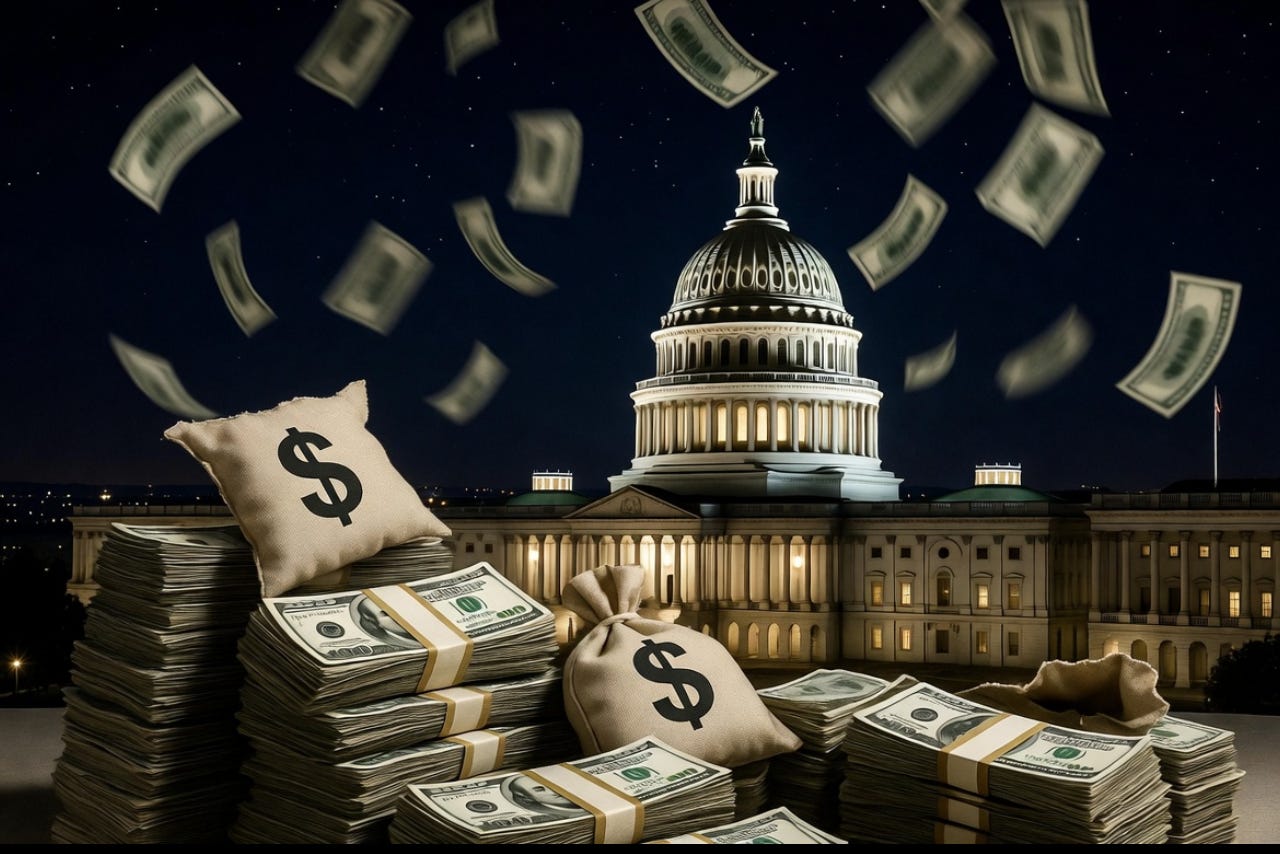
In the halls of Washington, where fiscal responsibility goes to die, President Trump’s bold crusade against government bloat has hit a brick wall built by his own supposed allies.
Trump, alongside the Department of Government Efficiency (DOGE)—initially led by Elon Musk—unveiled a sweeping plan to carve out up to $2 trillion in spending cuts—later dialed back to a still-ambitious $1 trillion—from a bloated $7.4 trillion federal budget. These weren’t arbitrary slashes; they targeted programs riddled with waste, fraud, and institutional corruption, the kind that siphons taxpayer dollars into black holes of inefficiency and cronyism. Yet, the Republican-led Congress, those self-proclaimed guardians of small government, has spectacularly failed to deliver.
Out of 30 key programs flagged for the chopping block, only one was fully eliminated: the obscure Office of Navajo & Hopi Indian Relocation, a paltry $1.65 million handout that barely registers as a rounding error. The rest? A pathetic patchwork of minor trims or outright preservation, ensuring that overall spending in fiscal 2026 actually increased from the previous year.
Trump’s hit list read like a rogues’ gallery of fiscal malfeasance. Take the Low Income Home Energy Assistance Program, a $4 billion behemoth that Trump rightly called out for duplicating state efforts and disproportionately benefiting wealthy, Democrat-run states with their anti-consumer energy policies—a classic case of pork-barrel politics masquerading as compassion. Congress’s response? They kept it funded at nearly $4.045 billion, the same as before, ignoring the redundancy and the fraud potential in a program that’s ripe for abuse.
Then there’s the National Endowment for the Arts & Humanities, each sucking down over $200 million annually to fund elite cultural indulgences that have zero bearing on everyday Americans’ lives. Trump wanted them zeroed out as symbols of wasteful virtue-signaling; Congress preserved every dime, proving that even Republicans can’t resist the siren song of “arts funding” when it means doling out grants to their donor class.
The spendthrift Democrats, ever the champions of endless entitlement expansions, bear their share of the blame. Their fingerprints are all over programs like the Ryan White AIDS initiative and the Council on Homelessness, which Trump targeted for elimination due to overlapping missions and questionable efficacy—hallmarks of bureaucratic empire-building. These are the same Democrats who cry poverty while funneling billions into feel-good schemes that perpetuate dependency rather than solve problems.
But don’t let the GOP off the hook; these swamp creatures, controlling both chambers, had every opportunity to wield the axe. Instead, they opted for autopilot budgeting, rejecting deep cuts to the National Institutes of Health (where a $17 billion reduction was proposed) and the Denali Commission ($17 million annual waste). Even foreign aid, a notorious slush fund for globalist adventures, saw only partial trims: the U.S. African Development Foundation dropped from $45 million to $12 million, but the National Endowment for Democracy held steady at $315 million, untouched despite its history of meddling abroad under the guise of “promoting democracy.”
A glaring example of this bipartisan betrayal is the Agency for Healthcare Research and Quality (AHRQ), a $345 million agency that DOGE sought to gut by slashing its workforce by 90% and merging it into the Department of Health and Human Services. This agency, born in the 1990s under a Republican president, has long been a conservative bogeyman for issuing questionable guidelines and for veering into “social justice” priorities under previous administrations, distorting its mission with diversity, equity, and inclusion fluff. Trump and DOGE viewed it as a prime target for waste elimination, impounding $80 million in grants and halting new funding, leaving research in limbo. Yet, Congress, in a bipartisan budget bill, handed it $345 million—a mere 9% cut from prior levels—ensuring its survival as an independent fiefdom.
This wasn’t fiscal prudence; it was a thumb in the eye to reformers, preserving an agency that’s survived multiple near-death experiences thanks to entrenched interests.

The Democrats’ role here is predictable: they’re the architects of ever-expanding health bureaucracies, prioritizing ideological agendas over taxpayer stewardship. But the Republicans? They’re the real villains in this saga, promising fiscal conservatism during campaigns only to morph into big-spending enablers once in power.
DOGE’s early momentum fizzled into a measly $20-40 billion in savings, mostly from executive tweaks like foreign aid reductions, not bold legislative action. Analysts have called this a “huge comedown,” underscoring how Congress rejected discretionary cuts that could have curbed the fraud and corruption Trump exposed. Six programs saw cuts over 25%, but that’s lipstick on a pig; the vast majority—23 out of 30—remained essentially intact, a testament to the swamp’s resilience.
Congress’s refusal to act extended to numerous other high-profile targets that Trump and DOGE had flagged for deep cuts or outright elimination due to waste, duplication, fraud, or ideological bloat:
The Centers for Disease Control and Prevention (CDC) received modest budget increases instead of the significant reductions proposed, preserving its expansive scope despite overlapping public health functions.
The National Science Foundation (NSF) saw only minor trims in congressional bills, rejecting Trump’s calls for drastic slashes that would have curtailed scientific research grants often criticized for inefficiency or non-essential priorities.
The Environmental Protection Agency (EPA) funding was decreased by just 4% overall—far less than the severe cuts sought—maintaining robust enforcement and regulatory programs laden with administrative overhead.
FEMA preparedness grants and state-level programs were largely protected, ignoring proposals to cut $646 million in what DOGE viewed as duplicative disaster readiness funding.
Substance use disorder programs under the Substance Abuse & Mental Health Services Administration (SAMHSA) avoided a proposed $1.06 billion reduction, keeping billions flowing into initiatives with questionable measurable outcomes and potential for overlap with other health agencies.
Fair Housing Initiatives Program (FHIP) funding at HUD was preserved against zero-out attempts, continuing grants for anti-discrimination efforts that critics argue entrench bureaucratic processes without sufficient results.
The Corporation for Public Broadcasting (CPB), parent to entities like NPR and PBS, retained substantial funding despite rescission pushes targeting it as wasteful media subsidies.
These preserved programs—often mired in redundancy, poor accountability, and special-interest capture—underscore how both parties favored entrenched interests and pet projects over genuine reform, allowing wasteful spending to endure unchecked.
Now, far from winding down, DOGE’s core efforts have been embedded directly into Executive Branch departments and agencies through dedicated DOGE teams—groups of at least four personnel per agency, including engineers, HR specialists, attorneys, and leads—tasked with advancing the efficiency agenda on an ongoing basis. This integration ensures that the push for modernization, waste reduction, and structural reform continues within the bureaucracy itself. But that’s beside the point: Congress betrayed both Trump and the American people by failing to fulfill its mandate to eliminate waste, fraud, and corruption in the federal government.
As midterm elections loom, the damage from unchecked spending remains: ballooning deficits that future generations will pay for. The irony is thick—Republicans, who rode Trump’s coattails to control Congress, have betrayed his vision, aligning with Democrats’ reckless extravagance and wastefulness to protect pet projects.
In the end, President Trump cannot be blamed for this grotesque orgy of spending. He fought valiantly, identifying thecancer, establishing DOGE to embed efficiency efforts across the Executive Branch, and pushing for reforms that would drain the swamp once and for all.
The fault lies squarely with Congress, that den of spendthrift Democrats and hypocritical Republicans who talk tough on waste but fold like cheap suits when it counts.
As voters head to the polls, they must keep this truth front and center: Trump delivered the blueprint and the institutional framework for efficiency; it’s the lawmakers who chose corruption over cuts. Ousting these enablers is the only way to make America fiscally great again. That should be our mandate going into the midterms.


