

🎧 LISTEN TO THIS ARTICLE ON THE SUBSTACK APP
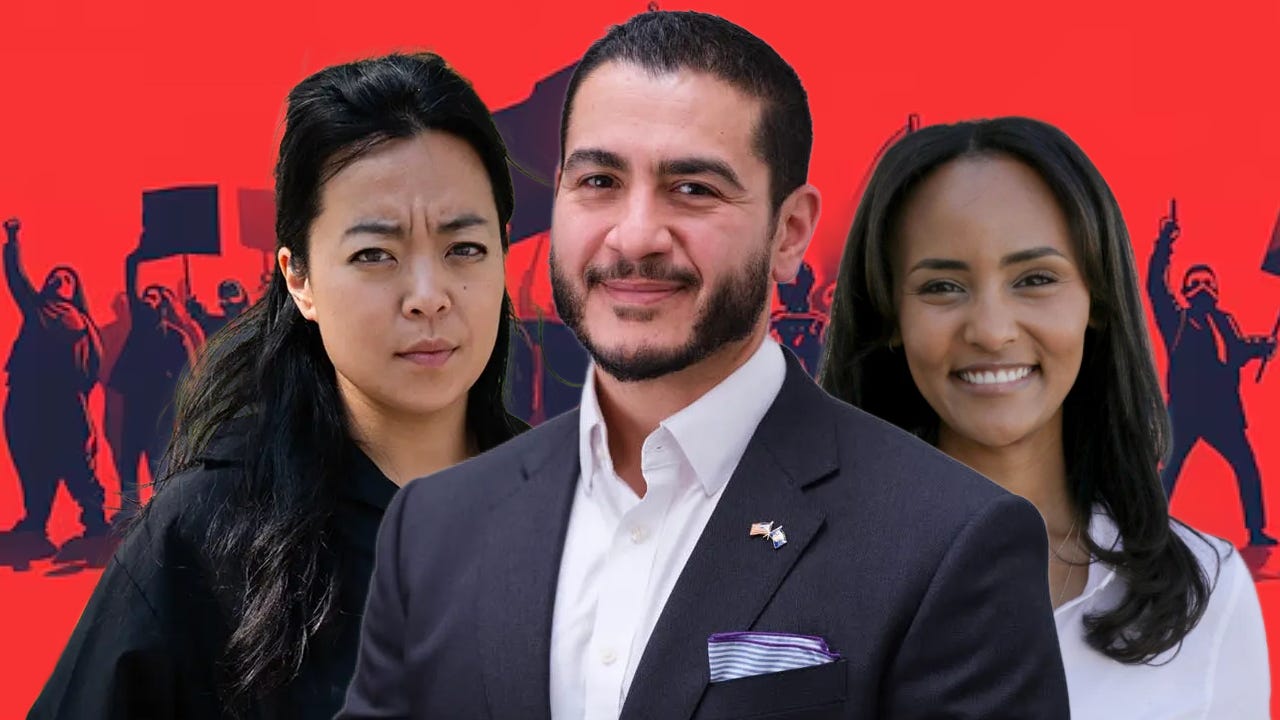
Democratic Socialists of America candidates and their close allies have mastered a cynical two-step. They court the activist base with explicit radicalism—abolish this institution, treat terrorism as inevitable blowback, choke capitalism—then pivot to denials, “evolution,” and “aspirational goals” the moment broader scrutiny arrives. Francesca Hong, Melat Kiros, and Abdul El-Sayed exemplify the pattern. Voters are left asking the obvious question: if they won’t stand by their own words about what they intend, why should anyone trust them with power?
Francesca Hong, the Wisconsin state representative and DSA member running for governor, offers the clear example. In February 2021, her campaign account posted three words: “Abolish the Senate.” It was a reaction to the second Trump impeachment acquittal. When her current opponent, Republican Tom Tiffany, highlighted the post alongside her past calls to abolish police and prisons, Hong’s campaign communications director declared that Hong “has never called for abolishing the U.S. Senate” and that Tiffany “can’t produce a single statement where she did, because it doesn’t exist.”
The post was still online. The campaign then shifted to “does not recall,” framed it as a one-day frustrated reaction, and insisted it isn’t her current position.
The same pattern appears on policing. Hong wrote that “Police exist to uphold white supremacy. Defund then abolish. Reform can’t be an option.” She has spoken of prison abolition as an aspirational goal akin to eradicating disease. Under pressure, she now says she won’t defund the police as governor, that the comments require context, and that voters must “evolve.”
Old posts calling to cancel Thanksgiving and describing America as an “abundance of suffering” receive similar treatment. First she said it should be abolished. Then she said she enjoyed cooking for Thanksgiving. Now, it’s one of her favorite holidays.
She appears on streams with figures who have trafficked in antisemitic language while her campaign issues statements condemning antisemitism and all forms of dehumanization. She once called police about a protest display she viewed as antisemitic, then later expressed deep regret for involving law enforcement after years of supporting its reduction.
This isn’t “evolving”. It’s selective memory calibrated to the audience. DSA chapters endorse her; she remains a dues-paying member of her local chapter. National platform elements that prove inconvenient—abolishing the Senate, borders, or the existing judicial structure—are suddenly positions she doesn’t fully share. The public is expected to believe the moderated version is the real one.

Melat Kiros, the DSA-endorsed Colorado congressional nominee who defeated long-time incumbent Diana DeGette, follows the same script on violence and ideology. On a stream with Hasan Piker, the nauseating, silver-spoon-in-the-ass, Islamo-Communist podcaster, she described the October 7 Hamas massacre as “an inevitable consequence of apartheid, of occupation, decades of occupation.” Pressed later by a local reporter, she insisted she wasn’t saying Israel “had it coming,” only that certain conditions lead people to feel violence is their only answer.
Asked whether the September 11 attacks were likewise an inevitable consequence of American foreign policy, she answered that they were “inevitable in the sense that we destabilized a lot of the Middle East, which led people to believe that another act of violence was the only response.” Responsibility, she said, lies in removing those conditions.
She declined to characterize the Boulder firebombing of a rally for Israeli hostages as antisemitic, saying she didn’t know what was in the perpetrator’s heart. She was fired from a law firm after a letter that treated calls for the elimination of Israel as something other than antisemitism and criticized firms for condemning campus protests. Her platform includes abolishing ICE and ending military aid to Israel. She joined DSA during the campaign after seeking its endorsement. The radical analysis of terrorism as structural inevitability is offered freely to the left base; the walk-backs and distinctions arrive for the general audience.
Abdul El-Sayed, the progressive Michigan Senate nominee, is not a formal DSA member and has repeatedly said so. “I’m not technically or practically DSA.” “I am not somebody who is a socialist. I believe in capitalism, I just believe that capitalism has to be regulated.” Yet between 2017 and 2020 he attended and spoke at multiple Detroit DSA events, headlined a fundraiser that raised thousands for the chapter, and was described by organizers as “a longtime friend of Detroit DSA” (he’s also a pal of the puke podcaster Piker). He was photographed next to Rashida Tlaib in front of a poster showing a DSA fist choking a snake labeled “capitalism.” He has been endorsed by Bernie Sanders, Alexandria Ocasio-Cortez, and other figures with DSA ties.
On policing, he once said “we do need to defund the police” in the sense of shifting resources away from incarceration toward social services. Later he insisted he “never, never called for defunding” and deleted tweets to avoid out-of-context readings.
Campaign claims that he “removed” lead from Detroit elementary schools as health director have been challenged by subsequent testing that found elevated levels in schools previously addressed under his tenure.
The pattern is consistent: proximity and rhetorical alignment with DSA when useful, categorical rejection of the label and selective memory when it is not.
Intellectual duplicity of this sort isn’t a minor character flaw. It’s a governing problem. These candidates advance transformative goals—restructuring or abolishing core institutions, reframing terrorist violence as the predictable result of Western or Israeli policy, expanding state control over large sectors of the economy—then treat their own prior statements as temporary or misunderstood. Primary voters hear one set of intentions; the broader public is offered a softer version. When the record is produced, the response is denial, non-recollection, or the claim that only the current, moderated position counts.
A candidate who won’t own yesterday’s explicit words can’t be trusted to execute tomorrow’s promises. If their radical stances are sincere, the public deserves to know it before handing over executive or legislative power. If it was never sincere, the campaign was conducted under false pretenses. Either way, the duplicity itself is disqualifying.
Voters aren’t required to pretend that “abolish,” “inevitable consequence,” and “longtime friend of DSA” mean something other than what the words and associations plainly convey.
Political trust is earned by consistency, not by the speed of the walk-back.
A Note About Subscribing:
At Underground USA, we pride ourselves on being fiercely independent—we only answer to our readers. This independence allows us to tackle tough questions, dive deep into important topics that often get overlooked, and share essays and podcasts, like this one, without asking for anyone’s approval.
Free subscriptions help us connect with a wider audience. They are the vehicle for the wide dissemination of the message. Paid subscriptions are what keep us going. They fund our research, document requests, interviews, fact-checking, and give us the time to dig deeper than just the headlines. Most importantly, they support something that’s getting harder to find: independent analysis that’s not swayed by advertisers, corporate sponsors, or political agendas.


