

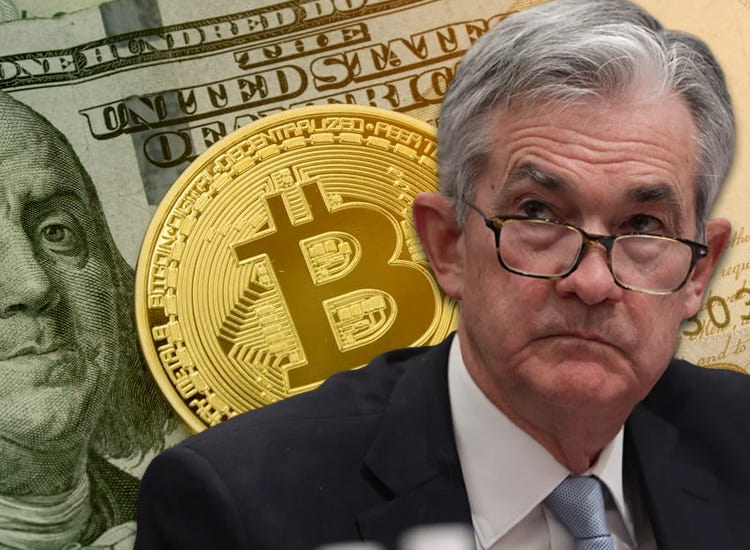
Demonstrating either a significant fear through a lack of knowledge on the subject or an understanding that has produced well-warranted fear, Federal Reserve Chair Jerome Powell said cryptocurrencies, including stablecoins, present risks to the US financial system and will require “new rules” to protect consumers.
Powell, as a member of a panel of central bankers, also said that while cryptocurrency platforms will likely make electronic payments cheaper and faster, they could also destabilize existing financial institutions.
“Our existing regulatory frameworks were not built with a digital world in mind,” Powell said. “Stablecoins, central bank digital currencies, and digital finance more generally, will require changes to existing laws and regulation or even entirely new rules and frameworks.”
Powell didn’t provide any details of what kind of regulations or how those regulations would be implemented but indicated they would most likely follow the principle of “same activity, same regulation,” meaning that transactions existing outside the banking system’s current purview would be co-opted and regulated the same as when fiat transactions are executed by banks.
Powell outlined several risks that stem from the growth of digital finance, including to consumers and the broader financial system, saying those who buy stablecoins or crypto “may not fully understand the extent of their potential losses, or that these investments generally lack the government protections that accompany many of the traditional financial instruments and services that they’re used to.”
“We don’t know how some digital products will behave in times of market stress, which could lead to large destabilizing flows,” Powell added, “nor do we know how stresses in crypto markets could potentially spill over into the traditional financial system.”
Powell also eluded to the now-debunked notion that the use of cryptocurrency and its base blockchain technology allows for criminals to more easily hide their activities and launder money. “We need to prevent this so that the innovations that do survive and do attract broad adoption are those that provide value over time” for legal uses, Powell said.
Christine Lagarde, the head of the European Central Bank (ECB), echoed Powell’s concerns about the use of cryptocurrencies to evade the law and, specifically, the potential use of crypto by Russian entities to skirt sanctions, saying, cryptocurrencies “are being used as we speak, as a way to try to circumvent the sanctions that have been decided by many countries around the world against Russia.”
Fabio Panetta, an ECB Executive Board member, joined in Lagarde’s concerns, arguing that the decentralized nature of cryptocurrencies constituted a loophole. “The risk of misuse of crypto-assets to circumvent the sanctions against Russia is an important reminder that these markets must be required to comply with the strictest standards,” Panetta said.

Why This Is Important
All of the comments and concerns issued both domestically and abroad by the established financial powers indicate one of two things, or maybe a mixture of both to varying degrees.
Either the people who currently control the fiat financial markets and systems around the world are grotesquely uneducated and ill-informed on what cryptocurrencies are and how they work, or they are frightened to the bone that they will lose control of their ability to control people through the manipulation of the world’s finances.
It is critical to “re-debunk” the false narrative that cryptocurrency offers criminals an avenue to exist undetected to law enforcement or that it is a way for people to hide their monetary transactions. In fact, the exact opposite is true and both the US Justice and Treasury Departments are on record as saying so.
Addressing the recent arrests of Ilya Lichtenstein and his wife, Heather Morgan, who launder $4.5 billion in stolen cryptocurrency – of which $3.6 billion was recovered, FBI Deputy Director Paul M. Abbate said:
“Criminals always leave tracks, and today’s case is a reminder that the FBI has the tools to follow the digital trail, wherever it may lead...we were able to uncover the source of even the most sophisticated schemes and bring justice to those who try to exploit the security of our financial infrastructure.”
Chief Jim Lee of Internal Revenue Service-Criminal Investigation Division (IRS-CI) said:
“In a methodical and calculated scheme, the defendants allegedly laundered and disguised their vast fortune...IRS-CI Cyber Crimes Unit special agents have once again unraveled a sophisticated laundering technique, enabling them to trace, access, and seize the stolen funds, which has amounted to the largest cryptocurrency seizure to date, valued at more than $3.6 billion.”
In fact, every transaction associated with any cryptocurrency is recorded in the “blockchain,” an unending and all-encompassing public ledger shared across the internet that is searchable and verifiable. This means that far from being a shadowy corner where criminals and financial scofflaws can hide, every transaction is an open book.
As John Bohannon writes in Science.org:
“...all of these transactions are public knowledge. The past and present ownership of every Bitcoin – in fact, every 10-millionth of a Bitcoin – is dutifully recorded in the ‘blockchain,’ an ever-growing public ledger shared across the Internet...The job of keeping the system running and preventing cheating is left to a volunteer workforce known as Bitcoin miners. They crunch the numbers needed to verify every transaction. Added to this is an evergrowing math task known as ‘proof of work,’ which keeps the miners honest.”
In return for “mining” the transactions, the act of verifying a 10-minute block of transactions on the blockchain generates 25 new Bitcoins for the miner.
Bohannon continued on to point out that “what remains hidden are the true identities of the Bitcoin owners. Instead of submitting their names, users create a code that serves as their digital signature in the blockchain.”
Sarah Meiklejohn, a computer scientist at University College London who recently co-chaired an annual workshop on financial cryptography, said law enforcement didn’t know what to make of cryptocurrency and blockchain when it erupted onto the scene.
“They thought these technologies were dangerous and made it harder for them to do their job,” Meiklejohn said. But as time went on law enforcement started to understand that cryptocurrency and blockchain are actually tools for prosecuting crimes.
“If you catch a dealer with drugs and cash on the street, you've caught them committing one crime...But if you catch people using something like Silk Road [an online black market], you've uncovered their whole criminal history,” Meiklejohn added. “It’s like discovering their books.”
In June of 2021, FBI Special Agent Elvis Chan, who manages an FBI squad responsible for investigating national cybersecurity matters, said, “You can’t hide behind cryptocurrency.” As as far back as 2015, FBI Assistant General Counsel Brett Nigh said that “investigators can follow the money.”
So, to the point of criminals finding safe haven in the cryptosphere, either Powell and Legrande are grotesquely uneducated on the mechanics of cryptocurrency and blockchain – which should disqualify them from the posts for their ignorance – or they are trying to use the false narrative to deflect from their real fear: the possibility of losing the ability to manipulate global finance.
Last December, I noted that the International Monetary Fund had the audacity to craft a paper outlining their want to execute a hostile takeover of the cryptosphere:
“According to the paper, published on the IMF’s website, the popularity of crypto assets, products, and services – and the interlinkages with the regulated financial systems, are making the world’s financial regulators nervous, producing a greed-based need for ‘comprehensive, consistent and coordinated’ global crypto regulation.
“At one point they openly state their ‘outsider-looking-in’ status in the cryptocurrency realm, saying, ‘Policymakers struggle to monitor risks from this evolving sector, in which many activities are unregulated. In fact, we think these financial stability risks could soon become systemic in some countries.’”
I go on to point out that any regulatory agency – domestic or international – would almost immediately subject the cryptosphere to the same financially cancerous mechanisms that have corrupted the purity of what was supposed to be a laissez-faire, capitalist financial system, namely: naked short selling, bear raids and the Uptick Rule, double and triple short ETFs, credit default swaps, “mark to market” accounting, foreign exchange derivatives, sovereign wealth funds, and Sharia-compliant banking, to name but a few of the poison pills that have skewed the financial sector to the elite at the expense of the everyman.
And during the current US Congress, legislation was proposed to give Janet Yellen, perhaps the most uneducated Secretary of the Treasury on the subjects of cryptocurrencies and blockchain, the ability to prohibit any crypto transaction at her discretion.
Jerry Brito, executive director of Coin Center, a crypto advocacy organization focused on public policy, warned the America COMPETES Act of 2022, “would essentially give the Treasury Secretary unchecked and unilateral power to ban exchanges and other financial institutions from engaging in cryptocurrency transactions.”
The governments and financial regulatory organizations of the world are copacetic with ignoring the wealth-generating concept of cryptocurrency just as much as they are terrified at the prospect of losing control of their ability to gerrymander currency valuations.
The decentralized nature of cryptocurrencies strikes terror into the hearts of the global elite because it removes the overly intrusive financial regulatory power the governments and non-governmental organizations of the world possess. It ends the grifting of the traditional banking system (which uses your money to create its wealth and charges you a price to do so) by bypassing traditional banking altogether. It puts Wall Street and elitist global entities like the IMF and the World Economic Forum on notice that their opportunistic, manipulative, and irresponsible derivative schemes must take a backseat to a financial system that holds accountability and transparency sacrosanct.
Powell, his cohorts at the US Federal Reserve, and the total of the establishment financial hierarchy around the world desperately need to find a way to control the cryptosphere so that their well-coordinated plan to employ the Communist Chinese, stakeholder commu-capitalist economic model can be implemented (read: The Great Reset). This is why the argument about whether their rhetoric and actions are products of ignorance or arrogance is still on the table.
But one thing is indisputable. We must make sure that the same corrupt politicians and financial sector cronies who gave us the 2008 housing market disaster, the almost two-year COVID economic shutdown, and the current supply chain and energy crises don’t corrupt what is now the only pure financial avenue to individual wealth generation. This is imperative.
Once they get their regulatory talons into the cryptosphere – once they can control your wealth in the digital world – they will have total control.


Today’s Headlines
US Supreme Court Reverses Revised Wisconsin Legislative Maps After GOP Challenge
Biden Administration Officially Declares Russia Has Committed War Crimes
Tens of Thousands Trapped in Mariupol; Tensions Growing Between Russia and Poland
Russia's New Law Banning Criticism of Its Military Causes Regulators to Ban Google News
Finnish People Make Massive Shift Towards NATO; Majority Now Support Joining
Germany Conducts Mass Police Raids Over Online ‘Insults’ Against Politicians
Russian Lawmaker Proposes Digital Ruble to Dodge Western Sanctions
Tokenized Gold Market Caps Grew Significantly Last Month Amid Fresh Demand
New Zealand Scraps All COVID Restrictions Including Vax Passports, Mandates, QR Codes
Critics Launch Campaign Against ‘Racially Divisive Policies’ at American Express
Students Who Blew Whistle On BYU ‘Revealing Whiteness’ Assignment Threatened with Discipline


