

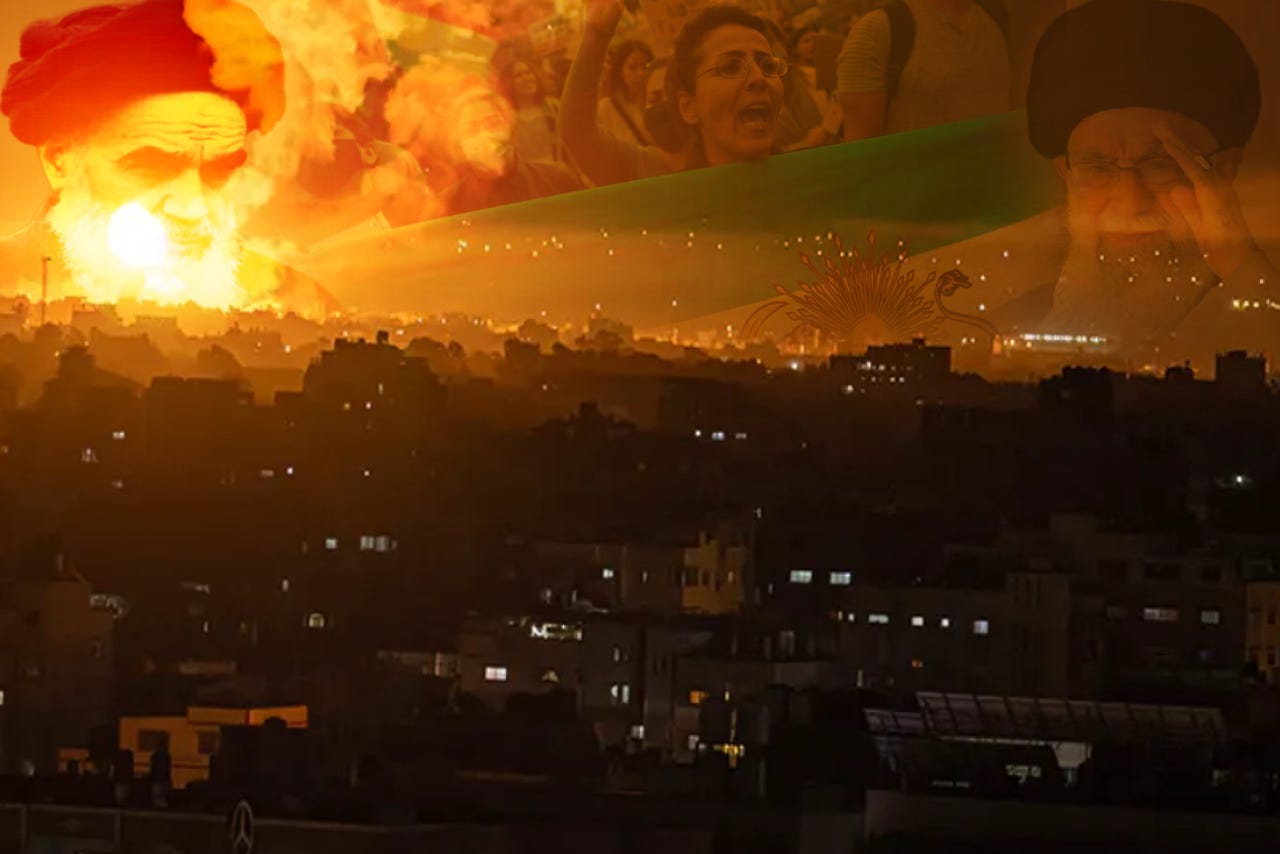
In the blistering heat of Operation Epic Fury, launched on February 28, 2026, by the allied forces of the United States and Israel, we have finally unsheathed the sword against the venomous Iranian regime. This long-overdue onslaught, a barrage of precision airstrikes that obliterated command centers, missile sites, and even felled the despotic Supreme Leader Ali Khamenei in its opening salvo, marks a pivotal reckoning with a theocratic monstrosity that has terrorized the world for decades.
As U.S. Central Command unleashes unmatched firepower—Tomahawk missiles from destroyers like the USS Thomas Hudner, B-2 stealth and B-1 supersonic bombers raining hell, and Israeli jets piercing the skies—the Iranian mullahs’ facade of invincibility crumbles. Eleven days in, with Iranian responses sputtering to a halt and their navy reduced to floating scrap, Secretary of War Pete Hegseth declares victory in sight: missile stockpiles decimated, air defenses shattered, nuclear ambitions crushed.
Yet this is no mere military skirmish; it’s the righteous dismantling of a regime that has embodied evil since its bloody inception.
Cast your mind back to the shadows of history. Before the al Qaeda horrors of September 11, 2001, no terrorist outfit had spilled more American blood than Hezbollah, the Iranian proxy spawned from the Islamic Revolutionary Guard Corps (IRGC). From the 1983 Beirut barracks bombing that slaughtered 241 U.S. servicemen to countless kidnappings and attacks, Hezbollah’s Iranian puppeteers orchestrated a symphony of death. The regime’s fingerprints stain the graves of innocents worldwide, a legacy of unchecked savagery that the West has too often ignored.
And how did it all begin? With the 1979 Islamic Revolution, a hostile takeover that hijacked the ancient Persian soul of Iran.
Fanatical clerics, led by Ayatollah Khomeini, stormed the U.S. Embassy in Tehran, seizing 52 American hostages for 444 agonizing days. This was no mere protest; it was a declaration of war on civilization, a barbaric act that humiliated America and empowered radicals everywhere. Yet the United States never delivered the crushing response it deserved—no invasions, no regime-toppling reprisals. Instead, we negotiated, appeased, and watched as the mullahs consolidated their iron grip, oppressing the Persian people under a veil of religious tyranny. That cowardice emboldened the regime, turning Iran into a rogue state exporter of terror.
Fast-forward to today, and the irony is deliciously damning. Surah Al-Anfal (8:72) in the Quran commands Muslims to aid their brethren against infidel aggression:
“Indeed, those who have believed and emigrated and fought with their wealth and lives in the cause of Allah and those who gave shelter and aided—they are allies of one another.”
By this holy mandate, the Iranian regime—self-proclaimed guardians of Islam—should rally the ummah against the “infidels” of Israel and the United States. But behold the betrayal: Sunni powerhouses like Saudi Arabia, the UAE, and even Jordan stand aloof and even tacitly supportive of the West’s assault. These Islamic nations, weary of Tehran’s meddling in Yemen, Lebanon, and Syria, have chosen pragmatism over piety, siding with the so-called Great Satan to curb the Shia extremists’ chaos.
It’s a theological slap in the face to the mullahs, exposing their isolation as divine judgment on their hypocrisy. Iran stands alone, its pleas for jihad echoing in empty mosques, as fellow Muslims prioritize peace over the regime’s apocalyptic fantasies.

Cornered like rabid dogs, the hardliners in Tehran are lashing out in a global frenzy, desperate to ignite the end times prophesied in their Twelver Shia eschatology. They dream of chaos summoning the hidden Imam, the Mahdi, who will usher in a messianic age. In pursuit of this delusion, they’ve fired missiles at U.S. bases, disrupted shipping lanes, and even attempted strikes on allies as far as Azerbaijan. Willing to “burn it all to the ground,” these fanatics accelerate their own doom, inching toward vanquishment by the West. Operation Epic Fury’s relentless pounding has exposed their fragility. As oil prices spike and global airspace reels, the regime’s death throes may hollowly threaten the world, but they also herald its inevitable collapse.
The fall of this odious regime promises a bounty of benefits. First and foremost, liberation for the Persian people, long suffocated under theocratic boot heels. Iranians, heirs to Cyrus the Great’s enlightened empire, deserve freedom from forced veils, sham elections, and economic ruin. With the mullahs gone, relative stability could bloom in the Middle East—no more proxy wars fueling Hamas, the Houthis, or Hezbollah’s mayhem. The regime, financial godfather to a majority of global terrorist networks, would cease bankrolling bloodshed from Gaza to Venezuela.
And economically? Iran’s vast oil reserves, currently funneled cheaply to China, would flood the global market, stabilizing energy prices and weakening Beijing’s grip on vulnerable countries through the Belt & Road. A post-regime Iran could rejoin the community of nations as a prosperous, secular powerhouse.
But victory demands completion, not half-measures.
History warns us: In Iraq and Afghanistan, toppled tyrants splintered into insidious fragments like ISIS, spawning endless insurgency. The IRGC’s remnants will do the same, morphing into shadowy terrorist pods scattering across the region. Eradicating them requires sustained military vigilance, hunting them down wherever they burrow.
President Trump, wisely averse to another U.S.-led quagmire, should forge a coalition of Gulf States—Saudi Arabia, UAE, Bahrain—to lead this charge. Offer America’s superior intelligence, surveillance, and, at most, precision strikes as our contribution, but insist that the Islamic nations of the region wield the sword. This isn’t colonialism; it’s regional responsibility, ensuring the fight against extremism is owned by those it most affects. No foreign occupations, just a united front to cauterize the wound.
In the end, the eradication of these Islamofascist usurpers in Persian Iran is an unequivocally good thing—for the liberation of its people, the pacification of the Middle East, the starvation of global terror, the normalization of oil markets, and so much more. But it must be done correctly and completely. Half-hearted efforts will breed resurgence; total commitment will yield a fruitful future.
As Operation Epic Fury rages on, let us commit to seeing the mullahs’ ashes scattered to the winds, paving the way for a reborn Iran, a free Iranian people, and a safer world.


