

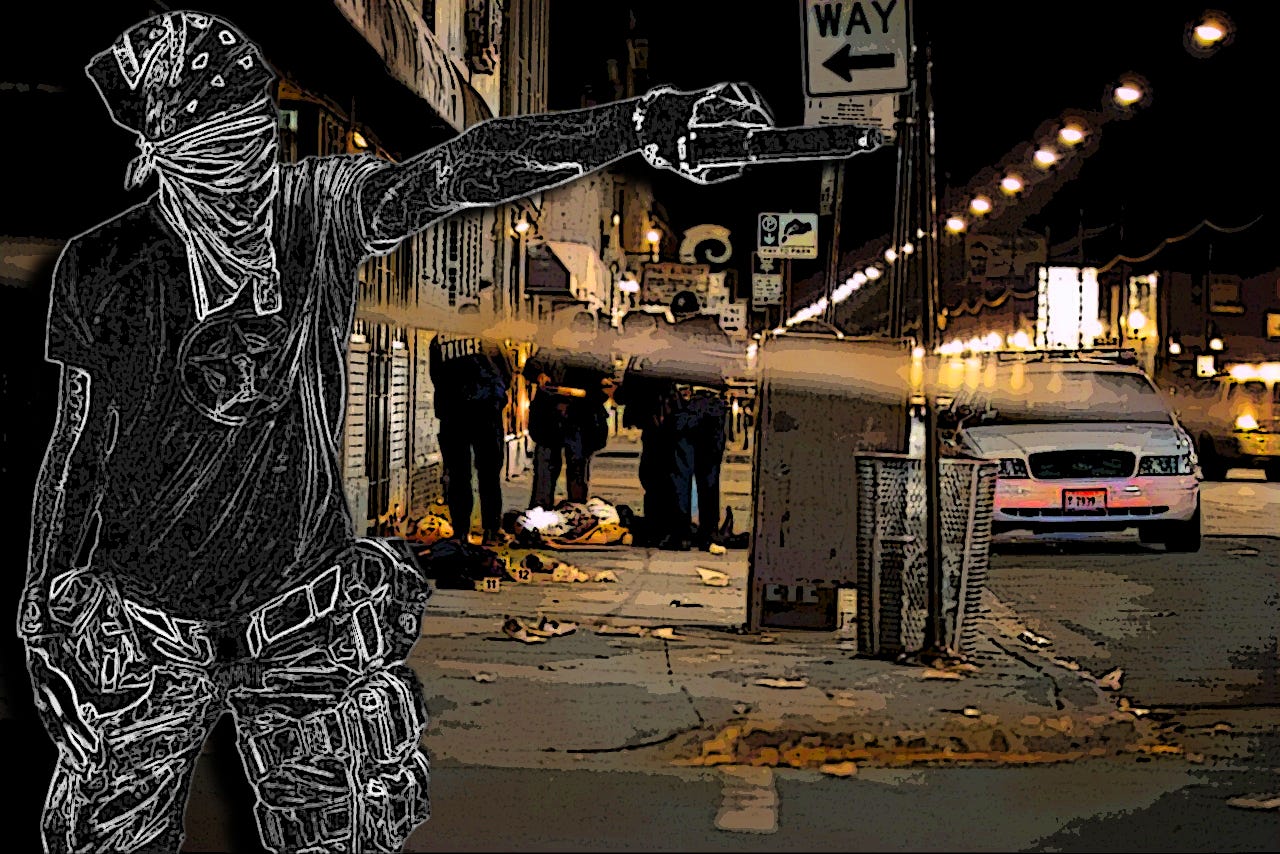
One headline summed up just a fraction of the violence that happened, “Shootings on Juneteenth Weekend Leave at Least 12 Dead, More Than 100 injured.” Shootings surrounding this “holiday” took place in Texas, Illinois, Wisconsin, North Carolina, and several other states. What did these events have in common? They all occurred within a cross-section of two demographics: adolescents and the Black community.
During a Juneteenth celebration at Old Settlers Park in Round Rock, Texas, a shooting occurred at around 11pm, resulting in two fatalities and six injuries, including two children. The incident took place as a confrontation broke out between two groups during a concert, leading to gunfire.
In Milwaukee, Wisconsin, six teenagers were shot after a Juneteenth celebration Monday outside the downtown area. The Milwaukee Police Department responded around 4:21pm near Rose Park after four females and two males between the ages of 14 and 19 years old were injured by gunfire. Police say they believe the shooting stemmed from a fight between the teens.
A two-day Juneteenth Festival at Asheville, North Carolina, one of North Carolina’s most popular tourist towns, came to a sudden halt after gunfire put two juveniles in a hospital on the first day. The shooting happened just before 9pm in the Court Plaza area of Pack Square Park. Asheville police said a 16-year-old was taken into custody in the area and identified “as the principal offender.”
And least one person was killed and 22 more injured at a strip mall in Willowbrook, Illinois, a suburb of Chicago. Police described the gathering as a peaceful "celebration of Juneteenth" that began at 6pm Saturday. Preliminary witness and victim reports indicated that at least 20 people were shot, with one victim deceased.”
This is just a sampling of the carnage that filled the streets of our urban areas in the celebration of “Juneteenth” a predominantly Black holiday celebrated by the Black community.
To Save Lives, It’s Time To Be Honest
In an article for City Journal, Heather Mac Donald, a Thomas W. Smith Fellow at the Manhattan Institute, writes:
“...Black juveniles were shot at 100 times the rate of White juveniles since the George Floyd race riots; Blacks between the ages of ten and 24 were killed in gun homicide at 24 times the rate of Whites in that age cohort. Those Black victims are not being gunned down by America’s alleged White supremacists or by the police; they are being gunned down by other Blacks, at rates equally disproportionate to the Black population share…”
Public safety in America’s urban areas – and this is expanding to the suburbs – has been severely compromised due to a deeply ingrained and misguided idea – that any law enforcement activity with a disproportionate impact on Black criminals is inherently racist. This belief, rooted in the “Disparate Impact Theory,” has led to a dangerous trend of turning a blind eye to criminal activity within Black communities, resulting in the weakening of law enforcement efforts and the deadly consequences, most often at the hands of the youth within the Black community itself, with countless lives lost and communities left in chaos.
Time To Destroy The Evil That Is Disparate Impact Theory
To restore a tangible sense of security within not only our urban centers but also within the Black communities themselves, it is crucial to invalidate and dispense with the Disparate Impact Theory and confront the reality of Black crime head-on, and this includes the issue of violence as conflict resolution in the Black youth demographic
The Disparate Impact Theory posits that if a policy or practice has a disproportionate effect on a particular group, it must be considered evidence of discrimination, even if there is no intent to harm or exclude that group. This idea has been applied to law enforcement activities, leading to accusations of racism whenever police enforcement measures disproportionately affect Black criminals. Consequently, law enforcement agencies are pressured to avoid such measures, fearing accusations of racism and legal repercussions.
The impact of this theory on law enforcement has been profound.
Police departments have been forced to adopt a soft approach, often overlooking criminal activities in Black communities to avoid accusations of racism. This has led to a rise in crime rates, as criminals feel enabled and emboldened by the lack of consequences for their actions.
Additionally, the constant threat of accusations has demoralized police officers, leading to reluctance to perform their duties and an overall decline in the quality of law enforcement and the number of officers within their ranks.
Disparate Impact & Racial Etiquette
The continued influence of Disparate Impact Theory can be attributed to well-meaning but naive Americans who, in their attempts to promote racial equality, turn a blind eye to Black crime. This phenomenon is rooted in the concept of “racial etiquette,” a set of unwritten rules governing social interactions between different races.
One key tenet of racial etiquette is the avoidance of discussions or actions that may be perceived as critical or judgmental of Black individuals or communities.
While such etiquette may be well-intentioned, it has led to a dangerous complacency and agnosticism when it comes to addressing Black crime. By avoiding any discussion or acknowledgment of criminal tendencies within the Black community – or the predominant use of violence as conflict resolution, we inadvertently perpetuate the underlying issues that lead to crime in the first place. This approach not only fails to address the root causes of crime but also leaves Black communities vulnerable to continued exploitation and victimization by the criminals within their own community.
The Cost of Ignoring Black-on-Black Crime
The consequences of ignoring or downplaying Black-on-Black crime are far-reaching and devastating. By turning a blind eye to criminal activities within Black communities, we not only compromise public safety but also perpetuate a vicious cycle of crime and victimization.
The failure to address the issue head-on has led to the following consequences:
Escalating Crime Rates: The lack of law enforcement in Black communities has emboldened criminals, leading to an increase in crime rates. This, in turn, has resulted in a heightened sense of fear and insecurity among residents, further destabilizing these communities.
Loss of Lives: The unwillingness to confront Black-on-Black crime has led to the tragic loss of countless lives, both within the Black community and beyond. Innocent individuals, including children, have become collateral damage in a misguided attempt to avoid accusations of racism.
Deterioration of Social Fabric: The breakdown of law and order has contributed to the deterioration of social fabric within affected communities. Trust in law enforcement has eroded, leading to a sense of hopelessness and despair among residents.
Perpetuation of Inequality: The reluctance to address Black crime has perpetuated a cycle of inequality, with Black communities disproportionately bearing the brunt of criminal activities. This further exacerbates existing economic and social disparities, making it even more challenging for these communities to break free from the cycle of poverty and crime.
The Way Forward: Confronting Black Crime
To restore public safety and rebuild the social fabric of our communities – especially in the Black communities, it is imperative to challenge and dismantle the Disparate Impact Theory. This requires a fundamental shift in our understanding of race and crime, acknowledging that criminal tendencies are not inherently tied to one's race or ethnicity. It is crucial to recognize that addressing Black crime – and particularly Black-on-Black crime – is not an act of racism, but rather a necessary step towards restoring law and order and ensuring the safety and well-being of all individuals, regardless of their race.
To achieve this, it is essential to address the underlying issues that contribute to criminal activities within Black communities, such as a lack of education and alternatives to violence as conflict resolution. By targeting these issues, we can work towards creating a more equitable and just society.
Further, we must develop and foster an environment that encourages open and honest discussions about race, crime, and their intersection in the Black communities, and that will require those in the Black communities to own up to the problem. This requires a willingness to confront uncomfortable truths and engage in constructive dialogue, even when it challenges our preconceived notions and beliefs, especially in the face of race-baiting charlatans who personally capitalize – monetarily or politically – off of the grievance industry of unwarranted race discrimination accusations.
It is also crucial to rebuild trust between law enforcement and Black communities. This can be achieved through increased transparency, community engagement, and a commitment to fair and impartial policing practices, many of which have been implemented in recent years.
In another article for City Journal, MacDonald writes:
“...The narrative that Blacks are at elevated risk [of being shot] for ‘existing while Black’ is true, but not because Whites are killing them. Their assailants are other Blacks, which means that these Black victims are of no interest to the race activists and to their media and political allies…
“The anarchy in American cities is carefully de-raced, whether the flash mobs that routinely maraud in shopping malls and down Chicago’s Magnificent Mile; the looters who plunder convenience stores and jewelry stores; or the Miami spring breakers who rape and kill. To name a suspect’s race when that suspect is Black is virtually taboo, no matter the race of his victim. Let a White person assault or kill a Black person, however, and the entire story will be about race.
“This double standard and the fiction that Blacks are under daily risk of their lives from Whites do no one any good, least of all the victims of Black crime.”
To put it succinctly, the Black community has a serious and deadly issue with how it executes conflict resolution, especially in urban areas. This is not a gun problem. These violent youth would and do resort to any violent means, any weapon at their disposal, to resolve their differences. So, too, this is not a “lack of law enforcement problem.” Local governments, led by woke ideologues, have handcuffed law enforcement in how they deal with violent offenders, especially in the youth demographic. And although both guns and a handcuffed law enforcement community play a part in the events, the problem – this deadly issue – is predominantly a cultural problem.
We all – including the Black community – must be brave enough to admit this fact and then actually do something about it. Lord knows our elected class is incapable of solving the problem.
Underground USA is reader-supported. Please consider becoming a paid subscriber



I selfishly hold on to my Chicago. When three young ladies could walk north on Michigan Avenue after work to their apartment on Scott at 3 in the morning. Riding the L from Cicero to State & Lake without a doubt for their safety. My beautiful Chicago - where did you go?